
Every season brings new sales pitches for turf biostimulants promising deeper roots, less stress and faster recovery. Some can be a good complement within a well-planned programme; others simply do not justify their cost. The key is to use them with judgement and check the results.
In this article we review five situations where turf biostimulants make sense on a golf course, what should already be sorted out before turning to them and how to design a simple trial to assess whether they work in your conditions. We will not discuss brands or rates: that depends on the label, current regulations and an authorised technical adviser.
What Turf Biostimulants Are and What They Cannot Do
The term covers substances or micro-organisms that, applied in small quantities, support natural plant processes such as nutrient uptake, stress tolerance or root development. They include seaweed extracts, humic and fulvic acids, amino acids or microbial preparations, among others.
They do not replace irrigation, fertilising or cultural practices. If the soil is compacted, the water is saline or fertilising is deficient, no biostimulant will make up for the underlying problem. Nor are they a treatment against disease. Think of them as support within a programme that is already well sorted.
It is also wise to be wary of universal promises. The same product can behave differently on a bentgrass green on the coast, a bermudagrass fairway or an overseeded ryegrass tee box. That is why your own course experience, well recorded, is worth more than any brochure, and why turf biostimulants are best evaluated with small, repeated trials rather than big purchasing decisions.
Use 1: Helping Turf During Periods of Heat or Drought Stress
When turf suffers high temperatures, limited irrigation or heavy traffic, some turf biostimulants can help maintain physiological activity and cushion stress. They are more useful as a preventive measure, before the critical period arrives, than as a remedy once the damage has already occurred.
- Plan their use before the harshest weeks of summer.
- Combine it with correct irrigation and cutting height management.
- Evaluate in a trial area before extending it to the whole course.
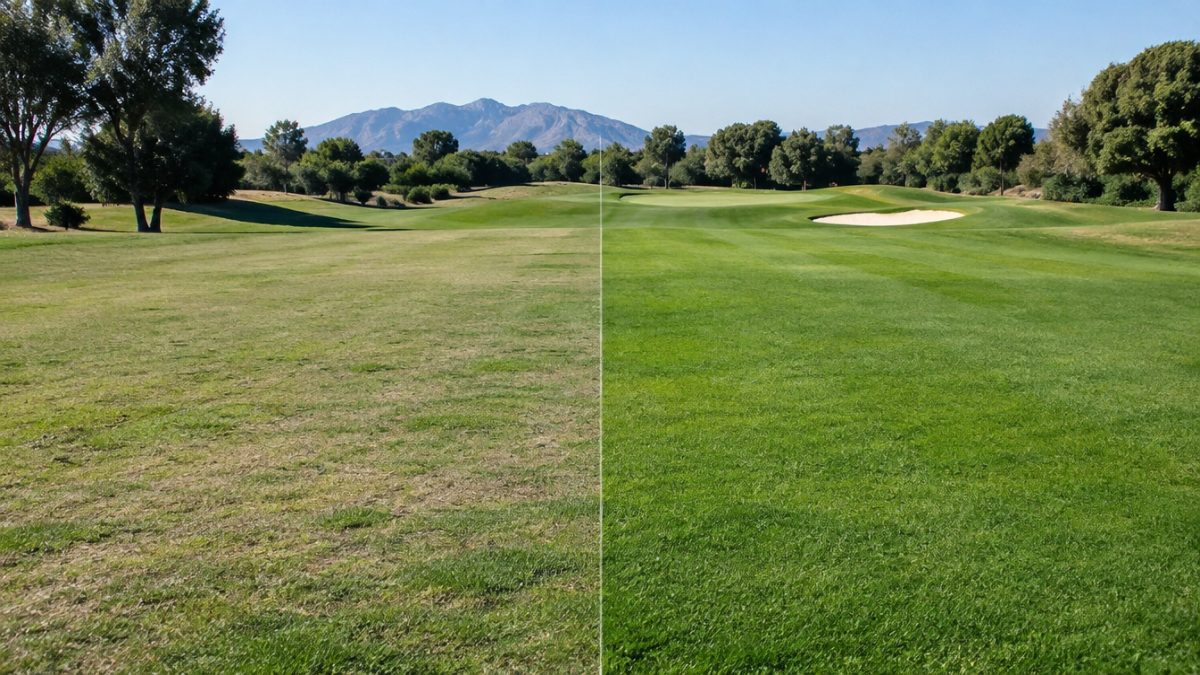
A field example: a team decides to apply turf biostimulants on the fairways most exposed to the sun before July, while leaving a similar fairway untreated. After a few weeks it compares colour, density and response to mowing. If the difference is visible and consistent, it has an argument; if not, it has avoided extending a cost to the whole course.
Use 2: Supporting Recovery After Aggressive Operations
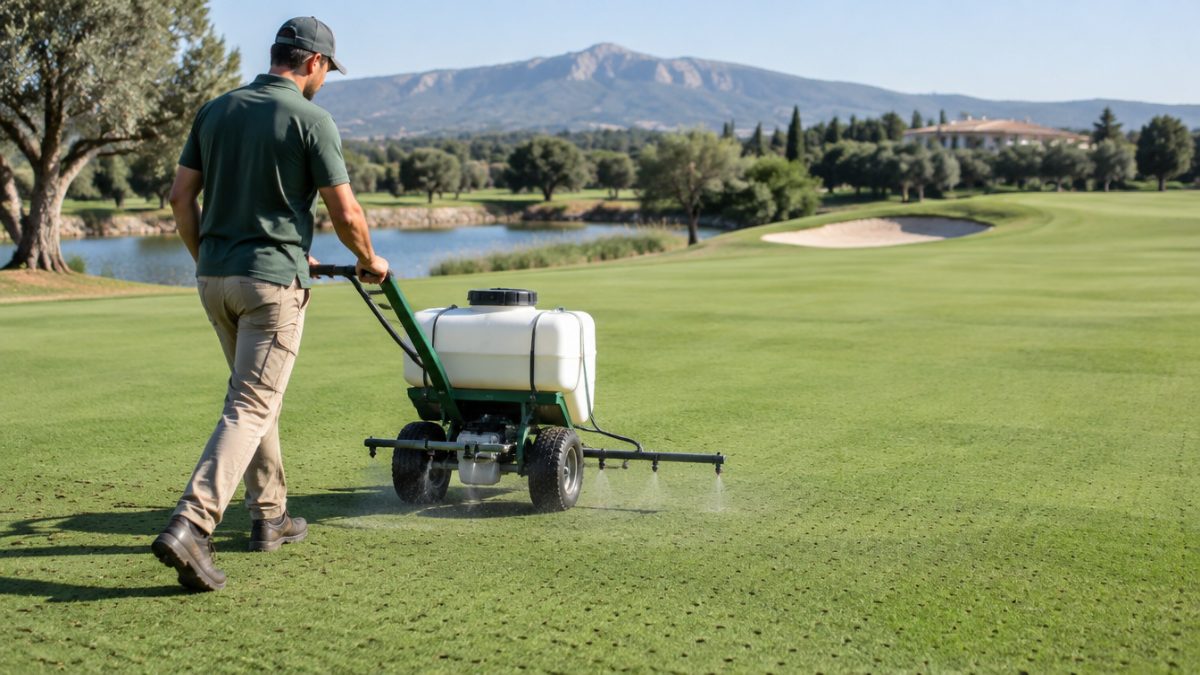
After spiking, verticutting or heavy sanding, the turf is weakened for a few days. Some teams add a biostimulant to speed up healing and shorten the disruption to play. It works best when temperature and moisture conditions are already favourable for growth.
Measure the effect simply: mark two similar areas, apply to only one and compare how long each takes to close over. If you see no clear difference, the limiting factor probably was not what you thought.
Bear in mind that recovery depends above all on temperature, moisture, nutrition and the intensity of the operation itself. Turf biostimulants can help gain a few days, but they do not replace planning that avoids stacking several aggressive operations in a row on the same green, or well-adjusted irrigation during the following week.
Use 3: Supporting Rooting in Overseeding and Young Turf
Seedlings and newly seeded or sodded areas have a small root system and are very sensitive to drying out. In these situations, turf biostimulants aimed at root development are sometimes used, always on a sound base: good soil preparation, quality seed and frequent, light irrigation.
- Ensure contact between seed or sod and soil before considering any extra input.
- Keep moisture constant during the establishment phase.
- Treat the biostimulant as support, not a substitute for management.
On young areas, moreover, it is easy to credit the product with what is really the merit of time, irrigation or a good seedbed. That is why it pays to always leave a small untreated strip to compare against. Turf biostimulants deserve a fair judgement, and that requires a control and a record of dates and conditions.
Use 4: Improving Management of Poor Soils or Those with Low Biological Activity
In sandy soils with little organic matter or little microbial activity, certain humic or microbial products can improve nutrient retention and soil activity. Before buying them, run a soil test: it may reveal that the problem is an unsuitable pH, a specific deficiency or an excess of salts, which are corrected in other ways.
If the test suggests a lack of biological activity, a biostimulant can enter the programme, but with clear monitoring. Note what you applied, where, when and what results you observed in the following weeks.
Use 5: Integrating Them with Traceability and Assessing Whether They Pay Off
The fifth use is really an attitude: apply turf biostimulants as part of a recorded programme, with measurable objectives. Define what you expect to achieve (less stress, better colour, faster recovery) and how you will check it.
- Choose a trial area and a control area with the same conditions.
- Record the date, product, area and application conditions.
- Assess colour, density, rooting or recovery time through repeatable observations.
- Calculate the cost of the application against the improvement observed.
Remember that any product must be used following the label, current regulations and the advice of an authorised technician. If after two or three trials you see no clear benefit, it is reasonable to drop it and put the budget into another priority, such as irrigation, aeration or testing.
Further reading: USGA. Through its research programme, the USGA publishes general criteria for assessing turf management products and practices.
Frequently asked questions
Do turf biostimulants really work?
They can bring benefits in specific situations, such as stress or recovery after operations, but their effect depends on the product, the soil and overall management. The sensible approach is to try them on a small area with a control, measure the result and decide with data whether they are worth the cost.
Can they replace fertilisation?
No. Turf biostimulants do not supply nutrients in the quantities the turf needs; they support plant processes. They must be integrated into a sound fertiliser programme, based on tests and real needs, and always applied according to the label, current regulations and the advice of an authorised technician.
When is the best time to apply them?
They tend to work best when the turf is active and conditions are favourable, preventively before a period of stress or just after an aggressive operation. Applying them to dormant or already badly damaged turf rarely gives good results. Adjust the timing to your species and climate.
Keep reading
- Turf fertilisation Turf Fertilisation: 6 Guidelines by Season
- Soil testing Soil Testing on Golf Courses: 6 Parameters That Matter
- Fertiliser programme Fertiliser Programme for Golf Courses: 5 Steps to Design One