

Turf fertilisation is one of the decisions with the greatest impact on course quality and on the budget. Too much nitrogen produces soft growth, more thatch, more mowing and more disease; a deficiency leaves the turf pale, thin and unable to recover. The middle ground is not found by intuition, but with a method.
These six guidelines help you plan turf fertilisation according to the time of year, the species and the function of each surface. You will not find specific rates or products, because they depend on each course, each analysis and current regulations, but you will find criteria to decide on a better basis.
Start with Analysis: Soil, Tissue and Water
Before setting any turf fertilisation plan, you need to know what the soil has and what the plant needs. A soil analysis shows available nutrients, pH and cation exchange capacity; a tissue analysis reflects what the plant is actually absorbing; and the irrigation water analysis reveals inputs and possible salt problems.
- Take representative samples for each surface: greens, fairways, tee boxes and rough do not behave the same.
- Repeat the analyses at a reasonable frequency and always on the same dates, to allow comparison.
- Keep the results alongside the application record.
On that basis, the plan stops being an inherited habit and becomes a reasoned decision. A detail that is often forgotten is pH: if it is too high or too low, some nutrients are locked up even though they are present in the soil, and adding more fertiliser solves nothing. Correcting the cause first is usually more effective and cheaper than increasing inputs.
Adapt Turf Fertilisation to the Species
Warm-season turf is not fertilised the same way as cool-season turf. Species such as bermudagrass, kikuyu or paspalum grow more vigorously in the warm months and go into partial dormancy in the cold. Cool-season species, such as ryegrass, fescue or bentgrass, have their growth peaks in spring and autumn.
- For warm-season grasses, concentrate the effort in spring and summer and reduce to a minimum in winter.
- For cool-season grasses, prioritise spring and autumn, and moderate in midsummer so as not to stress the plant.
- On courses with winter overseeding, adapt the plan to the change of dominant species.
Knowing each species’ growth rhythm avoids applying nutrients when the plant cannot use them. On courses with mixed species, for example bermudagrass with invasive Poa annua, too much nitrogen at the wrong time can favour exactly the one you least want.

Match Nutrition to Each Surface of the Course
Each surface has a different objective. On greens the aim is a dense, fine, consistent plant without excess growth; on fairways and tee boxes, recovery capacity against wear; on rough, minimal maintenance that keeps the cover.
- Greens: frequent, light inputs, adjusted to growth and the desired speed.
- Tee boxes: somewhat more nutrition to recover divots and withstand traffic.
- Fairways: moderate plans, making sure growth does not take off.
- Rough: minimum, or none if the input does not translate into better performance.
Also review special areas: slopes, shade or different soils may require their own criteria within the same surface. A green with a shaded area that declines in winter should not receive the same plan as the rest, and the same goes for collars, which take more machinery traffic.
Choose Formulation and Release Rate Wisely
Good turf fertilisation depends not only on how much is applied, but on how it is released. Slow-release products deliver nutrients gradually and reduce growth peaks; fast-acting ones correct deficiencies but require more care to avoid burn and leaching losses.
- Combine progressive-release base inputs with occasional adjustments when needed.
- Take soil temperature into account: in intense cold, many formulations release slowly.
- Consider foliar applications as a complement, not a substitute for the main plan.
Any product must be applied according to the label and current regulations, with the advice of an authorised technician where applicable, and never above the recommended amount.
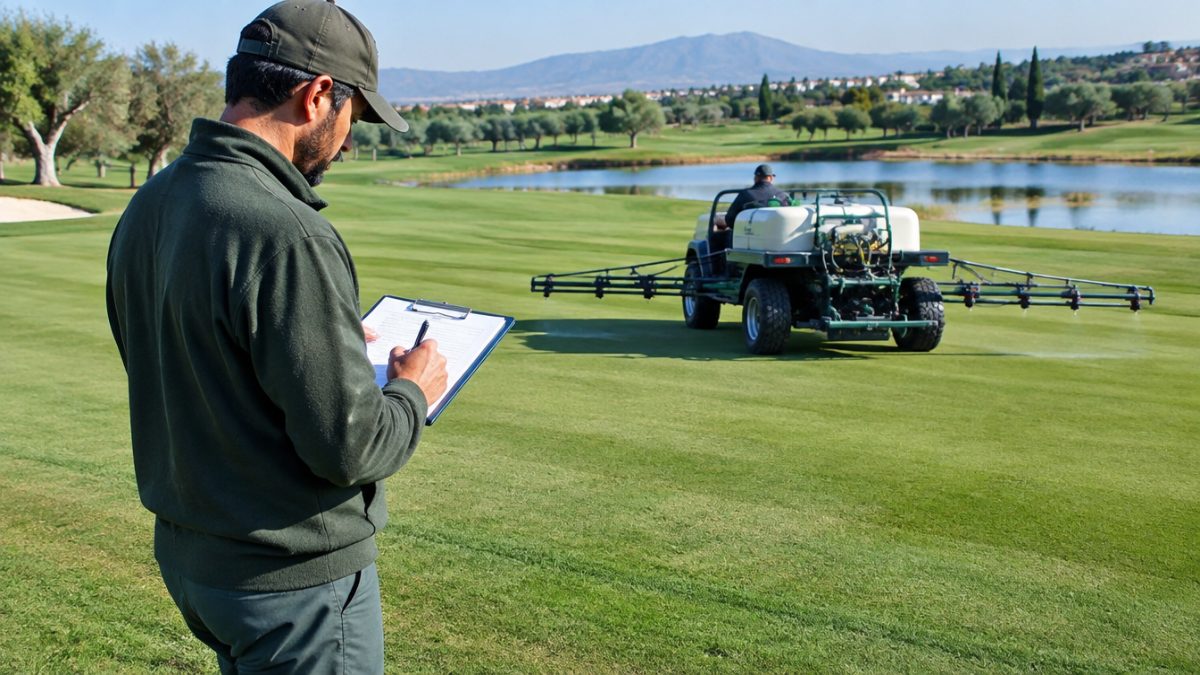
Turf Fertilisation Calendar by Season
A guideline calendar helps you avoid improvising. It is not a rigid script, but a framework that is adjusted according to the climate and the turf’s response.
- Spring: the turf wakes up and asks for nutrients. It is usual to start the programme when soil temperature allows sustained growth.
- Summer: caution in intense heat. Prioritise light, efficient inputs and avoid fertilising at moments of maximum water stress.
- Autumn: an excellent window to build up reserves, especially in cool-season species.
- Winter: minimum, and only if the analysis and the condition of the turf justify it.
Every course has its own microclimate. Note what worked and what did not, and let those notes guide next year’s calendar. Reviewing turf fertilisation at the end of each season, comparing what was planned with what was applied, is the simplest way to improve year after year.
Protect the Environment: Loss Risk and Record Keeping
Turf fertilisation also has an environmental dimension. Nutrients the plant does not absorb can be lost through runoff or leaching and reach lakes, aquifers or watercourses. Avoiding this is a matter of good practice and also of saving money.
- Do not apply before heavy rain or on waterlogged soil.
- Leave buffer strips next to water bodies and sensitive areas.
- Calibrate application equipment and check that spreading is uniform.
- Record date, surface, product, amount and conditions of each application.
That record is the basis of traceability: it lets you demonstrate good practice, compare results between seasons and detect whether any input is not working as expected.
Further reading: MITECO. To consult the general framework of good environmental practice and water protection against nutrient pollution, you can visit the website of the Spanish Ministry for the Ecological Transition (MITECO).
Frequently asked questions
When is the best time for turf fertilisation?
It depends on the species. For warm-season turf the best time is spring and summer, when there is active growth; for cool-season turf, spring and autumn. In both cases it pays to avoid applications in extreme heat, frost or waterlogged soil, and always to adjust the calendar to the real weather.
How do I know if I am applying too much in turf fertilisation?
The usual signs are excessive, soft growth, thatch build-up, higher mowing frequency and more disease. Cost also counts: if you apply more than the plant uses, you lose money. Soil and tissue analyses and the application record help detect excess.
Is it necessary to record every application?
Yes. The record tells you what was applied, where and when, lets you compare results between seasons and answer any query from management or a technician. It is also part of good traceability practice in turf fertilisation and in any other treatment on the course.
Keep reading
- How to keep the treatment record Pesticide Application Records: 6 Key Data Points
- Irrigation water salinity Irrigation Water Salinity: 6 Control Measures
- Key jobs for the month of October Greenkeeper Tasks in October: 7 Key Jobs