
One day a patch of yellowing turf appears that does not respond to irrigation or fertilizer. When you pull it, it lifts without resistance, as if it had no roots. Underneath, white C-shaped larvae. This is the classic picture of white grubs in turf, a group of beetle larvae that feed on roots and, at high density, can cause serious damage on fairways, tee boxes and roughs.
In this article we go through five signs that help you suspect white grubs in turf, how to confirm them with simple sampling and which control strategy makes sense on a golf course, from cultural practices to justified treatments.
First sign of white grubs in turf: patches that do not respond
The earliest symptom is deceptive: areas that look stressed as if short of water, with dull or yellowish tones, even when irrigation is correct. Unlike a localised drought, extra irrigation barely improves the appearance, because the plant has lost much of its root system.
If these patches appear in summer or early autumn, and especially in older, well-watered turf, it pays to suspect larvae. Note the location, the date and the shape of the patch. Turf with healthy roots resists the pull; turf eaten by larvae does not.
A good habit is to check more carefully the areas where white grubs in turf have already left their mark in previous years. Always compare with other possible causes, such as fungi, compaction or dry spots, because the initial appearance can be similar. The important thing is not to treat blindly or wait until the damage is obvious.
Second sign: the turf lifts like a carpet
The quickest and most effective test is manual. Grab the turf in the affected area and pull gently. If it lifts easily, with no roots holding it, and the soil underneath is loose, the diagnosis is close. With heavier infestation, the turf can roll up in strips.
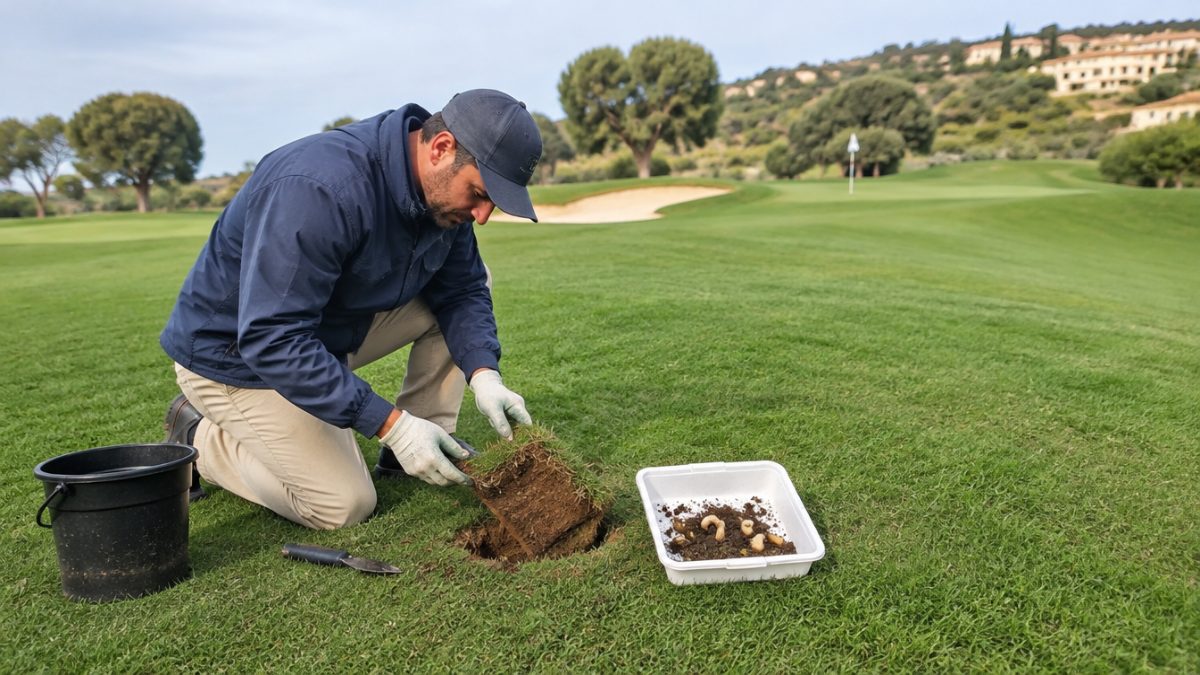
Then examine the soil in the transition zone between affected and healthy turf, which is where larvae tend to concentrate:
- Cut a square a few centimetres on each side and deep enough to see the root zone.
- Crumble it apart on a light-coloured surface.
- Count the larvae found and repeat the sampling at several points.
The presence of a few larvae does not mean serious damage; the problem arises when density is high and turf conditions are limiting. That is why it pays to record the number and location of each sample.
Third sign: birds, badgers and other animals digging
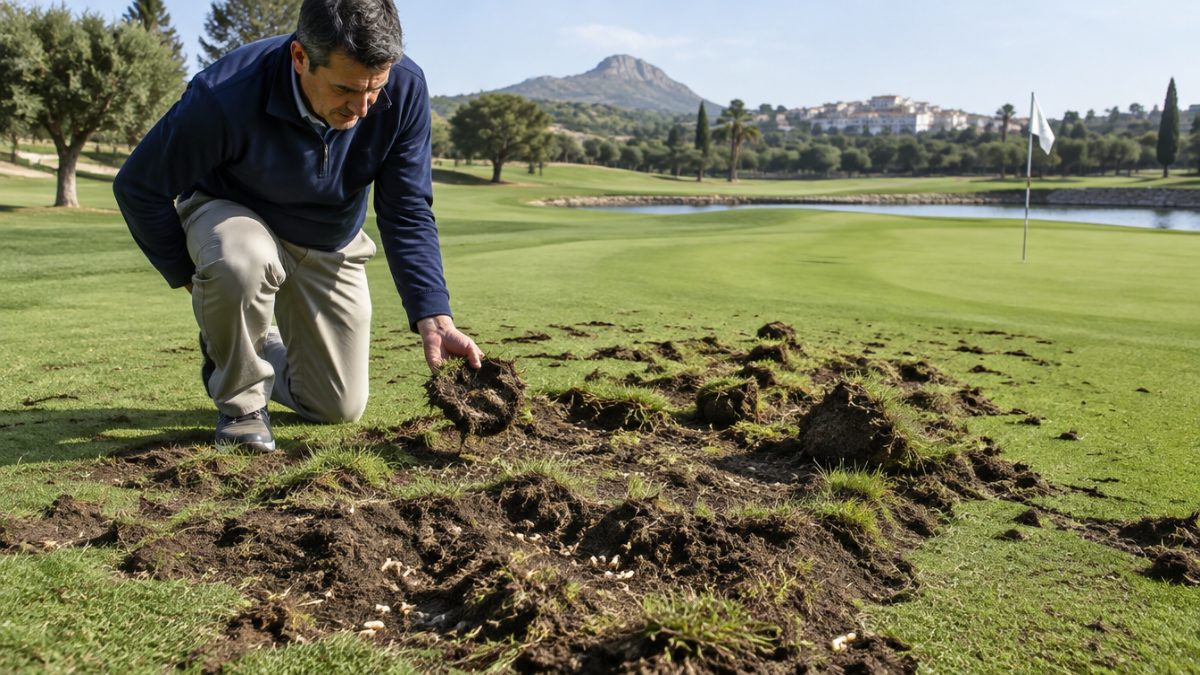
Larvae are appetising food for birds, mammals and other animals. When pecking, holes or lifted areas appear overnight, especially on tee boxes, fairways or roughs, the reason is often a search for larvae.
These visits are a useful warning sign, because they can appear before the damage is visible to the eye. If animals concentrate their activity in one area, take a sample there to confirm. Ask the staff who open the course in the morning too, because they are usually the first to see these signs of white grubs in turf. Sometimes the damage caused by the animals is worse than that of the larvae themselves, so repairing it in time, with reseeding or sod, is part of the recovery plan.
Do not conclude that you have white grubs in turf from the holes alone: they can be due to other insects or different causes. Always go back to sampling to confirm.
Fourth sign: adults and egg-laying in the preceding season
The life cycle helps you anticipate. Adult beetles emerge at certain times, fly, feed and lay eggs in the soil, from which small larvae hatch and feed on roots. If you have seen a heavy flight or beetles around lights and trees, it is an indicator that there may be larval pressure weeks later.
Make use of that information:
- Note the dates adults appear each year.
- Take preventive samples in areas with a history.
- Watch loose, moist soils in particular, which tend to favour egg-laying.
- Ask neighbouring courses and your technical adviser how pest pressure looks.
Each course’s own experience is worth more than any generic calendar, hence the importance of keeping a history.
Fifth sign and control: the history of recurring areas
If white grubs in turf have already affected an area, they are likely to return. Soils and turf type, together with moisture, light and proximity to adult areas, create conditions that repeat. A map of each season’s incidents lets you concentrate effort where it is really needed.
Control of white grubs in turf should follow an integrated approach:
- Cultural management: vigorous turf, balanced irrigation, adequate fertilization and aeration to encourage roots.
- Monitoring: periodic sampling in risk areas and thresholds defined with technical advice.
- Biological control: in some cases, beneficial organisms applied under the right conditions.
- Chemical treatments: only when justified, at the right moment of the cycle and always following the label, current regulations and the advice of an authorised technician or adviser.
The timing of action is decisive: when larvae are small, control is more effective and the damage is not yet serious. A late treatment on large larvae gives less and can prove expensive.
After any intervention, sample again to check the result and repair the damaged turf. White grubs in turf are better managed with consistency and data than with an emergency reaction.
Further reading: GCSAA. To broaden the integrated approach to pest control in turf, the GCSAA offers training resources
Frequently asked questions
How do you tell white grubs in turf from drought?
Pull the turf in the affected area. If it lifts without roots and you find white C-shaped larvae in the soil, it is larvae. If the roots are healthy and the soil is dry, an irrigation problem is more likely. Take the sample in the transition between healthy and damaged areas.
When should you act against white grubs in turf?
The most effective time is when larvae are young, before the damage is serious, after confirming by sampling that the density justifies it. The exact timing depends on the species and the local climate, so follow the label, current regulations and the advice of an authorised adviser.
Can white grubs in turf be prevented?
The risk cannot be eliminated completely, but it can be reduced. Vigorous turf with a good root system tolerates attack better. In addition, monitoring adults, sampling recurring areas and keeping a history of incidents let you anticipate and limit chemical intervention to the cases that are really necessary.
Keep reading
- Armyworms in turf: steps to control them Turf Caterpillars: 5 Steps to Control Them
- Crane flies in turf: how to avoid damage Leatherjackets in Turf: 5 Steps to Avoid Damage
- Integrated pest management in golf Integrated pest management in golf: 6 key steps