
A golf soil without air is a soil without deep roots. With player and machine traffic, compaction advances almost unnoticed, and the most common technical response is turf aerators. But they do not all do the same thing or serve the same purpose: choosing wrongly can mean wasting time, damaging the surface or leaving the problem where it was.
We review five types of turf aerators, what effect each produces, when it makes sense to use it and what precautions to take. You will also see how to plan the passes and record what was done to get the most from each operation.
Type 1: solid-tine aerators
Solid-tine turf aerators perforate the soil without removing a core. Their great advantage is speed and little impact on play: they leave small holes that heal in a short time, which is why they are common on greens during the playing season.
They relieve surface compaction, encourage the entry of air and water and produce no debris to collect. Their limit is that, by pushing the soil sideways, they can create a denser layer at the bottom of the hole if overused or if worked when the soil is too wet.
That is why many crews alternate the depth from one pass to the next and occasionally reserve a coring operation to break up that possible layer. Solid-tine turf aerators work best as part of a programme, not as the only solution.
- Ideal for frequent, minimally invasive operations.
- Useful for improving infiltration in periods of heavy play.
- Vary the depth between passes.
Type 2: hollow-tine or coring aerators
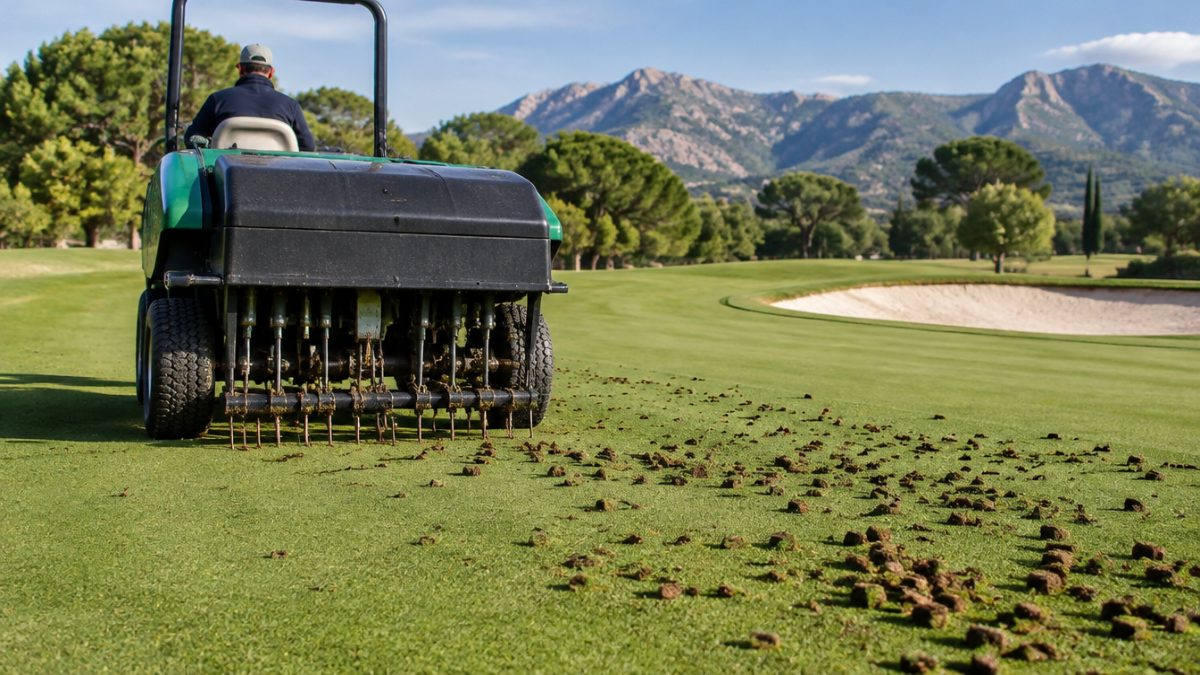
Coring turf aerators remove a cylinder of soil, the so-called core, and leave a hole that can be filled with sand. It is the most effective technique for reducing the organic layer and gradually modifying the soil profile, but also the most intrusive: the surface is left uneven for a few days.
It is usually reserved for the windows of lowest playing pressure and best turf recovery. After the operation, the cores must be collected or incorporated, then the area top-dressed and irrigated to help healing.
- Choose the diameter and depth according to the objective.
- Remove the cores and fill with sand if appropriate.
- Run the brush or drag mat and irrigate carefully.
- Warn members and players of the temporary effect on play.
Type 3: slicing or knife-blade aerators
Slicing aerators make fine vertical cuts in the soil, which relieve compaction with minimal disturbance of the surface. They are a good option when you want to maintain playability and work close to the root without lifting the soil.
They are especially useful on tee boxes, fairways and areas where conventional tining would leave too much of a mark, and also as a complement on greens when you want to cut the tissue without pulling it up. Their effect is more moderate than that of coring, but so is their impact on play.
- Good for intermediate maintenance between intensive operations.
- Recommended on soils prone to sealing.
- Less effective against a very thick organic layer.
Type 4: vibrating or deep-action aerators
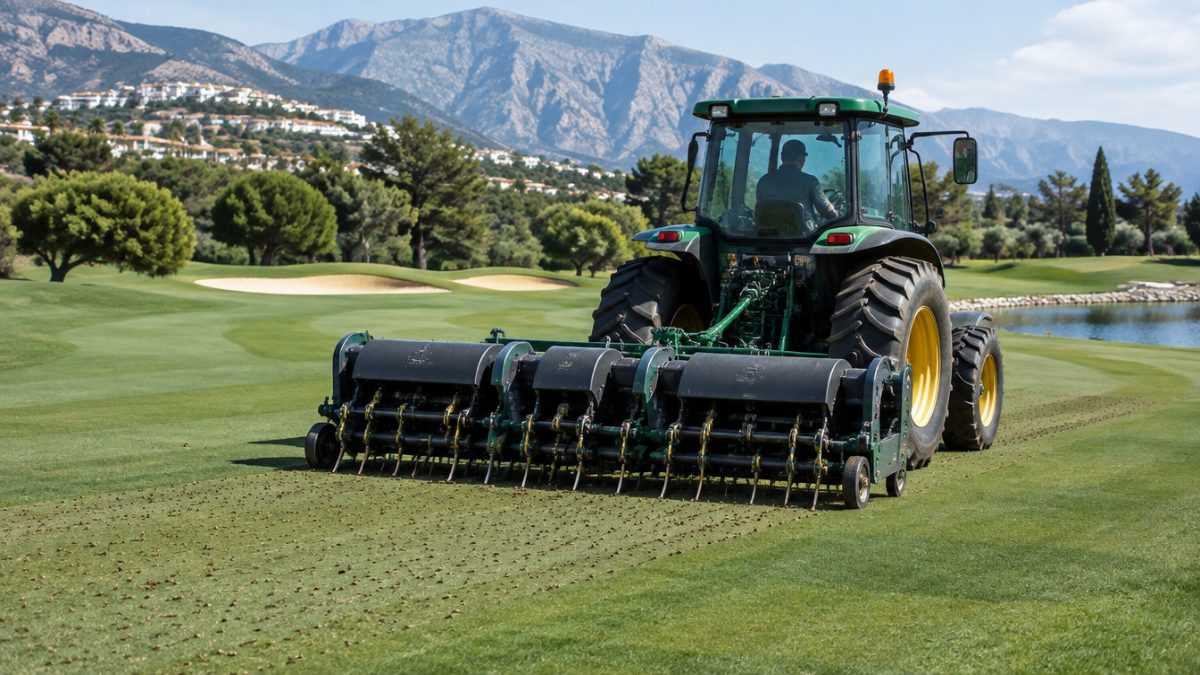
Deep-action turf aerators work by vibration or penetration into deeper layers of the soil, breaking up compacted strata without lifting the surface. They are a tool designed for deep compaction problems, on fairways, rough or heavily trafficked areas.
This kind of operation requires careful calibration of soil moisture: if it is too dry the machine does not penetrate; if it is saturated, it can make the problem worse. It pays to try first in a small area and check how the profile behaves.
A field trick: after the pass, open a trial pit with a spade and look at whether the roots are already using the new space. If the profile is still in layers and the roots turn aside when they reach the hard zone, the operation has not done its job and you need to review depth, moisture or equipment before repeating it.
- Useful in areas with persistent drainage problems.
- Require robust machines and a suitable tractor.
- Call for passes planned to disturb play as little as possible.
Type 5: water-jet or injection aerators and hand tools
The last group includes turf aerators that inject air or water under pressure to fracture the soil, and small-scale hand tools. The former have minimal effect on the surface and allow intervention with little impact on play. The latter serve for corners, banks and small areas the big machine cannot reach.
They are not usually the main equipment on a course, but they can become a good complement for treating specific spots or working at delicate moments, such as before a tournament.
- Excellent for one-off, low-impact interventions.
- Practical on edges, collars and hard-to-reach areas.
- More limited output on large areas.
How to choose between turf aerators and plan the passes
The choice depends on the objective: relieving surface compaction, reducing organic matter, improving drainage or simply keeping the soil alive. A balanced programme combines several types through the year: light, frequent operations, and some coring work in the most favourable windows.
- Define the objective of each operation before choosing the machine.
- Avoid intense aeration in heat peaks or when the turf is stressed.
- Adjust depth and spacing according to the zone.
- Check tines, blades and greasing before each use.
Record which machine you used, in which zone, at what depth and how much time you spent. Over time, that history will tell you which turf aerators give the best results in each part of your course and when to replace them.
Further reading: USGA. The USGA offers technical resources on turf cultivation and green soil management that help plan aeration operations.
Frequently asked questions
How many times a year should turf aerators be used?
It depends on the soil, species and playing pressure. Greens usually need several operations of differing intensity through the year, while fairways and rough need fewer. The most practical approach is to combine frequent light operations with one or more coring operations in the seasons of best recovery.
What is the difference between solid and hollow tines?
Solid tines perforate without removing soil and recover quickly, while hollow tines extract cores and let you reduce organic matter and fill with sand. Hollow tines are more effective but more invasive. With turf aerators it pays to alternate both types according to the objective and the season.
When should you not aerate?
Avoid aerating when the soil is saturated or very dry, in the middle of a heatwave or when the turf cannot recover, and before a tournament if the operation leaves visible marks. At those times it is better to use low-impact turf aerators or wait for a better window.
Keep reading
- Preventive maintenance of golf machinery Preventive Equipment Maintenance: 7 Key Tasks
- Soil compaction: how to detect and correct it Soil Compaction: 5 Causes and Fixes on Golf Courses
- Scarifying turf: when and how Turf Scarifying: 5 Steps to Reduce Thatch