
When a green drains poorly after rain, a fairway always floods at the same spot or the turf dries quickly despite irrigation, the problem is often below the surface. Soil compaction reduces the pore space through which air and water move, and shapes rooting and turf health throughout the season.
In this article we will see how to recognise it, five common causes on a golf course, which operations help correct it and how to organise a plan so that it does not return with the same intensity.
How to Detect Soil Compaction on the Course
Before acting, you need to confirm that soil compaction really exists, because some symptoms resemble other problems. These signs, combined, are usually reliable:
- Water that takes time to infiltrate and forms puddles after irrigation or rain.
- Short, shallow roots or roots growing horizontally.
- Turf that dries out in patches even though irrigation is sufficient.
- Difficulty pushing a screwdriver or probe rod into the ground.
- Layers of different colour or texture when opening a trial pit.
The most useful test is to open a small trial pit with a core sampler and observe the profile. There you can see at what depth the root stops and whether there are hard or anaerobic layers, grey in colour or with an unpleasant smell. A periodic check at the same points lets you compare progress.
Cause 1: Traffic from Players, Buggies and Machinery
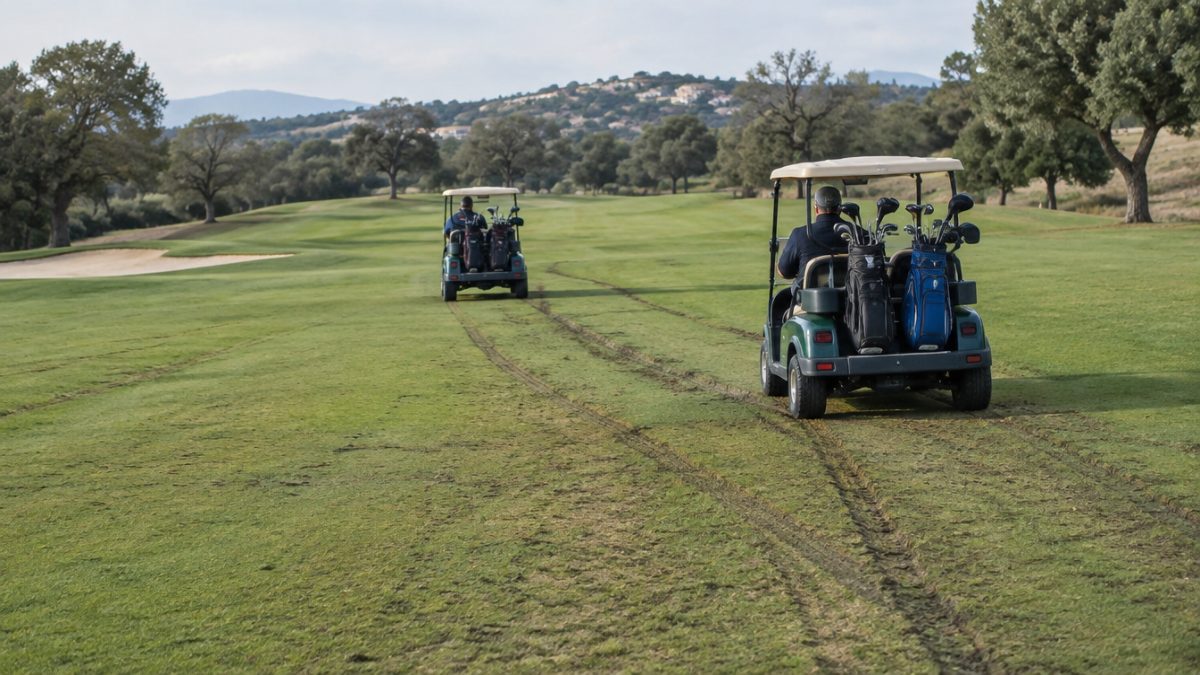
This is the most obvious cause of soil compaction. Green entry and exit corridors, buggy turning points and machinery routes concentrate repeated pressure on the same soil.
- Mark and rotate access points to spread the wear.
- Establish buggy traffic rules, with path-only sections when the ground is wet.
- Change the routes of heavy machinery and avoid always running over the same tracks.
Wet soil compacts more than dry soil, so the risk increases after rain or heavy irrigation. Restricting traffic at those times is an inexpensive and very effective measure.
Cause 2: Texture with Excess Fines and Poor Structure
Soils with a lot of silt or clay suffer soil compaction easily, and greens built with unsuitable or aged mixes lose porosity as fine particles accumulate. Over the years, the sand can become sealed by organic and fine material that migrates downwards.
It pays to analyse texture and fines content with a trusted laboratory, so that aeration and sand-input decisions are based on data and not on assumptions. A well-interpreted soil analysis says a lot about infiltration capacity and how the profile has changed over time.
Cause 3: Poorly Adjusted Irrigation and Poor Water Quality
Irrigation has more influence than it seems. Excess water keeps the soil saturated and favours soil compaction under the passage of machinery. Water with high sodium can also damage structure and seal the surface.
- Check irrigation uniformity: points with excess compact sooner.
- Adjust run times according to evapotranspiration and real soil moisture.
- Analyse water quality and consider amendments where there are sodium or salinity problems.
On courses with reclaimed or hard water, this cause of soil compaction often goes unnoticed for years, until the symptom becomes obvious.
Cause 4: Build-Up of Organic Matter and Thatch
Excess organic matter retains water, restricts air and creates a spongy layer that, paradoxically, becomes poorly permeable when it dries out. In soil compaction on greens and tee boxes, a thick thatch hinders the passage of water and root development.
Control combines several operations:
- Regular, light top-dressing, with sand suited to the profile.
- Aeration with tines or cores that open drainage channels.
- Moderate scarifying or verticutting, adjusted to the season and species.
It is important not to act all at once: an intervention that is too aggressive can damage the turf and spoil play for weeks.
Cause 5: Insufficient or Poorly Scheduled Aeration
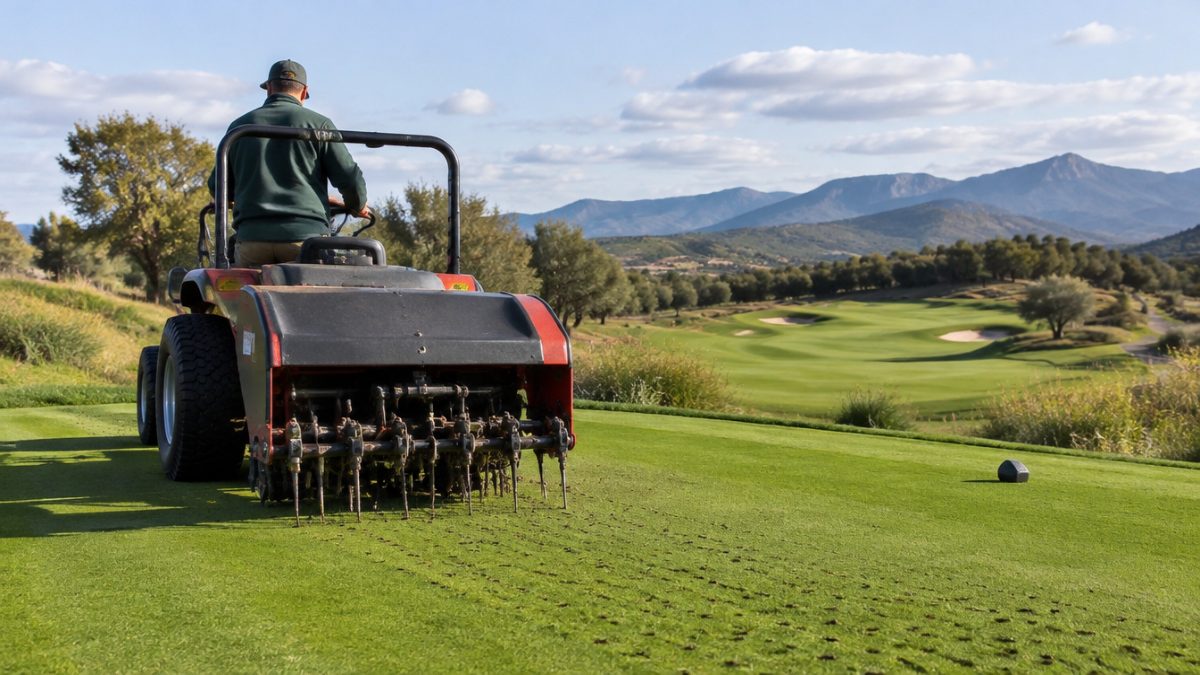
Sometimes the problem is not aerating, or doing it at the wrong time and with the wrong tool. Tines always at the same depth create a compacted layer just beneath, known as a pan.
- Alternate depths and types of tool throughout the year.
- Schedule the most intensive operations in periods of fast growth and recovery.
- Adjust the calendar to the type of turf: bermudagrass in summer is not the same as ryegrass in autumn.
- Avoid working when the soil is too wet, because it aggravates the problem.
Without an orderly aeration calendar, soil compaction advances silently. By the time it shows, it has already taken two or three seasons to build up.
How to Design a Plan Against Soil Compaction
A sensible plan starts by mapping the problem and prioritising areas. Greens, tee boxes and the highest-traffic fairways usually require the greatest effort. A realistic work proposal:
- Diagnose with trial pits and infiltration measurements at fixed points.
- Correct the external causes first: traffic, irrigation and water quality.
- Schedule the mechanical operations throughout the season, not all at once.
- Record each intervention, with date, zone and tool used.
- Review the result each year and adjust the calendar.
To curb soil compaction, consistency matters more than intensity. A course that aerates, top-dresses and rotates traffic regularly rarely needs drastic interventions.
Further reading: USGA. The USGA Green Section publishes technical recommendations on profile construction and soil management on golf surfaces.
Frequently asked questions
How often should I aerate to prevent soil compaction?
There is no universal frequency. It depends on the soil type, traffic, species and time of year. It is usual to schedule several operations of different intensity throughout the year, with more frequent light aerations and others deeper and more spaced out. It is best to adjust it to what your trial pits show.
Does soil compaction affect greens and fairways equally?
It affects both, but differently. On greens it is usually related to thatch, fines and aged mixes; on fairways and tee boxes, to traffic, machinery and heavier-textured soils. That is why the diagnosis should be done by zone and the operations adapted to the use and profile of each surface.
How do I know if aeration is working?
Compare the condition before and after using the same tests: root depth in a trial pit, infiltration rate and penetration resistance. If after several operations the profile is still sealed or the roots do not go deeper, review the tool, the depth and the timing. Recording each intervention helps to see patterns.
Keep reading
- Thatch on greens: how to control it Thatch in greens: 6 warning signs and how to reduce it
- Irrigation water salinity Irrigation Water Salinity: 6 Control Measures
- Turf fertilisation step by step Turf Fertilisation: 6 Guidelines by Season