
Sprinkler maintenance rarely tops the priority list, until in midsummer a clogged nozzle leaves a tee box yellow or a stuck sprinkler floods a green. With hundreds of heads scattered across the course, systematic inspection is the only way not to depend on luck.
This article proposes eight inspection tasks, grouped by timing and by type of fault, so that sprinkler maintenance becomes a clear routine and not a reaction to complaints. You will see what to look at, how often as a guide, and how to keep a record of what was done.
Why Sprinkler Maintenance Starts with a Good Visual Round
The first tool is observation. Walking the course with irrigation running, preferably at night or first thing in the morning, lets you see things that go unnoticed by day: crooked fans, streams that fall short, heads that do not rotate or leaks at the base.
- Note each issue with its station or sprinkler number.
- Distinguish the urgent (leak, flooding) from what can wait for the weekly round.
- Photograph the problem if it helps the mechanic prepare the repair.
If you can, always do the round in the same order of zones: that way one week can be compared with another and the eye gets used to spotting what changes. Someone experienced in sprinkler maintenance can tell at a glance a healthy spray fan from one with a worn nozzle. This round is task 1. What is not seen is not fixed, and sprinkler maintenance always starts with detecting problems in time.
Sprinkler Maintenance Tasks 2 and 3: Nozzles and Filters
The nozzle determines flow and reach, and it is the part that suffers most from wear and from particles in the water. A worn nozzle delivers more water close in and less far out, and the irrigation pattern is distorted. Check its condition and confirm that each sprinkler has the nozzle specified in the zone design.
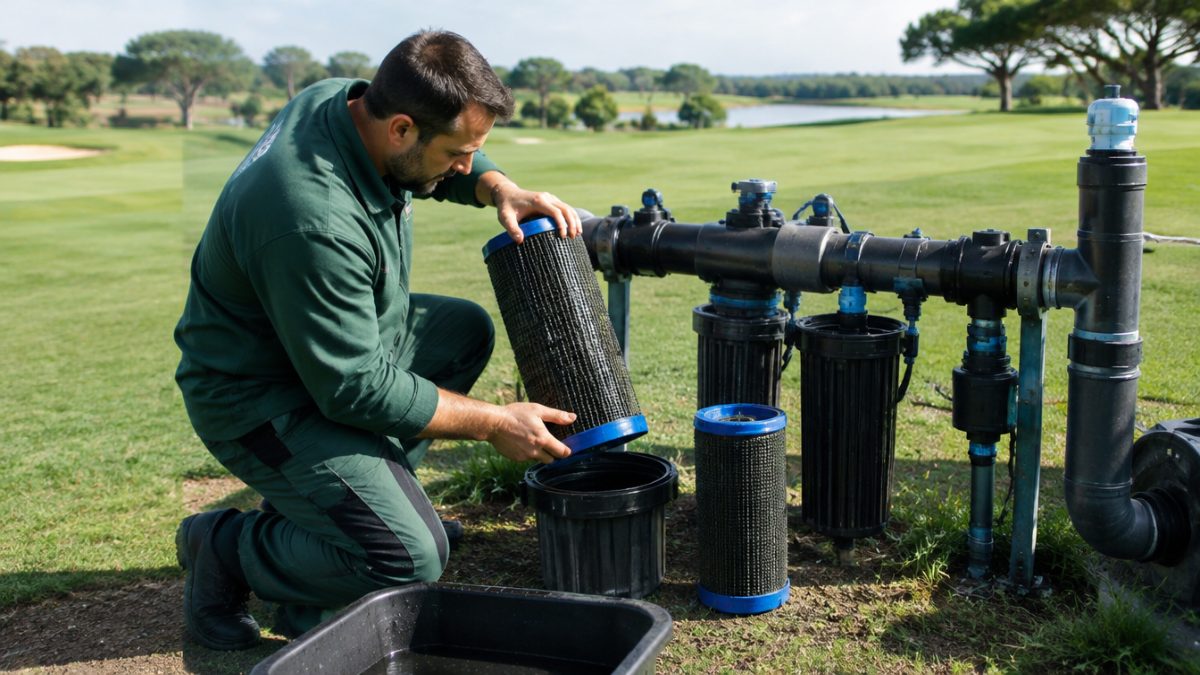
Task 3 is filters, both the head-end ones and the internal ones in each sprinkler head. If the water carries sand, algae or organic debris, they clog sooner than expected and reduce flow without anyone noticing.
- Clean filters at the interval set by water quality, more often if the water is reclaimed or from a reservoir.
- Replace nozzles with visible wear, even if they still work.
- Keep a small stock of the most common ones so you do not wait for spares.
Tasks 4 and 5: Rotation, Arc and Levelling of the Sprinkler
A sprinkler should rotate smoothly and complete its arc with no jumps or sticking. Check the rotation arc, the stops and the speed. Irregular rotation usually points to dirt in the mechanism, worn seals or sand inside.
Task 5 is levelling. Over time, machinery traffic, ground settlement and turf growth leave heads sunken or tilted. A sunken sprinkler waters badly because the turf or rough blocks the stream; a crooked one throws water where it should not.
- Check the height relative to the turf surface.
- Reset the head to position with compacted soil or the appropriate adjustment.
- Verify that the stream does not hit obstacles or trees.
Task 6: Seals, Leaks and Pressure in Sprinkler Maintenance
A small leak at the base of a sprinkler wastes water for weeks, over-wets an area and encourages disease. Check seals, connections and associated valves. A permanently soft area, or turf greener than normal around a head, is a classic sign.
Working pressure also matters: if it is excessive, the water is atomised and the wind carries it off; if it is insufficient, the reach falls short. As a guide, each sprinkler model has a manufacturer-recommended pressure range, and it is worth checking that it is respected at different points in the network, especially at the end of the lines.

Tasks 7 and 8: Programming, Stations and Recording What Was Done
Task 7 is verifying that each station switches on and off correctly from the controller, that run times match the plan and that there are no overlaps between zones. A failing solenoid or damaged cable can leave areas without irrigation or with continuous irrigation.
Task 8 is the one most often forgotten: keeping a record. Note which sprinklers were checked, what was replaced and when. Sprinkler maintenance without a record is hard to improve, because you do not know whether what you are doing works. With that history you can spot problem heads that keep recurring, plan renewals by zone and justify the investment to management.
- Date, zone and sprinkler checked.
- Part replaced and reason.
- Person who did the work and time spent.
Suggested Inspection Calendar and How to Avoid Breakdowns in the Middle of the Season
A good sprinkler maintenance plan combines short, frequent rounds with planned in-depth checks. Before the period of highest water use begins, it is worth doing a general inspection: filters, nozzles, rotation and leaks. During the season, the visual round and fixing simple issues are enough to keep the system in order.
- Weekly: visual round with irrigation running and correction of obvious faults.
- Monthly: filter cleaning and inspection of critical zones such as greens and tee boxes.
- Before the irrigation season: general inspection by zone.
- At the end of the season: wear check and planning of spares.
Always prioritise the zones where a failure costs most, such as greens and green aprons. An example: if sprinkler maintenance focuses first on the twelve or fifteen heads around the greens, the benefit to play is immediate, and the rest of the course can be checked more calmly in sections. And remember that sprinkler maintenance is not a minor expense: every well-maintained sprinkler waters more uniformly and wastes less water.
Further reading: Irrigation Association. Organisations such as the Irrigation Association offer general documentation on the design, efficiency and maintenance of irrigation systems.
Frequently asked questions
How often should sprinkler maintenance be done?
As a guide, a weekly visual round with irrigation running, filter cleaning and inspection of critical zones every month, and a general inspection before the irrigation season. The actual frequency depends on water quality, sprinkler type and the age of the installation.
What signs show that a sprinkler needs checking?
Yellow or drier areas around it, permanent puddles, crooked streams or ones that fall short, irregular rotation and leaks at the base. If you see any of these signs, note the sprinkler and check it as soon as possible: a simple nozzle change or a clean usually fixes it at little cost.
Is it worth keeping records of sprinkler maintenance?
Yes. The history lets you detect heads that fail again and again, plan renewals by zone and justify investments to management. It also avoids duplicate inspections and makes it easier for another team member to carry on the work without depending on the irrigation manager's memory.
Keep reading
- Irrigation audit step by step Irrigation audit: 7 steps to detect water losses
- Preventive maintenance of machinery Preventive Equipment Maintenance: 7 Key Tasks
- Soil moisture sensors Soil Moisture Sensors: 6 Key Uses in Golf