
Almost every course waters what it thinks it waters, and almost none checks. An irrigation audit is precisely that: measuring how much water comes out, where it lands and how much is lost along the way, so you can decide with data what to repair, what to adjust and what to schedule differently.
In this article you will find seven steps to carry it out with the resources of an ordinary course: gather the information, inspect the infrastructure, measure uniformity, compare with turf needs, locate losses, prioritise improvements and keep control over time. Done in winter or early spring, it is one of the most rewarding investments of the year.
Gather the data before going out on the course
A good irrigation audit starts in the office. For the audit, collect the system plans, the inventory of sprinklers and valves, the sector layout, design flows and pressures, meter consumption records and the current irrigation schedules. If no reliable plans exist, reconstructing them is already a valuable first result.
Before you start, ask the operators to point out the trouble spots: dry areas that never get fixed, recurring puddles, sectors that start up with a strange noise. Their experience saves hours of searching and directs the inspection to where it is most needed.
Inspect the infrastructure sector by sector
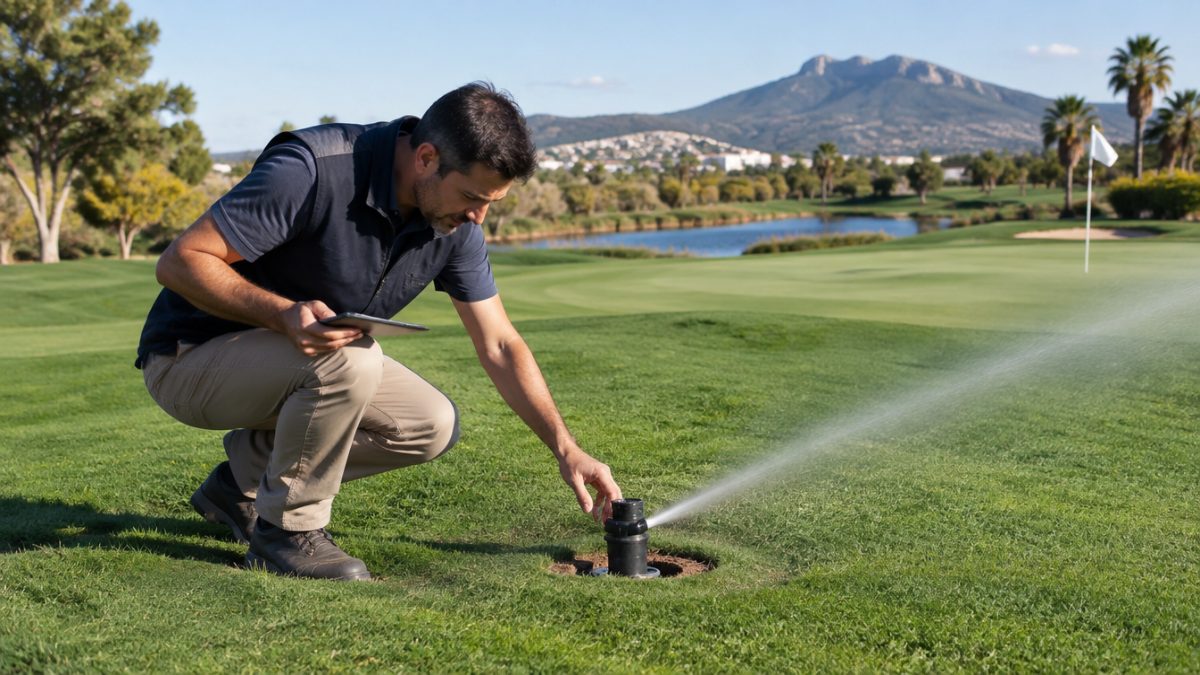
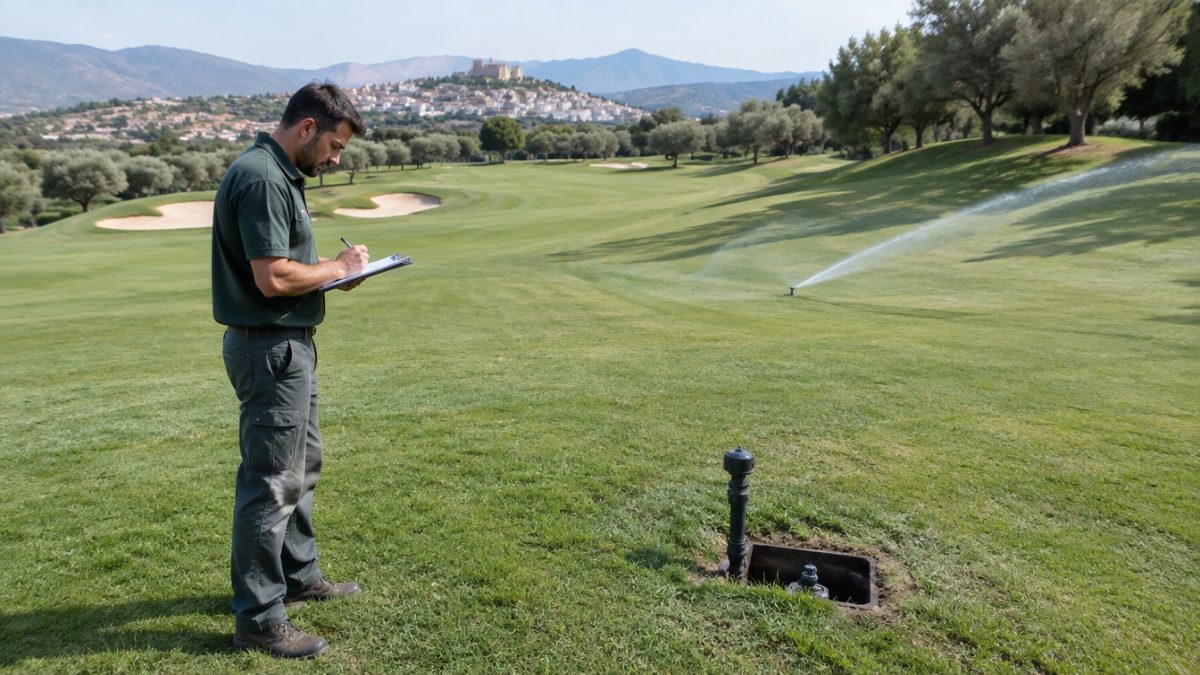
This phase of the irrigation audit demands patience: walk the sectors with the system running, preferably at night or first thing, when there is no play or strong wind. Note everything that does not fit on a card for each sector.
- Sprinklers that are tilted, sunken, blocked by turf or fitted with different nozzles from their neighbours.
- Leaks at joints, pipes or valves, visible as puddles or excessively green areas.
- Badly adjusted arcs and rotations that water paths, bunkers or rough.
- Pressures that are too high or too low, which distort the rain pattern.
Take photos and geolocate each finding. Later it will be the basis for ordering repairs by priority.
Measure uniformity with a catch-can test
The classic uniformity test consists of placing collection containers in a regular grid, running the sector for a fixed time and measuring the water collected in each one. With that data you can see whether some areas receive much more than others. The greater the difference, the more water has to be applied overall so the driest area does not suffer, and that means unnecessary spending and excess on the rest.
You do not need to audit the whole course in a day, and it is not advisable to do it in wind, because that skews the measurement. Start with greens, tee boxes and the sectors with the most problems, and extend the work in phases. Repeat the test after each major repair to confirm that the improvement is real and not just an impression.
Compare what is applied with what the turf needs
A uniform system is of little use if it applies the wrong volume. Compare the scheduled run times with the water needs of the species and the season, relying on weather data, actual soil moisture and what you observe on the ground. Two sectors with different exposure, soil texture or slope cannot have the same schedule.
In an irrigation audit it is common to discover that watering is done out of inertia: inherited timetables, long run times that cause runoff or identical programmes for areas that behave very differently. Also estimate how much water is applied per sector per week, and compare it with the meter consumption. Any large mismatch deserves a second look before touching a single sprinkler.
Quantify water losses with the meter
In the irrigation audit, the meter is your best ally. A simple test is to shut off all consumption and see whether the meter keeps turning: if it does, there is a leak. Then compare the recorded consumption with the theoretical volume calculated from the schedules and flow rates; a large difference points to losses, wrong settings or consumption that does not appear in the work reports.
Distinguish between visible losses, such as breaks and stuck-open sprinklers, and silent losses, such as small buried leaks or valves that do not fully close. The latter are detected by pressure drops, by areas that are always damp or by unexplained night-time consumption.
Prioritise improvements by impact and cost
After the irrigation audit you will have a long list, probably messier than you expected. Order it by a clear criterion: impact on consumption, impact on playing quality, repair cost and ease of execution. Many improvements are cheap and quick, such as changing nozzles, readjusting arcs or correcting pressures, and should be done first.
- Immediate actions: leaks, broken sprinklers, absurd schedules.
- Short-term improvements: replacing heads, readjusting sectors, new timetables.
- Larger investments: replacing pipe sections, sectorisation, flow control, pumping.
Present each item with its estimated cost and expected benefit, without promising exact savings figures. For now, leave out works that depend on a full technical project, and keep them for a second phase in which the investment can be justified with the data you will already have gathered.
Turn the irrigation audit into a routine
An irrigation audit done once and filed away loses its value within a few months. Schedule periodic reviews, even if shorter, and record the results: date, sector, findings, repairs and observed improvement. With that history you will see whether consumption falls, whether repairs hold and where problems reappear.
Define owners and deadlines for each finding the irrigation audit produces, and make inspection reports part of daily work. When a leak is detected in two days and not in two months, the saving shows without the need for big investments.
Further reading: EPA. To learn general criteria for water-use efficiency, you can consult the resources of the US Environmental Protection Agency (EPA).
Frequently asked questions
How often should an irrigation audit be carried out?
The usual approach is a full review every few years or after major changes to the system, and partial checks each season, especially before summer. If there are symptoms, such as persistent dry areas, consumption rising for no reason or recurring puddles, bring it forward.
Do you need a specialist for the irrigation audit?
A maintenance team with a method can carry out a simple first irrigation audit with catch cans, the meter and good observation. For complex systems, old designs or major investment decisions, a specialist technician provides more complete calculations and tests that are worth considering.
What do you usually find when doing an audit?
The most common findings are misadjusted sprinklers or wrong nozzles, pressures out of range, inherited schedules nobody has reviewed, small but constant leaks and poor uniformity in critical areas. Many of these corrections are simple and pay for themselves quickly.
Keep reading
- The importance of efficient irrigation in golf course care The importance of efficient irrigation in golf course care
- Greenkeeper tasks in January: key jobs Greenkeeper tasks in January: 7 key jobs
- Complete guide to turf maintenance on golf courses Complete guide to turf maintenance on golf courses