
Every greenkeeper has lived the same scene: the green looks perfect on the surface, but ten centimetres down the roots are swimming in water or, on the contrary, running out of it. Soil moisture sensors turn that hunch into an objective reading that can be compared day by day and zone by zone.
In this article we review six specific uses of moisture sensors on a golf course, how to place them so the measurements are worth something, and which mistakes to avoid. You do not need a large investment to get started: you need method, judgement and consistent record keeping.
What a sensor really measures, and what it does not
Before buying anything, it helps to understand what soil moisture sensors offer and what they do not. A sensor inserted into the profile indirectly measures the volumetric water content of the substrate. It is a useful figure, but it does not tell the whole story: the same value in a green’s sand and in a loamy-clay fairway soil means very different situations for the plant, because water retention and availability change with texture.
So it is worth being clear from the start:
- The sensor gives a number; the interpretation depends on the soil or substrate type.
- A single reading is less valuable than the trend over several days.
- Salinity and temperature can skew some devices, so you need to know their limitations.
Treating the data as one indicator among others, alongside visual observation and feel, prevents hasty decisions.
Use 1: Adjust irrigation frequency on greens
On greens, where the profile is sandy and drains quickly, the difference between sufficient moisture and water stress sits within narrow margins. Well-placed soil moisture sensors let you see how long water content takes to fall after irrigation and when it approaches the threshold the team considers safe.
The usual procedure is simple:
- Define a target range for each green, based on experience and a few weeks of readings.
- Irrigate when the trend approaches the lower limit, not on a fixed schedule.
- Note the effect of the irrigation to refine the range next season.
Use 2: Detect dry spots and wet spots
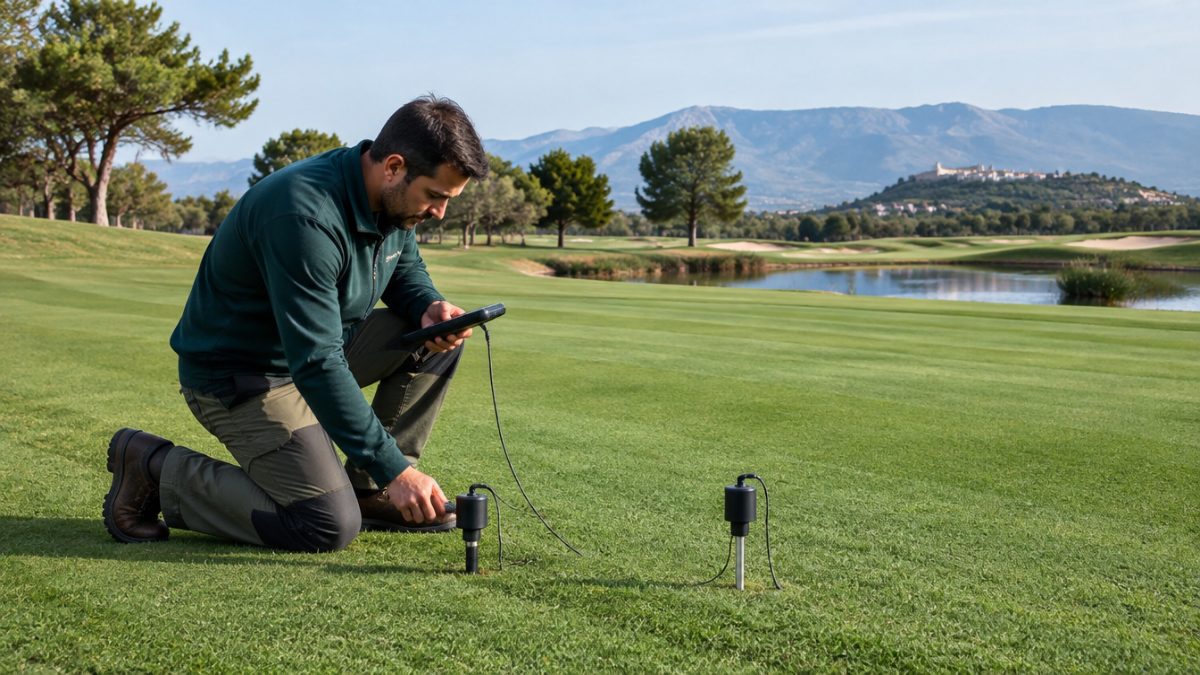
Almost every course has greens that behave unevenly: one side that dries out first because of exposure, a depression that collects water, a sector where the sprinkler distributes poorly. With a few comparative readings at fixed points on each green, what used to be the team’s impressions becomes objective. Soil moisture sensors do not replace the inspection round, but they make it more precise and let you prioritise which greens to visit first each morning.
This helps you decide whether the solution is:
- Targeted hand watering on the dry spot.
- A check of nozzles and sprinkler overlap.
- Specific aeration or spiking where water does not infiltrate well.
Use 3: Decide when not to irrigate
Perhaps the most profitable use of soil moisture sensors is not irrigating better but avoiding unnecessary irrigation, something that is rarely valued because the water you do not use leaves no visible trace. After rain, a night of heavy dew or a run of cloudy days, the reading confirms whether the profile still has enough reserve.
Skipping an irrigation cycle with data to back it up reduces water use, pumping energy and the risk of diseases favoured by excess moisture. It also gives you a solid argument when the greens committee or management asks why the course was not watered on a particular night.
Use 4: Manage summer water stress
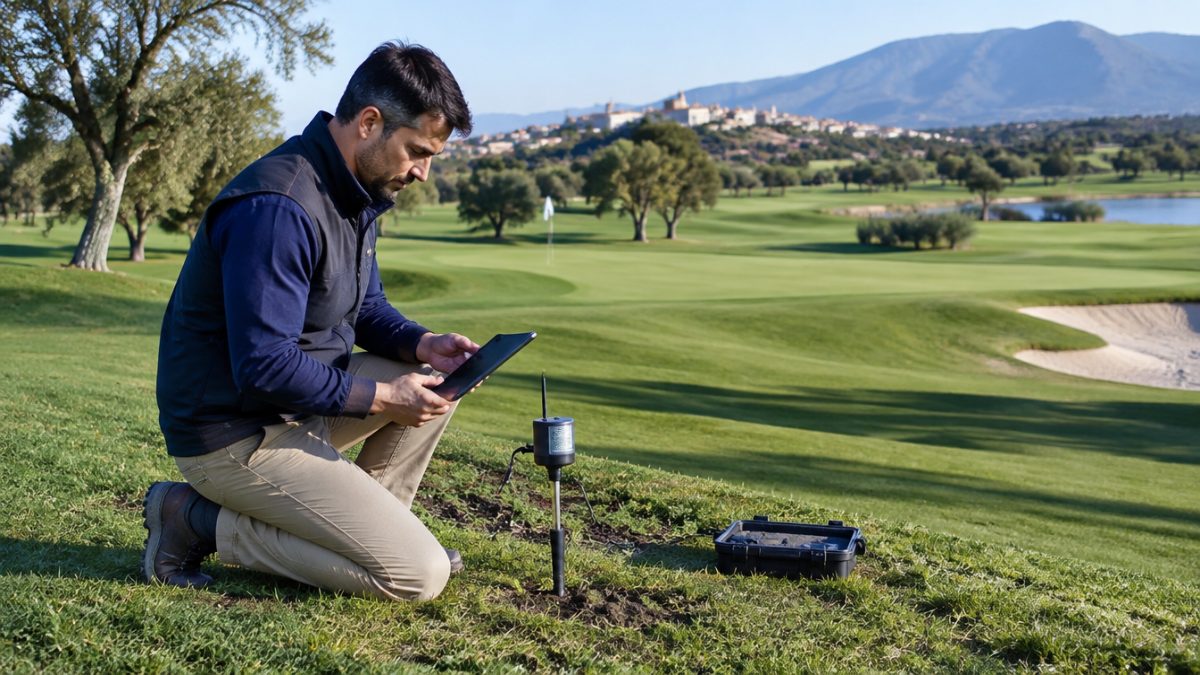
With high temperatures and heavy evaporative demand, the margin for error narrows. Having soil moisture sensors at different depths lets you check whether water reaches the root zone or stays in the top few centimetres, and adjust the application rate and the split of the pulses.
In warm-season species such as bermudagrass or paspalum, and in cool-season grasses such as bentgrass on greens, the stress response is different, but the principle is the same: keep moisture in a range that sustains the plant without forcing shallow rooting. Combining the readings with an estimate of evapotranspiration gives a fuller picture of the turf’s real demand.
Use 5: Monitor salinity and salt leaching
Many Mediterranean courses irrigate with reclaimed water or water of limited quality. Some sensors also report electrical conductivity, which lets you track salt build-up in the profile and decide when to schedule leaching irrigation.
If your equipment does not include that measurement, moisture alone already helps, and soil moisture sensors are still useful as an early warning: a profile that does not drain as it should is a warning sign of compaction or surface sealing. In any case, regular soil and water analyses remain the reference for amendment decisions.
How to install soil moisture sensors and avoid mistakes
The quality of the measurement depends more on the installation than on the device, and poorly placed soil moisture sensors give misleading data with every appearance of precision. Some good-practice guidelines:
- Soil contact: avoid air pockets around the probe, which distort the reading.
- Representativeness: choose points that reflect the zone, not the most extreme corner.
- Depth: place them in the active root zone of the turf type being managed.
- Calibration: check occasionally against a manual measurement or a reference method.
- Maintenance: check batteries, cables and communications before the season of highest demand.
A very common mistake is to collect lots of readings and not record the decisions. Without noting what was done with each piece of data, it is impossible to learn from it.
Further reading: USGA. The USGA offers technical resources on water and soil management on golf courses that serve as a reference for interpreting readings.
Frequently asked questions
How many soil moisture sensors does a golf course need?
It depends on the budget and the variability of the course. A common strategy is to start with a few representative greens, a tee box and a problem fairway, and expand as the team gains confidence. Limited coverage that is well interpreted is better than many sensors with no follow-up and no record of the decisions made.
Can soil moisture sensors replace the greenkeeper's judgement?
No. Soil moisture sensors provide objective data, but professional judgement remains essential to interpret it alongside the visual condition of the turf, the forecast, the playing schedule and pending tasks. They work best as a support tool that reinforces the team's decision.
How often do sensors need to be checked and calibrated?
Check that they work before each intensive irrigation season and compare them periodically with manual measurements or another reference method. If a reading deviates persistently from what you observe on the course, check the installation, soil contact and the condition of the equipment.
Keep reading
- Irrigation audit: steps to detect losses Irrigation audit: 7 steps to detect water losses
- Evapotranspiration: keys to irrigating just enough Evapotranspiration in golf: 5 keys to watering just right
- The importance of efficient irrigation on golf courses The importance of efficient irrigation in golf course care