

While people debate whether the course of the future will be autonomous, some clubs have already added driverless mowers to their fleet. Robotic mowers in golf do not replace a greenkeeping team, but they can absorb repetitive work and free up staff for tasks that call for human judgement.
Here are five practical uses, the limitations worth knowing, the factors to analyse before adding one to your fleet, and how to fit it into daily operations without creating new problems.
What Robotic Mowers in Golf Can and Cannot Do
A robotic mower works autonomously within a defined perimeter, using batteries and positioning systems that let it cover a surface following set patterns. It is very good at uniform, repetitive jobs with low finish requirements; less so on surfaces where precision cutting is critical.
Before considering robotic mowers in golf at your club, it helps to separate promise from reality, especially because advertising tends to show only the best-case scenario:
- Can do: frequent, regular mowing in defined areas, making good use of night-time or low-occupancy hours.
- Struggles with: steep slopes, very soft soils, unexpected obstacles and surfaces with very high finish requirements.
- Does not replace: supervision, checking cut quality or maintaining the machine.
Use 1: Short Rough and Low-Demand Areas
Lower-height rough and transition areas are the ideal testing ground. They are large surfaces where frequent, light mowing improves the overall look and hardly calls for a fine finish. They are also where the most conventional mowing hours are spent, so the effect on weekly planning is felt straight away.
Many clubs that started with robotic mowers in golf did so here, because the risk is low and it lets you learn how the machine behaves on real terrain, slopes and irrigation systems before moving on to more sensitive uses.
Use 2: Practice Areas, Driving Range and Access Areas
Practice areas, the edges of access roads and the zones around the clubhouse need regular, clean mowing. Robotic mowers in golf can maintain them far more often than a crew could, with less strain on staff and with a uniformity that practice-area users appreciate.
- Define the perimeters carefully so the mower does not stray into bunkers or lakes.
- Coordinate its schedule with players’ use of the area.
- Check ground conditions after rain to avoid ruts.
Use 3: Night-Time or Out-of-Hours Mowing
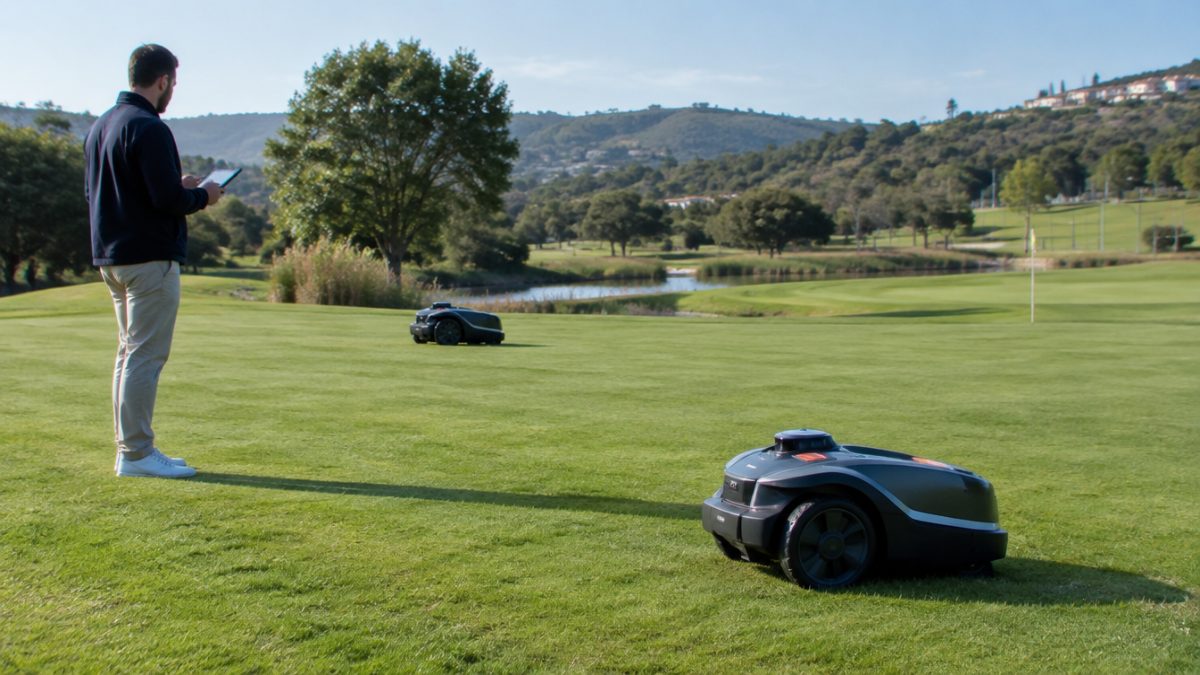
One of the strongest arguments for robotic mowers in golf is the chance to work when the course is empty. That reduces interference with players, avoids interruptions and concentrates human tasks in the most productive hours of the day.
It does require getting safety in order: wildlife protocols, security staff informed, fenced-off areas and pre-checks. With robotic mowers in golf working at night, the best way to avoid surprises is to start with limited time windows and extend them as you gain experience with the equipment.
Use 4: Light Maintenance in Hard-to-Reach Areas
Gentle banks, lake edges or areas that are awkward for conventional machinery can be suitable for robots, provided the slope is within what the manufacturer allows. Robotic mowers in golf reduce the risk to the operator and bring more regular cutting, something hard to achieve by hand on long banks.
Even so, be cautious: extreme slopes, wet grass or banks with stones are a risk to both the machine and the turf. Test on small areas before extending use, and document the results so you can decide based on data.
Use 5: Support for Sustainability Projects
Being electric and quiet, robotic mowers in golf fit well into strategies to cut noise, fuel and emissions. They also suit a management approach that favours frequent, gentle mowing, which can benefit the turf in certain situations.
- Lower fuel consumption on surfaces where they replace engine-powered machines.
- The option of charging from renewable energy if the club has it.
- Less noise near homes or rest areas.
Measure the real savings rather than assuming them: you need to add maintenance, batteries, training and supervision time.
What to Assess Before Adopting Robotic Mowers in Golf
An impulse purchase often ends with a machine parked in a corner. Before deciding, think it through carefully:
- Surface and topography: slopes, obstacles and ground condition.
- Technical support: availability of service, spare parts and training in your area.
- Safety: protocols for people, wildlife and vandalism.
- Integration: how it fits into the schedule and who supervises it.
- Total cost: purchase, batteries, maintenance and management hours.
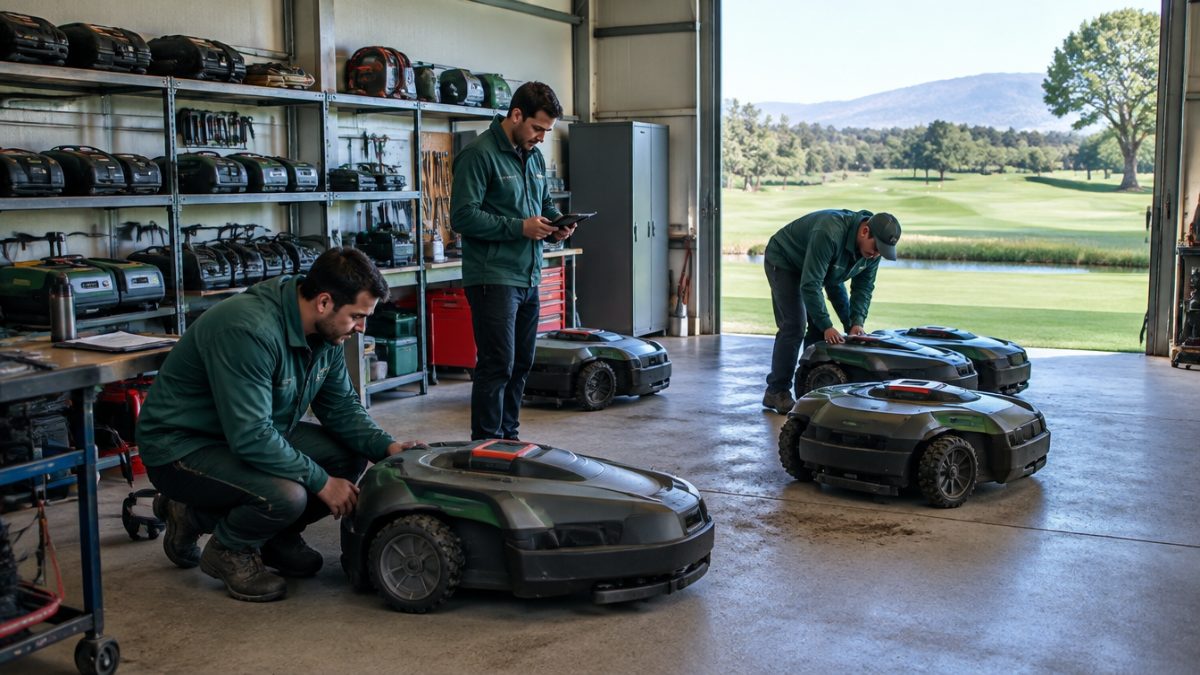
The most prudent approach is to run a pilot in a limited area for a season and compare costs and results with your current method. Robotic mowers in golf that are managed like any other machine, with a service record and preventive maintenance, perform far better than those treated as a toy. It also helps to make one named team member responsible for each unit, so nobody assumes someone else has checked it.
Further reading: GCSAA. The GCSAA provides useful information on technology and machinery for golf course maintenance.
Frequently asked questions
Can robotic mowers in golf mow greens?
Today their use is concentrated mainly on lower-demand surfaces such as rough, practice areas or banks. On greens, the finish, cutting height and consistency required are very high, so the prudent approach is to review each case with the manufacturer and test on limited areas before making any decision.
Do robotic mowers in golf reduce course staffing?
That is not their main purpose. Typically they free up hours from repetitive tasks to be spent on work that requires judgement, such as irrigation, treatments, detailing or supervision. The robot also needs monitoring, safety checks and maintenance, so team time is redistributed rather than eliminated.
How do you maintain a robotic mower so it lasts?
Like any machine in the fleet: regular cleaning, checking blades, battery condition and sensors, and logging incidents. Keep a service record for each unit and a preventive maintenance calendar. Following the manufacturer's guidance and training staff prevents most avoidable breakdowns.
Keep reading
- Preventive maintenance of machinery Preventive Equipment Maintenance: 7 Key Tasks
- Electric golf machinery Electric Golf Course Machinery: 5 Advantages and Limits
- How to renew your machinery fleet Replacing the machinery fleet: 6 key decision factors