
Electric golf course machinery has gone from a curiosity to a serious option in many workshops. Greens mowers, utility vehicles, work carts and small hand-held machines already run on batteries and promise less noise, fewer emissions and less mechanical maintenance. But it is not all advantages: range, recharging and the initial investment call for careful thought.
If you are considering adding electric golf course machinery to your fleet, these five advantages and their corresponding limits will help you decide sensibly, without rushed enthusiasm or reflex rejection. We talk about criteria, not brands.
Advantage 1: Less Noise with Electric Golf Course Machinery
Silence is probably the most immediate advantage of electric golf course machinery. Early mowing no longer wakes neighbours in nearby housing developments and no longer disturbs the first players out in the morning. On courses integrated into residential areas, this can be decisive for maintaining a good relationship with the surroundings.
- It allows work hours to be brought forward or staggered without conflict.
- It improves communication within the crew, who can talk without shouting.
- It reduces the operator’s hearing fatigue throughout the day.
The limit: the silence of electric golf course machinery demands extra attention to safety. An operator or a player may not hear a machine approaching, so signage and protocols should be reinforced.
Advantage 2: Lower Emissions and Environmental Footprint
An electric machine emits no exhaust gases at the point of use, and that improves the working environment in enclosed areas such as workshops and storerooms. It also eliminates the risk of fuel and oil drips onto the turf, a frequent problem with combustion-engine equipment.
To assess the real impact, it pays to look at the whole picture:
- The source of the electricity that charges the batteries: if it comes from renewable sources, the benefit grows.
- The battery life cycle, its recycling and its management at end of life.
- The reduction in fuel consumption and in oil and filter waste.
The limit: the environmental advantage is not automatic. It depends on how the energy is generated and how the batteries are managed when they lose capacity.
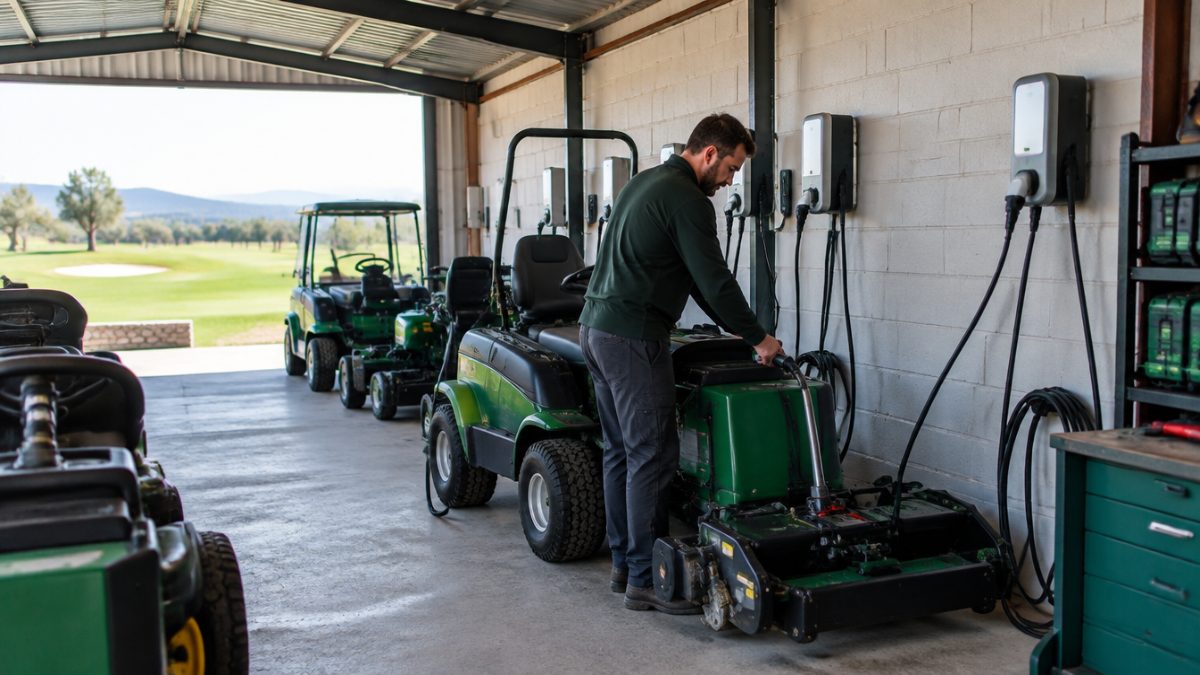
Advantage 3: Less Mechanical Maintenance, Different Care
An electric motor, the basis of electric golf course machinery, has fewer moving parts than a combustion engine. Oil changes, fuel filters, spark plugs and drive belts disappear, and typical starting faults are reduced. The result can be a workshop with less intervention time per machine.
- The preventive maintenance schedule for the drive side is simplified.
- Stoppages due to unexpected mechanical breakdowns are reduced.
- Hydraulics and cutting cylinders still need the same care as always.
The limit: new care requirements appear, such as checking batteries, connectors, chargers and electronic systems. The mechanic needs training, work must follow proper electrical safety measures and it must be defined who intervenes on each type of fault. It does not replace sharpening or adjusting the cylinders, which remains key to a good cut.
Advantage 4: Consistent Cut with Electric Golf Course Machinery
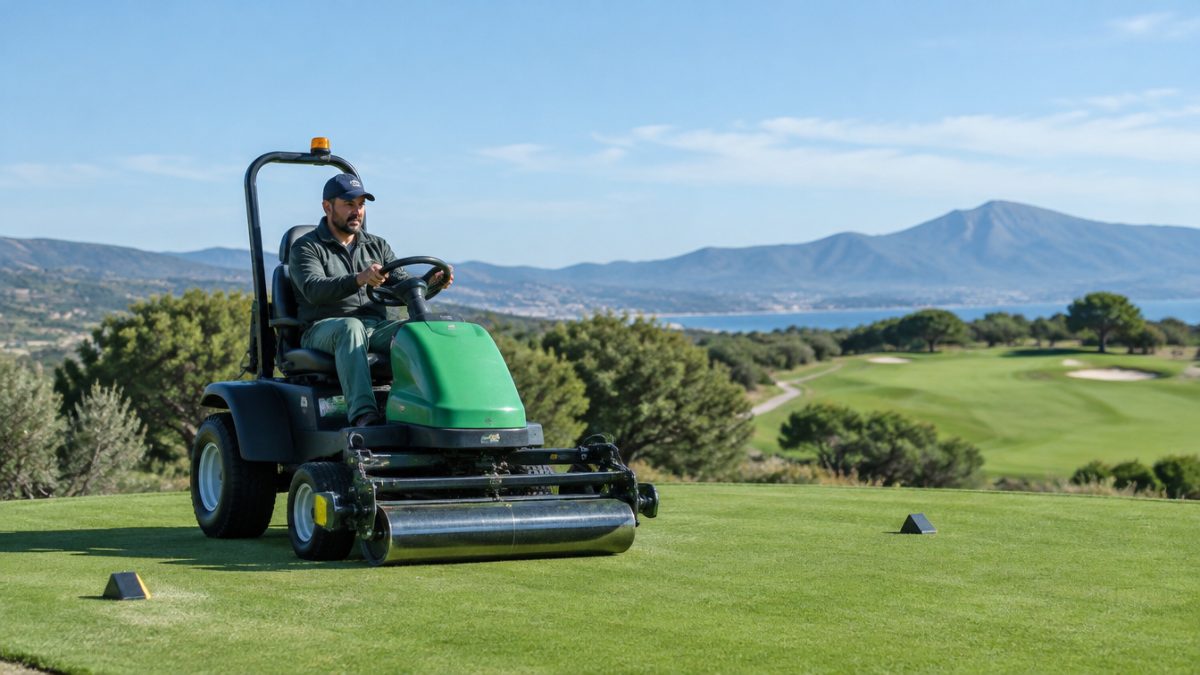
Many electric machines offer very stable torque and fine control of rotation speed, which translates into a regular cut and a constant clip frequency, even with load variations. On greens and tee boxes, that stability can be seen in the uniformity of the finish.
- Less vibration transmitted to the operator and the turf.
- No hydraulic leaks on machines that replace the circuit with electric motors.
- Possibility of adjusting the machine’s behaviour easily.
The limit: cut quality also depends on sharpness, adjustment and the condition of the turf. A poorly adjusted electric machine cuts as badly as a petrol one. It pays to test it on your own greens, with your turf and your operations, before deciding.
Advantage 5: More Predictable Operating Costs
Electricity is usually cheaper per hour of work than fuel, and the operating cost is easier to forecast. With good charging planning, you can even take advantage of energy at off-peak prices or connect to the club’s own solar installation.
- Lower spending on fuel and lubricants.
- Less wear on frequently replaced items.
- Ability to calculate the cost per machine hour more precisely.
The limit: the initial investment is usually higher, the electrical installation has to be adapted and charging points planned, and battery range shapes the working day. If the batteries do not cover a full shift, spares or mid-shift charging are needed, and that affects how the crew is organised.
Before deciding, compare the total cost of ownership over several years, not just the purchase price. And start with machines that have short runs and defined shifts, such as those for greens and tee boxes, before electrifying the ones that work hardest.
How to Trial Electric Golf Course Machinery Without Risk
The best way to decide is a controlled trial. Ask for a demonstration on your course, over several days and in real conditions: with dew, with slopes, with a full shift and with the usual operator. A one-hour visit says nothing about range or behaviour on a demanding day.
- Choose a frequently used machine with a predictable route.
- Note working hours, battery consumption and recharge times.
- Ask the operator and the mechanic: they spot details that do not appear on a spec sheet.
- Compare the result with the equivalent combustion machine.
With that data you will be able to justify an investment in electric golf course machinery to management and plan the transition gradually, machine by machine, without stopping operations or taking unnecessary risks.
Further reading: GCSAA. The superintendents' association GCSAA publishes resources on sustainable management and course operations that serve as a reference for assessing new maintenance technologies.
Frequently asked questions
Is electric golf course machinery worth it?
It depends on the course and the use. It is especially interesting where noise is a problem, where the goal is to reduce emissions or where shifts are short and predictable. It pays to compare total cost over several years, test the machine on your turf and assess the charging infrastructure needed.
What range does electric golf course machinery have?
It varies with the model, the battery, the terrain and the type of work. What matters is to check that it covers your real working day, with a safety margin. If it falls short, you will need to plan spare batteries or mid-shift charging, and organise the crew's shifts around that constraint.
What care does an electric machine need?
Besides sharpening and adjusting the cylinders, which remain just as important, you need to check batteries, connectors, chargers and electronic components, and follow the manufacturer's instructions. It is advisable to train the mechanic and record interventions in each machine's service history.
Keep reading
- When to renew the machinery fleet Replacing the machinery fleet: 6 key decision factors
- Preventive maintenance of machinery Preventive Equipment Maintenance: 7 Key Tasks
- How to measure the carbon footprint of golf Carbon Footprint in Golf: 6 Steps to Measure It