
Talking about IoT sensors in golf sounds like big-resort technology, but the reality is simpler: these are devices that measure something on the course, such as moisture, temperature or consumption, and send it to a platform so you can check it without going out to look. The question is not whether the technology works, but in which cases the return justifies the investment and the work of maintaining it.
We review five use cases where sensors usually add value, which mistakes recur in rollouts and how to prepare the team so that the data turns into decisions and not one more screen nobody consults.
Before Buying IoT Sensors in Golf: The Decision You Want to Improve
The most frequent mistake is to start with the device. The sensible thing is to start with the decision: when should this green be irrigated? Can an irrigation pass on the fairways be delayed? Which machine should be serviced before it fails? If there is no clear decision behind it, the data piles up uselessly.
Before adding IoT sensors in golf, write down three or four questions you currently answer by eye or with a lot of effort, and consider whether continuous measurement would improve them. That list will also help you compare suppliers on a common basis and explain to management what you expect to get, without promises of savings that are hard to prove.
A typical example: a course with greens that behave very differently from one another, where the team irrigates out of habit. There, IoT sensors in golf can provide an objective view of which green needs water and which does not, as long as the measurement is compared with what the greenkeeper sees and feels each morning.
Case 1: Soil Moisture to Fine-Tune Irrigation
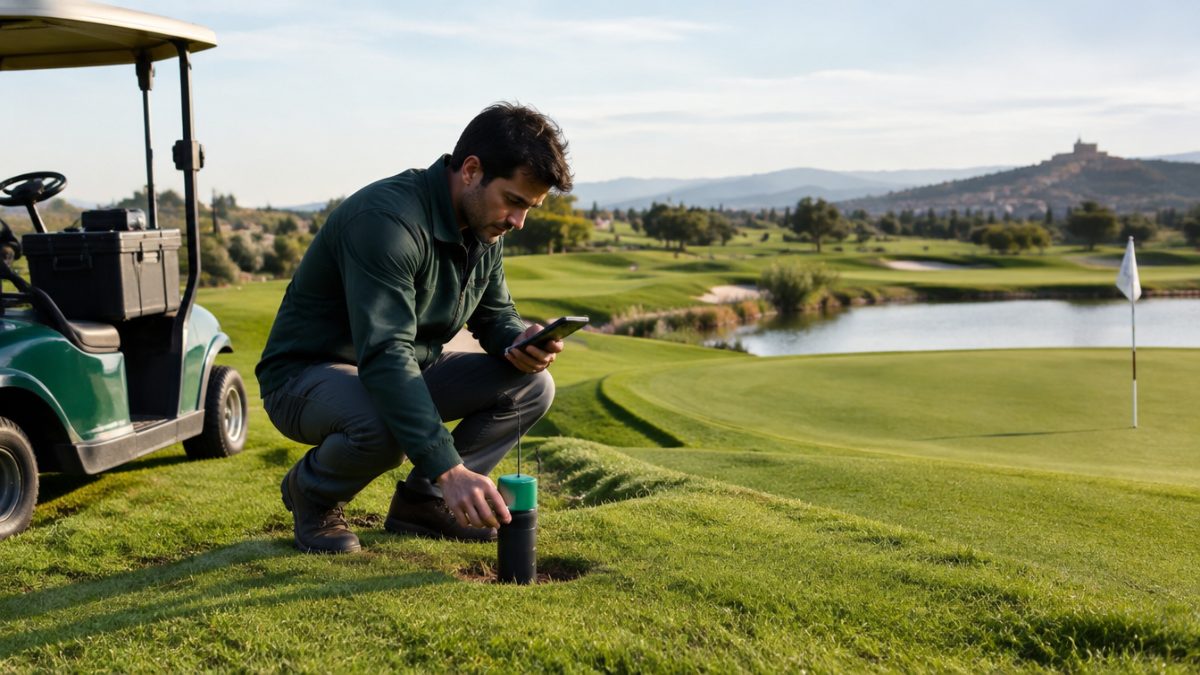
This is the best-known use. A probe in the soil profile shows how moisture changes through the day and between irrigations, something impossible to see from the surface alone. Well interpreted, it helps decide on deeper, less frequent irrigation, or detect areas that dry out sooner.
Its value depends on how representative the point is: a sensor placed in the driest or wettest spot on the green skews every decision. It is best to place several points, cross-check with field observation and calibrate the reading to the soil type.
A good practice is to note the surface feel next to each reading: firmness, colour, footprint marks. After a few weeks the team learns which sensor value corresponds to a comfortable green and which to one starting to suffer. That way, IoT sensors in golf stop being abstract numbers and become part of the team’s shared language.

Case 2: Local Weather and Application Conditions
Temperature, relative humidity, wind and rain measured on the course itself are more useful than data from a nearby town. With them you anticipate the risk of heat stress, schedule wind-sensitive operations and make better decisions on when to spray or not.
When readings are stored continuously, they also allow you to analyse past episodes: why an area was damaged in a heatwave, or what conditions preceded a disease outbreak. That history is often more valuable than the measurement of the moment.
This is also the simplest case to start with: a small weather station does not require touching the soil or the playing surfaces, and its data serves every department. For many courses it is the most logical entry point to IoT sensors in golf, because the return is seen soon and the risk of getting it wrong is low.
Case 3: Flow and Pressure to Monitor the Irrigation Network
Measuring flow and pressure at key points in the network lets you detect leaks, bursts or abnormal consumption that would otherwise go unseen for weeks. On large courses, a small but constant loss can add up to a considerable volume of water over the season.
To get the most from it, define in advance what a normal value is in each zone and what deviation requires a check. Without that threshold, the sensor merely records and nobody reacts.
It is also worth deciding who receives the alert and what they do on receiving it. A pressure anomaly at three in the morning is only useful if someone knows whom to notify, which zone to isolate and how to log the incident. IoT sensors in golf pay for themselves when there is a procedure behind them.
Case 4: Machinery Condition and Usage-Based Maintenance
Hour meters, temperature and basic alerts help move from calendar-based maintenance to maintenance based on actual use. A mower that works many hours needs servicing sooner than one used little, even if both have spent the same time in the workshop.
The great ally of these sensors is a good preventive maintenance system: without a record of interventions, usage information does not turn into action. That is why, before adding technology, make sure the workshop already works with a service record for each machine. Technology amplifies the order that already exists, but it also amplifies disorder.
Case 5 and Implementation Keys: Connectivity, Maintenance and People
The fifth case for IoT sensors in golf is soil conditions in critical areas, such as green temperature during cold snaps or heatwaves. For this one and the previous ones, there are several keys that recur in projects that work:
- Start small: one zone, one question, one quarter of trial.
- Ensure connectivity on the course before installing, because a sensor with no signal is a useless object.
- Plan maintenance of the devices themselves: batteries, cleaning, calibration and replacement.
- Train the team to interpret the readings and make decisions, not just to look at them.
In short, IoT sensors in golf perform when they are built into the daily routine and not when they are installed as an isolated project.
Further reading: USGA. The USGA publishes technical material on water and turf management that serves as a reference for interpreting field measurements.
Frequently asked questions
Which IoT sensors in golf should I try first?
Usually soil moisture and local weather sensors, because they answer daily irrigation and planning decisions and are easy to cross-check with field observation. Start with a limited zone, define what you want to improve and evaluate the results over a sufficient period before extending the installation.
Do IoT sensors in golf replace the greenkeeper's observation?
No. They provide continuous, objective data, but the judgement of someone who knows the course remains essential for interpreting it. A moisture value, for example, needs context: soil type, turf condition and the weather forecast. The combination of measurement and experience is what really improves irrigation and management decisions.
How do I know whether investing in IoT sensors in golf pays off?
Before installing, define which decision you want to improve and how you will measure the change, for example fewer unnecessary irrigations, leaks detected sooner or better-scheduled maintenance. If you cannot describe that outcome, it is better to postpone the purchase. Avoid comparing with generic figures from other courses, because every installation is different.
Keep reading
- soil moisture sensors in practice Soil Moisture Sensors: 6 Key Uses in Golf
- setting up a weather station on the course Weather Station on a Golf Course: 6 Data Points That Save Water
- NDVI in turf to monitor vigour NDVI for Turf: 5 Uses to Detect Stress