

The forecast for a nearby town rarely matches what happens in the hollow on the 14th hole or next to the sea. A golf course weather station measures the climate right where the turf is and lets you irrigate according to real demand, not habit or gut feeling.
In this article we review six data points a good station provides that directly affect water use, where and how to position it, what maintenance it needs and how to build its readings into the irrigation team’s daily routine.
Why Install a Weather Station on a Golf Course
Irrigation is one of a course’s biggest costs and responsibilities, and it depends on a variable that changes every day: the weather. Without your own data, decisions are made by looking out of the window or from a general forecast that misses local nuances.
A golf course weather station lets you:
- Adjust irrigation to the course’s actual evapotranspiration.
- Justify decisions with data to management or the authorities.
- Anticipate conditions that put the turf at risk of disease or stress.
- Choose the best moment for weather-sensitive operations.
Above all, it builds a history of your own that improves every season with the team’s experience. A club that invests in a golf course weather station usually recovers the cost through tighter irrigation and better-founded decisions, especially where water is expensive or limited by concession.
Data Point 1: Temperature and Relative Humidity
These are the basic variables and the ones consulted most. Temperature sets the pace of turf growth, water needs and the risk of heat or cold stress. Relative humidity helps you understand how water evaporates and anticipate disease development.
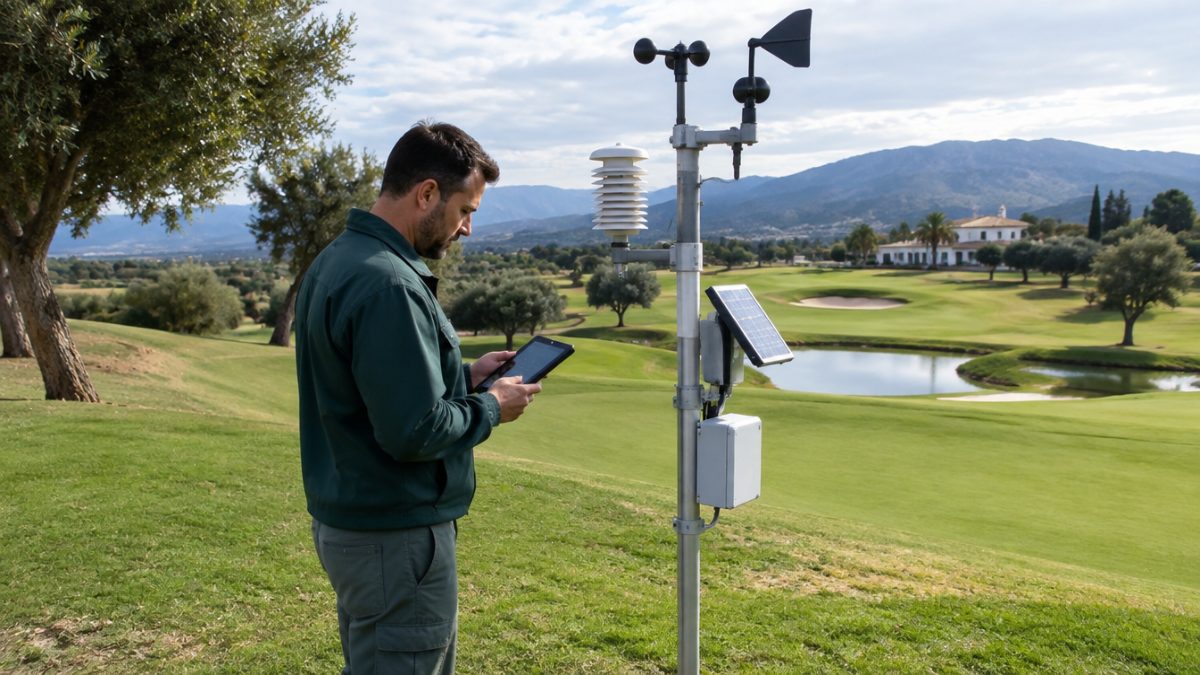
It pays to track not just spot values but also highs, lows and the length of periods of high humidity. Those prolonged periods are the best warning to step up monitoring on sensitive greens. With a well-configured golf course weather station you can also set internal alerts, for example when humidity stays high for several nights in a row, and warn the team before the first symptoms appear.
Data Point 2: Actual Rainfall in Each Area
Measuring rain on the course itself avoids irrigating when it is not needed, or skipping irrigation when the rain gauge in the nearest town said otherwise. Storms are local, and the difference between two points a few kilometres apart can be considerable.
- Record daily rainfall and intensity, because a downpour is not the same as a drizzle.
- Assess whether the water infiltrates or is lost as runoff.
- Cross-check against actual soil moisture before cutting back irrigation.
The rain that counts for the turf is the rain that penetrates the profile, and that depends on the soil and intensity, not just the millimetres logged by the golf course weather station. That is why it is worth confirming the figure with a field check before trimming irrigation cycles.
Data Point 3: Wind, the Most Underrated Factor
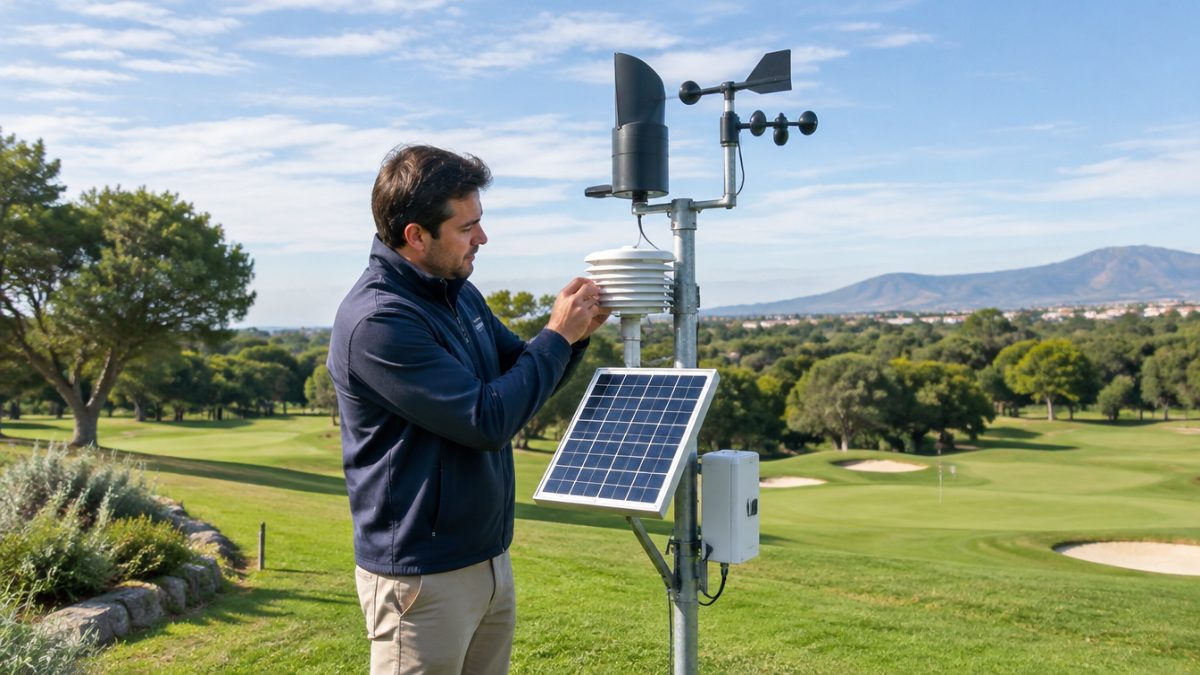
Wind speeds up evaporation, distorts sprinkler distribution and complicates treatments. A golf course weather station that records speed and direction helps you decide when to irrigate so that water lands where it should and is not lost to drift.
It is especially valuable on coastal or exposed courses, where a windy day can dry out a green in a few hours. With wind data it is easier to schedule night or early-morning irrigation, avoid applications in unfavourable conditions and explain why one area suffers more than another.
Data Point 4: Solar Radiation, the Basis of Water Demand
Radiation is one of the heaviest factors in calculating evapotranspiration, the water that turf and soil lose in a day. Together with temperature, humidity and wind, it is used to estimate how much water needs replacing.
- Check the daily reference evapotranspiration calculated by the station.
- Apply the right crop coefficient for the species and season.
- Replace what the turf has used, adjusted for the uniformity of your irrigation system.
A golf course weather station with radiation sensing lets you move from calendar-based irrigation to demand-based irrigation, which is normally more efficient and better tuned to each season.
Data Point 5: Soil Temperature
Not every station measures it, but it is very useful. Soil temperature affects germination, root growth and the right timing for overseeding, fertilising and some other operations.
With a golf course weather station that records this, the greenkeeper can better decide when to start or finish an overseeding, when to resume spring fertilising or when to expect turf activity to slow in winter. These decisions used to rely on experience and can now be backed by an objective value, without giving up the greenkeeper’s judgement, which still decides how to read the data on each green.
Data Point 6: History and Trends from Your Own Course
The sixth data point is not a spot reading but the accumulation. Over the seasons, the station builds series that let you compare years, spot patterns and justify investment decisions. A reliable history helps answer very specific questions:
- How many days a year does the course face frost risk?
- When do irrigation needs really begin in spring?
- Do diseases cluster under certain conditions?
For this to work, the golf course weather station must be well sited: in open ground, representative of the course, away from buildings, trees or surfaces that distort readings. It also needs regular calibration and cleaning, because a dirty or misaligned sensor gives misleading data.
Further reading: AEMET. AEMET, Spain's State Meteorological Agency, offers climate and reference data to cross-check the readings of local stations.
Frequently asked questions
What should a golf course weather station measure at a minimum?
The basics are temperature, relative humidity, rainfall and wind. If it also includes solar radiation, it can estimate evapotranspiration, which is the basis for adjusting irrigation. Soil temperature is a very useful extra. What matters is not having the most sensors, but having reliable data that is used every day.
Where should a golf course weather station be placed?
In open ground, representative of the course and away from buildings, trees, asphalt or anything else that distorts readings. Follow the manufacturer's recommendations on heights and distances. If the course has very different microclimates, consider more than one measuring point to compare areas.
How do you maintain a station so its data stays reliable?
With periodic cleaning of the sensors and rain gauge, checks on batteries and connections, and calibration as the manufacturer indicates. Compare its readings from time to time with manual measurements or other reference sources. A log of inspections avoids doubt when a reading looks odd.
Keep reading
- Evapotranspiration: the basis of efficient irrigation Evapotranspiration in golf: 5 keys to watering just right
- Irrigation audits on golf courses Irrigation audit: 7 steps to detect water losses
- Soil moisture sensors Soil Moisture Sensors: 6 Key Uses in Golf