
Has all the rough really been mown this week? How many hours has the fairway mower actually worked? These are simple questions that, without data, get answered from memory. GPS on golf course machinery provides objective information on where and how much the machines work, and it can change the way you manage the workshop and the course tasks.
It is not a magic wand and it does not replace the head greenkeeper’s judgement, but used well it brings control, traceability and evidence. We review five practical uses, the precautions to take with your team and how to get started without complications.
GPS on golf course machinery: what it really delivers
In essence, a tracking system records the position of a machine over time. From that you get routes, working times, stops and speeds. Depending on the equipment chosen, you can add engine or implement usage data, but the core value lies in position and time.
It helps to distinguish two scenarios. The first is passive tracking, where the information is used to look back at what has been done. The second is operator or application assistance, with real-time guidance. The second requires more investment and training; the first is usually a good starting point for anyone who has never worked with machine data.
Before buying anything, define which question you want to answer. If the goal is to control hours, you do not need the same thing as if you are after precision guidance. Many courses buy more features than they use and end up with underused GPS on golf course machinery, with nobody reviewing its reports. Choosing a solution that matches your needs and your team’s ability to interpret the data avoids that frustration.
Use 1: verify coverage and work routes
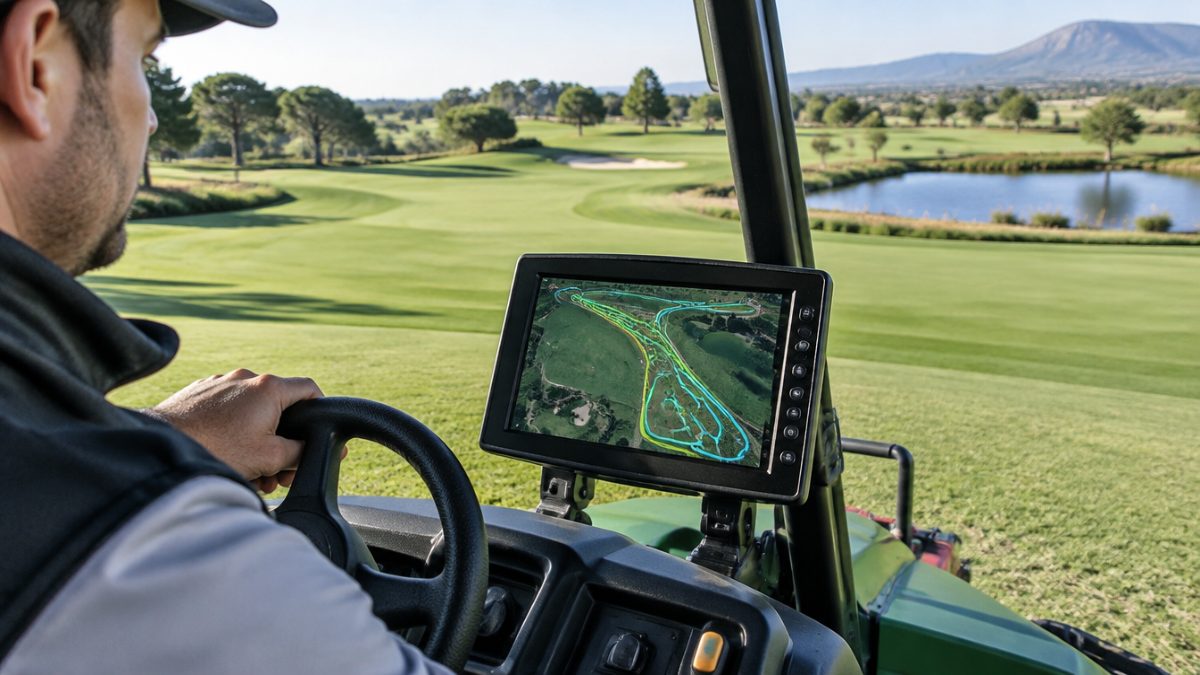
The most immediate use of GPS on golf course machinery is to check that a task has been completed across the whole planned area. Seeing the path of a mower or tractor on the course map lets you spot forgotten areas and unnecessary repetition.
- Confirm that every fairway, rough or tee box has received the scheduled task.
- Detect inefficient routes, excessive turning or unproductive travel between sectors.
- Help train new operators by showing the routes that work best.
A course example: a distant area of rough that, according to the work orders, was mown every week but was barely driven over every three. The record exposes it without arguments.
Use 2: control machine hours and preventive maintenance
Preventive maintenance is based on real hours of use, not estimates. When GPS on golf course machinery records working time, it is easier to schedule oil changes, filters, sharpening and inspections at the right moment.
- Distinguish between engine-on time and effective working time.
- Calculate the utilisation of each machine and detect those that are underused or overloaded.
- Provide objective data to decide when to replace a machine or get more value from it.
This information is very useful in conversations with management about fleet investment, because it replaces the feeling that a machine is always broken with concrete usage figures.
Use 3: avoid overlaps and improve application
In fertiliser, seeding or plant protection applications, overlaps and gaps cause poor uniformity and unnecessary spending. Guidance through GPS on golf course machinery helps keep passes parallel and reduces these errors, especially in large areas with few visual references.
- Repeating the pattern on different dates helps make the task repeatable.
- Makes applications more even and reduces variation between operators.
- Forces you to keep machines calibrated: GPS guides, but it does not fix a worn nozzle.
For plant protection products, any use must follow the label, current regulations and the advice of an authorised technician, regardless of the supporting technology.
Use 4: strengthen security and fleet protection
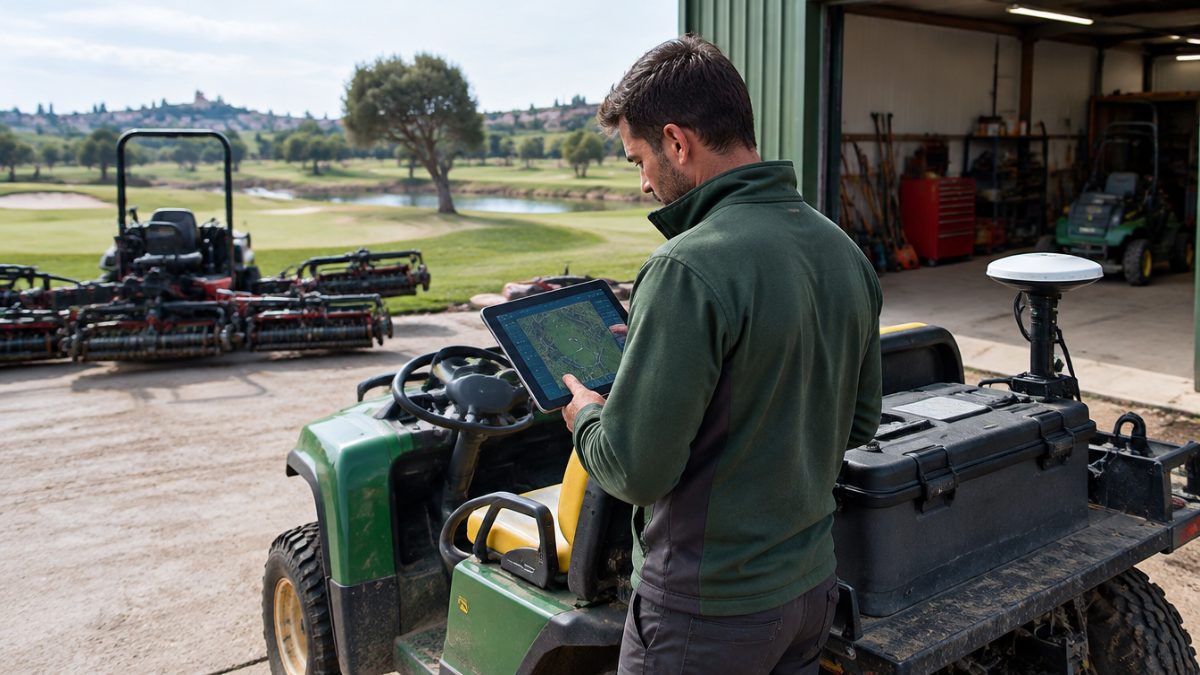
GPS on golf course machinery lets you know where each machine is outside working hours and can help locate equipment in case of theft. You can also define exclusion zones, such as greens or sensitive areas, and get alerts if a vehicle enters them.
- Control of use outside working hours or outside club premises.
- Tracking of support vehicles and machines shared between courses.
- Data on speeds and risky behaviour to reinforce safety training.
This function is useful, but it must be handled with care: tracking machines can affect the people who operate them. Explaining that GPS on golf course machinery protects both the club and the operator, for example in the event of theft or an accident, helps it be seen as a safety tool and not a means of surveillance.
Use 5: cross-reference the data with costs and work orders
Position data becomes more valuable when it is compared with work orders, staff hours and costs. That way you can calculate how much it costs to mow a fairway, a rough or a tee box, and compare with the usual times of each operator or machine.
- Compare planned theoretical time with actual time.
- Identify tasks that take more hours than expected.
- Prepare simple reports for the green committee with verifiable data.
Before rolling it out, explain the reason to the team, make clear which data is collected, comply with the applicable data protection and labour regulations and start with a pilot on one or two machines. After a few months, review with the team which reports have actually been used, which data was surplus and what decisions GPS on golf course machinery has made possible. That honest evaluation determines whether it is worth extending to the rest of the fleet.
Further reading: STRI. Leading turfgrass research organisations, such as STRI, publish general information on technology and maintenance management on golf courses.
Frequently asked questions
Is GPS on golf course machinery worth it on a small course?
It depends on the goals. On a small course the main benefit is usually controlling hours of use and protecting the fleet, rather than optimising routes. It is best to start with a trial on the machines that work the most and then assess whether the data obtained justifies extending the installation to the rest of the fleet.
Do I need to inform staff about GPS on golf course machinery?
Yes. The right approach is to be transparent about what data is collected, what it is used for and who has access, complying with the applicable labour and data protection regulations. Presenting the tool as support for planning and not as surveillance makes it easier for the team to accept and improves the quality of the information obtained.
Does GPS replace the work order?
No. GPS on golf course machinery shows where and for how long a machine has worked, but on its own it does not capture the specific task, the cutting height, incidents or the operator's judgement. Location data complements work orders and lets you cross-check them, but does not replace them.
Keep reading
- Drones on golf courses: uses and limits Drones on golf courses: 6 valuable applications
- Preventive maintenance of golf course machinery Preventive Equipment Maintenance: 7 Key Tasks
- GIS maps of golf courses GIS Maps for Golf Courses: 6 Maintenance Uses