
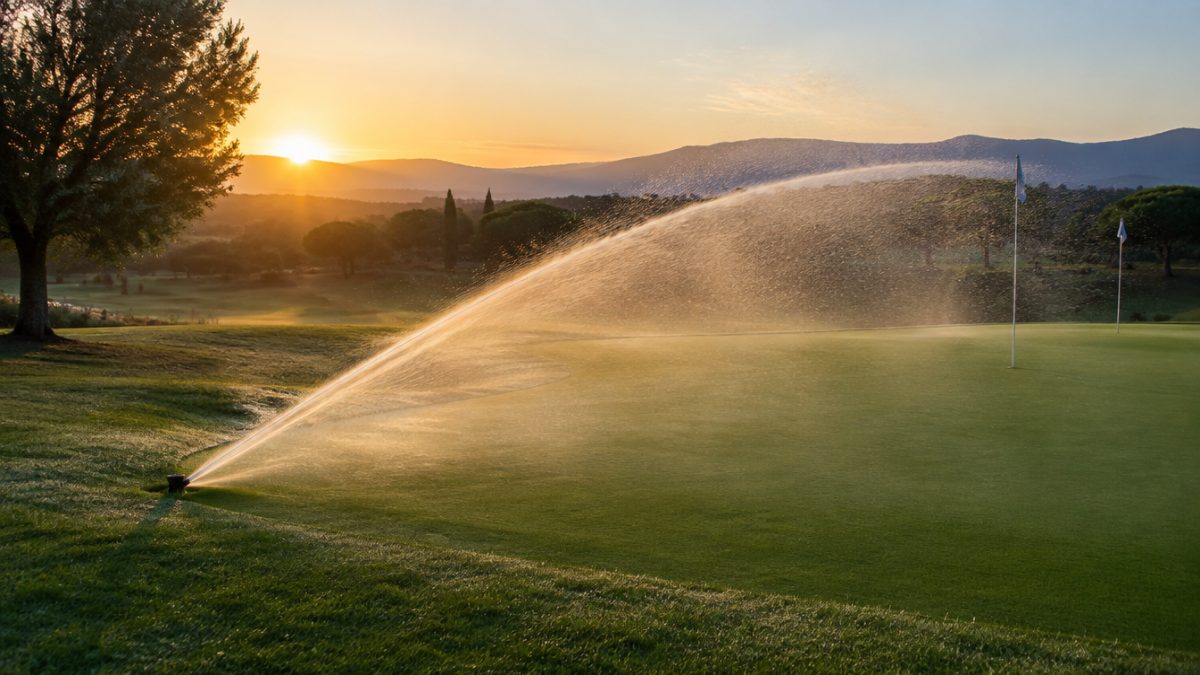
Watering out of habit, by the calendar or because “it has always been done this way” is the most common way to waste water. Evapotranspiration offers an alternative: measure, or at least estimate, how much water the turf loses through soil evaporation and plant transpiration, and replace exactly that amount.
In this article you will see what evapotranspiration really means on a golf course, five keys to apply it without complications and how to record your decisions so that irrigation becomes a practice you can explain and improve season after season.
Understand what reference evapotranspiration measures
Reference evapotranspiration, usually called ET0, expresses in millimetres per day the water demand of turf under standard conditions. It is calculated from weather variables: temperature, radiation, air humidity and wind. The more heat, sun, dryness and wind, the greater the demand.
That figure is not exactly what your course needs, but the starting point. Two courses with the same ET0 may irrigate differently according to their species, soil and quality demands. That is why evapotranspiration is then corrected with a coefficient and by direct observation of the ground.
Key 1: get reliable weather data
Without good data, any evapotranspiration calculation is fiction. You have several routes, which can be combined:
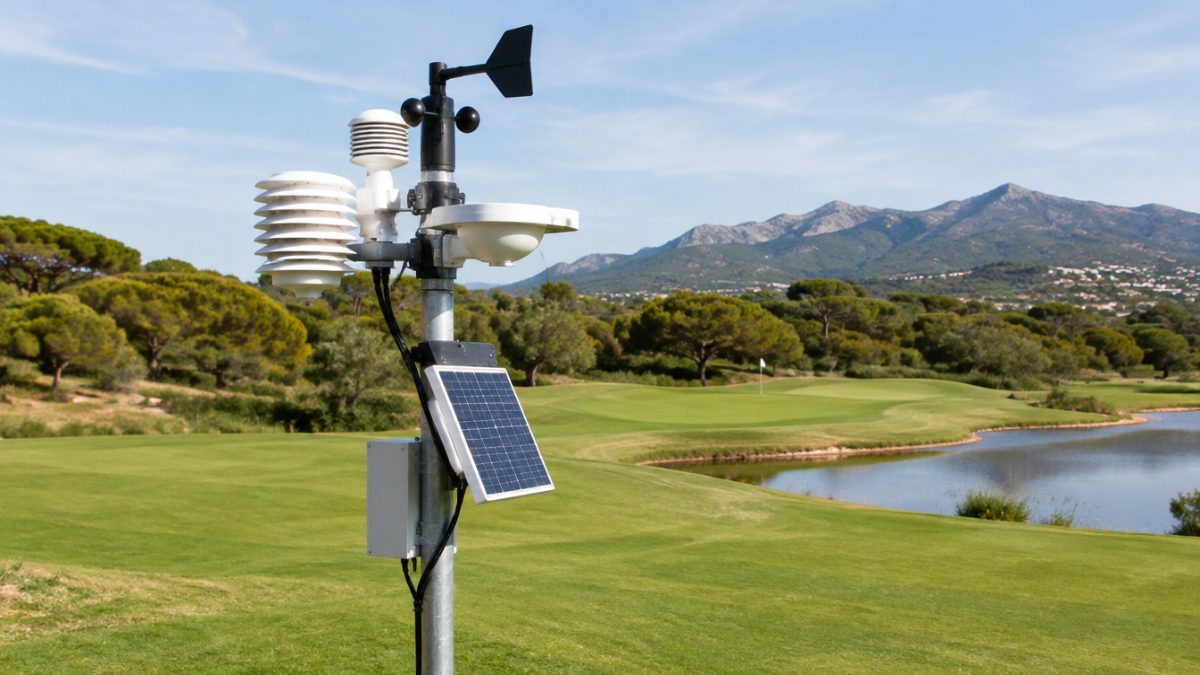
- Your own weather station on the course, well sited and with regular sensor maintenance.
- Nearby public stations, such as those run by the agricultural and meteorological agencies of the autonomous region.
- Cross-checking between the two to detect drifting sensors.
If you use your own station, make sure it is not next to a building, a shaded area or a sprinkler that wets it. A badly placed rain gauge and wind sensor distort everything else.
Also check cleanliness and calibration at least at the start of the irrigation season. Cobwebs, dust and deposited lime alter readings very easily, and the error accumulates day after day without anyone noticing until the turf shows it.
Key 2: apply the crop coefficient for each species
Turf does not consume the same amount depending on its species. Warm-season species, such as bermudagrass, kikuyu or paspalum, usually require proportionally less water than cool-season species such as ryegrass or bentgrass in summer, although it depends on the variety and the cutting height. That factor is called the crop coefficient.
Crop evapotranspiration results from multiplying the reference value by that coefficient. In practice, it pays to start from indicative values in the literature and adjust them with your own experience, noting when the turf shows symptoms of too little or too much water. Over time you will obtain your own coefficients per area, far more useful than generic ones.
Key 3: distinguish greens, fairways and rough
Applying a single figure to the whole course is a frequent mistake. Evapotranspiration must be translated differently by area:
- Greens: sandy profile, shallower roots and high quality demands. They usually require more frequent, lower-volume irrigation, supported by hand watering at dry spots.
- Fairways: deeper roots and more margin. They allow more widely spaced, deeper irrigation.
- Rough and low-demand areas: candidates for controlled deficit irrigation, accepting some loss of colour.
This distinction by area is where the greatest savings come from without penalising playability.
A typical example: on a west-facing fairway, with slopes and a lot of afternoon sun, the turf dries out sooner than on the neighbouring one in a hollow. Splitting irrigation into sectors with different programmes, even if it takes a little more planning, avoids watering the hollow to save the slope.
Key 4: subtract rainfall and measure irrigation uniformity
Evapotranspiration tells you how much water is lost, but not how much arrives. Two factors correct the balance:
- Effective rainfall: not all precipitation benefits the turf. Very light rain evaporates and very intense rain runs off. Measure with the course’s own rain gauges and subtract cautiously.
- Application uniformity: if the sprinklers apply unevenly, there will be dry areas and waterlogged areas even if the overall calculation is correct.
That is why evapotranspiration works best alongside a periodic audit of the installation. There is no use calculating precisely if worn nozzles or uneven pressures distribute the water badly.
Key 5: check the calculation against the soil and the plant
The model guides, but the ground rules. Complement evapotranspiration with simple observations that any crew can make daily:
- Check moisture at root depth with a soil corer or a probe.
- Look for signs of stress: a bluish tint, footprints that are slow to recover, heat marks in exposed areas.
- Watch for waterlogging or algae growth in areas with excess water.
When the calculation and the observation disagree, investigate the cause rather than forcing one of the two. It often reveals a breakdown, compacted soil or a sector with a badly programmed system.
Record, review and improve each season
Evapotranspiration generates value when it becomes a documented habit. Note by area the irrigation applied, the evapotranspiration for the period, the rainfall and the condition of the turf. At the end of each month compare three things: how much water was applied against the calculated demand, which areas deviated and which decisions explain it.
With two or three seasons of data you will be able to justify the course’s consumption to management, detect waste and defend investments, for example in replacing sprinklers or adjusting scheduling. Water is one of the biggest costs and one of golf’s biggest social concerns; being able to explain it with numbers is a reputational advantage.
Further reading: AEMET. To consult official weather data for your area you can go to Spain's State Meteorological Agency.
Frequently asked questions
What is evapotranspiration on a golf course?
It is the amount of water the turf loses through evaporation from the soil and transpiration through the leaves. It is expressed in millimetres per day and depends on temperature, radiation, humidity and wind. Knowing it lets you give the turf back approximately the amount it needs, avoiding excessive or insufficient irrigation.
Do I need my own weather station to use evapotranspiration?
It is not essential. You can start with data from nearby public stations and cross-check it against rainfall measured on your course. A station of your own improves accuracy, as long as it is well sited and calibrated. What matters is that the data are consistent and that you record them regularly.
Can I irrigate solely by evapotranspiration without looking at the turf?
It is not advisable. Evapotranspiration is a model and does not capture breakdowns, compacted soils, shade or irrigation non-uniformity. It must be combined with daily observation of moisture and turf condition, and corrected when there are differences between what is calculated and what you see on the course.
Keep reading
- the importance of efficient irrigation on the course The importance of efficient irrigation in golf course care
- how to detect losses with an irrigation audit Irrigation audit: 7 steps to detect water losses
- complete guide to turf maintenance Complete guide to turf maintenance on golf courses