
Few things worry a greenkeeper like seeing a yellowish patch appear in the middle of an immaculate fairway. Chlorosis in turf is the loss of green colour through lack of chlorophyll, and it is a symptom, not a disease: behind it there may be a nutritional, soil, water or root problem, and each cause calls for a different response.
Acting on instinct when faced with chlorosis in turf is usually expensive: you over-fertilise, over-irrigate and the problem comes back. In this article we offer five keys to diagnose in an orderly way, correct the real cause and keep a record of what is done, so that next time the response is quicker.
Key 1: observe the pattern before touching anything
The first diagnostic clue is how the chlorosis in turf is distributed. A uniform yellowing across a whole fairway is not the same as isolated patches, stripes following the path of the machine or discolouration in the low spots where water collects.
- Uniform and widespread: usually points to a lack of nutrients or a general imbalance.
- In irregular patches: may indicate disease, local compaction or irrigation problems.
- In stripes or lines: suggests overlaps from the spreader, sprayer or irrigation.
- Linked to slopes or depressions: speaks of drainage and waterlogging.
Photograph the area, locate it on a plan and note the date. It seems a minor detail, but it will let you compare progress without relying on memory.
Key 2: tell chlorosis apart from simple passing stress
After a cold snap, very low mowing or a period of heavy rain, turf can lose colour without there being a real deficiency. Before rushing to correct, check whether the area recovers on its own in a few days under normal conditions.
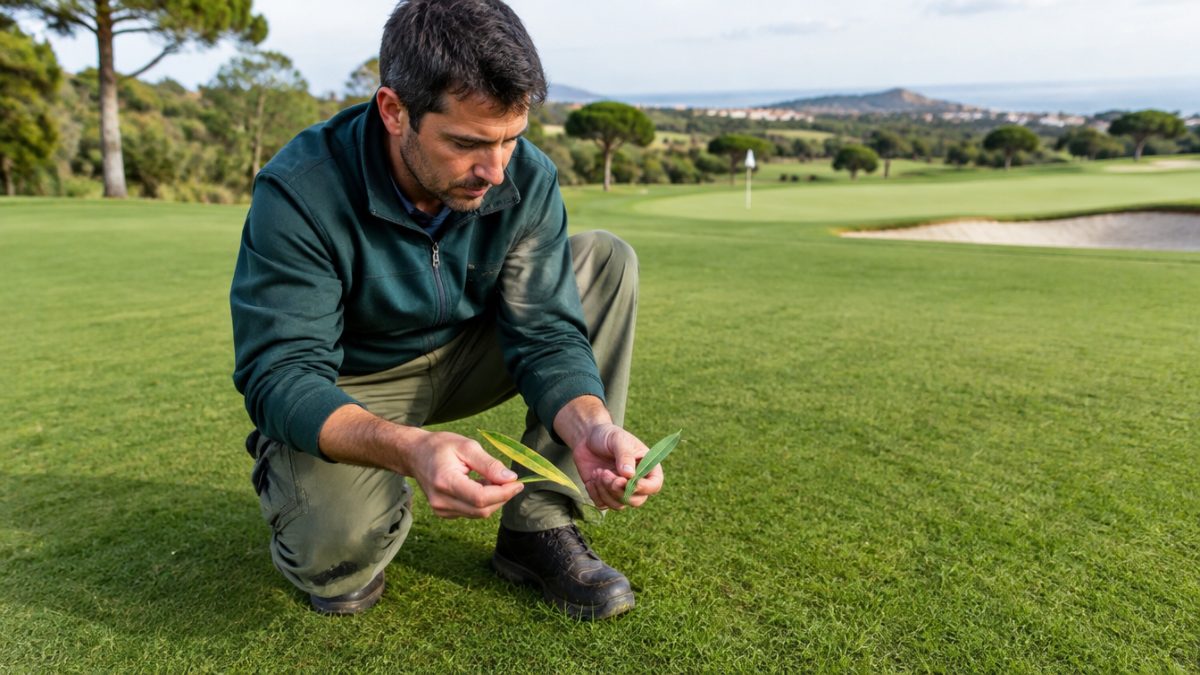
If the yellowing persists, look closely at the leaves: if colour is lost between the veins or in the young leaves, chlorosis in turf may be nutritional; if it shows in the old leaves, the picture is different. A visual examination does not replace an analysis, but it guides what sample to take and what to ask the technician.
- Review the latest operations: mowing, aeration, applications.
- Check temperature and moisture in the preceding days.
- Observe whether the colour change coincides with any specific action.
Key 3: check soil, water and roots when faced with chlorosis in turf
Many cases of chlorosis do not come from an absence of nutrients in the soil, but from the plant being unable to absorb them. An unfavourable pH, excess salts, a waterlogged soil or roots shortened by compaction block uptake even if the fertilisation is correct.
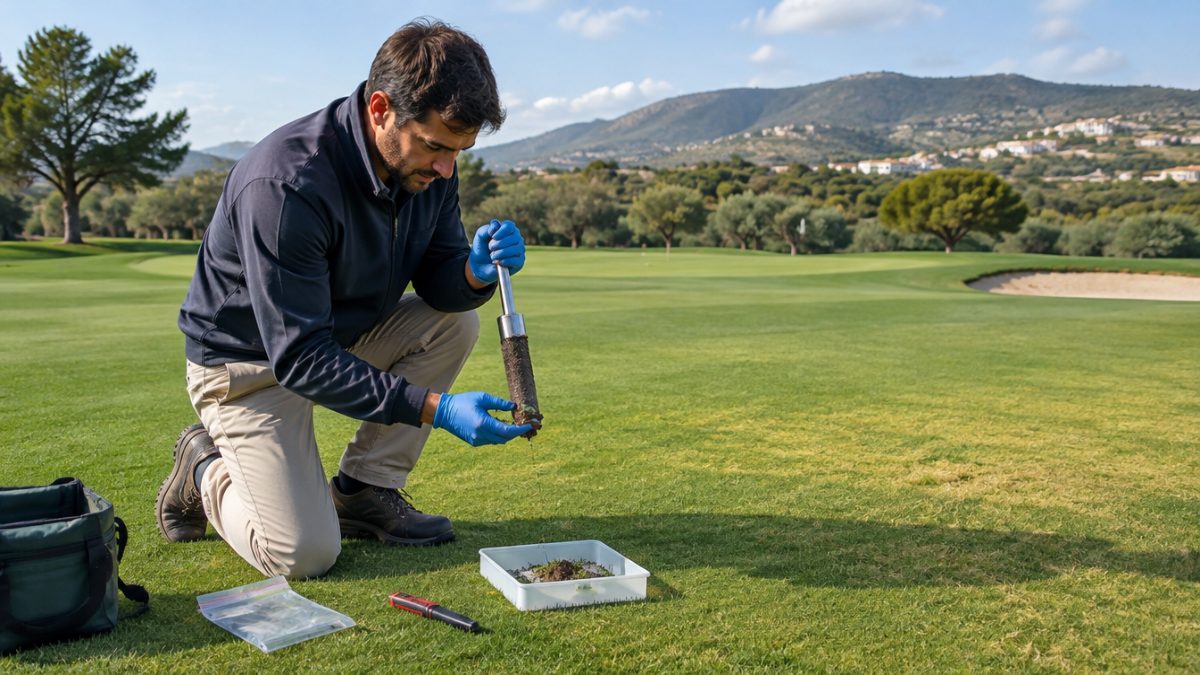
- Take a soil core and observe the depth and colour of the roots.
- Check drainage: does the area pond after irrigation?
- Review the quality of the irrigation water, especially if it contains salts or bicarbonates.
- Take samples for soil analysis when the pattern is not clear.
In a Mediterranean climate, the combination of hard water and calcareous soils favours iron chlorosis, especially in sensitive turf. Here a technician can tell you how to interpret the results.
Key 4: correct the cause, not just the colour
An application of nutrients brings the colour back in a few days, and that is precisely why it is so tempting. But if the chlorosis in turf is caused by waterlogging or compaction, fertiliser only masks the symptom for a while. Aeration and drainage first; nutrition afterwards.
When the cause is nutritional, the adjustment should be made within a coherent fertilisation plan, with products suited to the species, the season and current regulations, and under the advice of a licensed technician or adviser. If any pesticide treatment is considered, always follow the label and the applicable regulations.
- Fix the physical factor first: compaction, drainage, irrigation.
- Adjust nutrition with judgement and without exceeding the plan.
- Avoid abrupt corrections that cause excessive growth.
- Reassess after two or three weeks, photographing the same area.
Key 5: record and monitor the recurring areas
Chlorosis in turf rarely appears just once in the same place, and anyone who has suffered it on a particular hole knows it will be back if the source is not dealt with. There are holes, tee boxes or corners where it recurs every spring or every autumn, and recognising them is the best prevention tool. A history of problem areas lets you anticipate irrigation, aeration or fertilisation before the colour is lost.
Create a record per area with the date of appearance, the diagnosis, the actions taken and the result. With two seasons of data you will discover patterns that go unnoticed today: an irrigation line that always fails, a spot where water collects or a tee where compaction rises every summer.
- One file per problem area, with photos and dates.
- Monthly review of recurring areas.
- Sharing the findings with the irrigation and machinery managers.
When to ask for outside help with chlorosis in turf
There is no need to wait for the patch to grow. If chlorosis in turf does not respond to the first corrections, if it affects critical playing areas such as greens or if it appears in several areas at once, turn to a laboratory or a licensed adviser. The cost of an analysis is small compared with that of an emergency overseeding.
An outside diagnosis also serves to train the crew: anyone who sees how an analysis is interpreted learns to recognise the symptoms sooner the next time chlorosis in turf appears. Keep a small dossier ready with the photos, the plan and the history of recent operations. The better the starting information, the more precise the recommendation and the less time you will lose on trial and error.
Further reading: STRI. The STRI institute publishes research and technical guides on nutrition and the diagnosis of sports turf problems.
Frequently asked questions
Is chlorosis in turf always corrected by fertilising?
No. Chlorosis in turf can be due to compaction, waterlogging, unsuitable pH, excess salts or damaged roots, and in those cases fertiliser does not solve the underlying problem. Diagnose the cause first and, if it is nutritional, adjust the fertilisation plan with a technician.
How do I tell chlorosis from a disease?
Diseases usually leave patterns of patches with defined edges, lesions on the leaf or visible fungal growth under certain conditions, whereas chlorosis is a more diffuse loss of colour. If in doubt, take a sample and consult a licensed adviser before applying any treatment.
How long does turf with chlorosis take to recover?
It depends on the cause, the species and the season. Nutritional deficiencies usually respond within days or a few weeks, while soil, drainage or root problems take longer. Reassess with comparison photos every two or three weeks to know whether chlorosis in turf is improving.
Keep reading
- Turf fertilisation: basics and common mistakes Turf Fertilisation: 6 Guidelines by Season
- Soil analysis: what to measure and when Soil Testing on Golf Courses: 6 Parameters That Matter
- How to prepare a fertilisation plan Fertiliser Programme for Golf Courses: 5 Steps to Design One