
To the member, the course is a landscape. For the maintenance team it is a workplace with reel mowers, tractors, slopes, chemical products, dawn start times and, in summer, a lot of heat. That is why risk prevention in greenkeeping is not an administrative formality but an essential part of managing the team.
In this article we propose seven practical measures, designed for a head greenkeeper who wants to improve safety without excessive bureaucracy. You will see what to check, how to involve the staff and how to keep a record of what is done, something that protects both people and the club.
Measure 1 of risk prevention in greenkeeping: assess every job and every area
The foundation of any risk prevention plan in greenkeeping is knowing what can happen and where. Walk the course and the workshop with a different eye than usual and note what you see: steep banks, crossings with buggy paths, lake edges, power lines, areas with poor visibility.
Then link each job to its main risks. Someone operating a mower does not face the same hazards as someone preparing a product mix or raking bunkers. This assessment should be reviewed by the prevention service or competent technician responsible for the club, but it is greatly enriched by the opinions of those who work on the course every day. A one-hour joint walk with two or three team members often brings to light hazards that cannot be seen from the office.
Document the result in a short, reviewable format. Risk prevention in greenkeeping improves when the assessment is updated with every significant change: a new machine, construction work, a change to the layout or the arrival of inexperienced staff.
Measure 2: machinery with guards and clear procedures
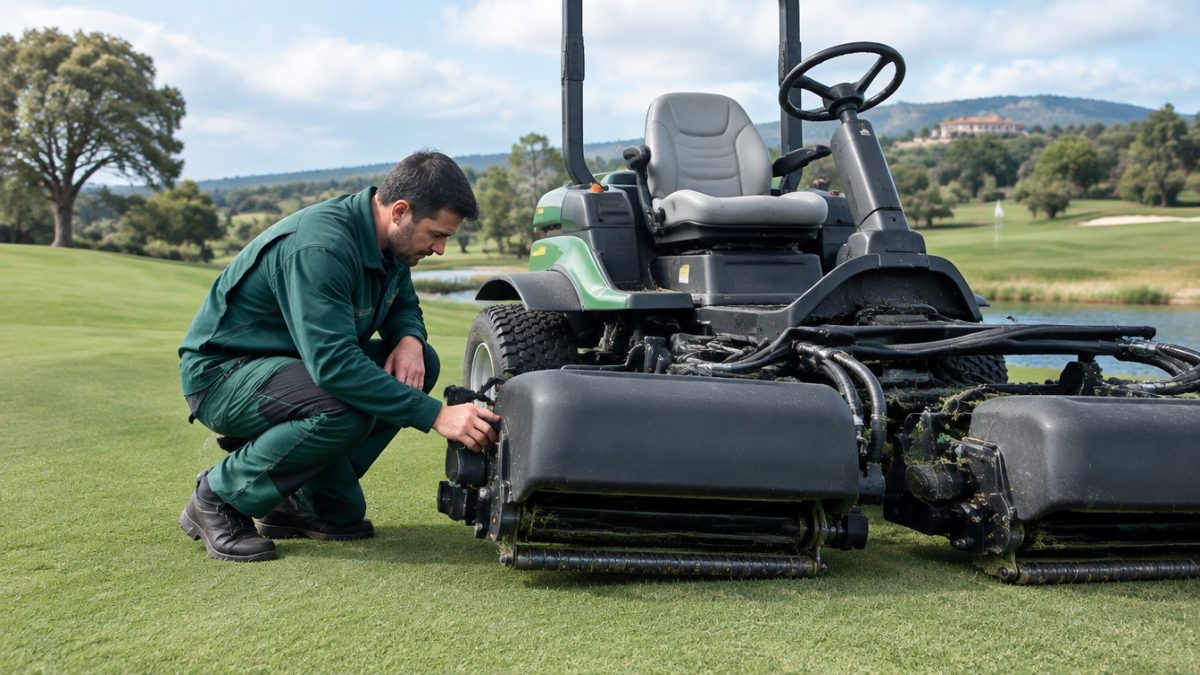
Machinery accounts for a good share of maintenance accidents. The most effective measures are simple, but they have to be sustained over time:
- Keep guards on blades, drive shafts and belts in place.
- Switch off the engine and remove the key before cleaning, clearing blockages or adjusting cutting units.
- Check brakes, steering and safety systems as part of preventive maintenance.
- Prohibit the use of machines by staff without specific training.
A well-maintained machine is also a safer machine. That is why inspections should be recorded by machine and date, not just in the mechanic’s memory. Risk prevention in greenkeeping starts in the workshop: that is where worn brakes, leaking hoses and guards that someone removed “for a moment” and never put back are found.
Measure 3: slopes, water and vehicle traffic
The terrain has its own hazards. On banks and lake margins, the risk of rollover or falls increases in wet conditions or with long grass. Define which machines may work on each slope and which areas are cut with walk-behind equipment or by hand, and review the routes when conditions change.
You must also consider traffic alongside players. The crossing of maintenance vehicles, buggies and golfers requires clear rules on priority and speed, signage where needed and communication between crews to avoid surprises. In risk prevention in greenkeeping, organising routes is one of the cheapest and most worthwhile measures.
Measure 4: safe handling of products and fuels
Plant protection products, fertilisers, fuels and oils require proper storage, visible labelling and accessible safety data sheets. Only staff with the training and accreditation required by current regulations should handle plant protection products, always following the product label and the advice of an authorised technician.
Within the risk prevention plan for greenkeeping, it is worth reviewing:
- The personal protective equipment available and its condition.
- The procedure for preparing, applying and cleaning the sprayer.
- Spill management and the location of containment material.
- Washing hands and clothing after working with products.
Measure 5: heat, hydration and working hours
In summer, long days in the sun are a real health risk. Moving the heaviest tasks to first thing in the morning, scheduling breaks in the shade, providing cool water to every crew and watching for the first symptoms of heatstroke are basic measures that are easily forgotten when the course is under pressure.
Also review clothing and sun protection, and define who can stop a task if conditions become dangerous. Good task planning, adjusted to the weather, reduces risk without sacrificing course condition. If the team sees that management backs these decisions, risk prevention in greenkeeping stops being seen as an obstacle and becomes part of the work culture.
Measure 6: lone working and communication
A lot of maintenance work is done alone and at dawn, with few people around. Set up a system to know where each person is and how to raise the alarm in case of an incident: radios, phones with verified coverage, patrol routes or check-in calls at the start and end of the shift.
This simple point makes the difference in the event of a fall, a cut or someone feeling unwell. Rehearsing the protocol once a year, with a simple drill that includes how to guide an ambulance to a specific point on the course, avoids doubt on the day it is needed. In risk prevention in greenkeeping, speed of alert is as important as preventing the accident.
Measure 7: training, records and continuous improvement
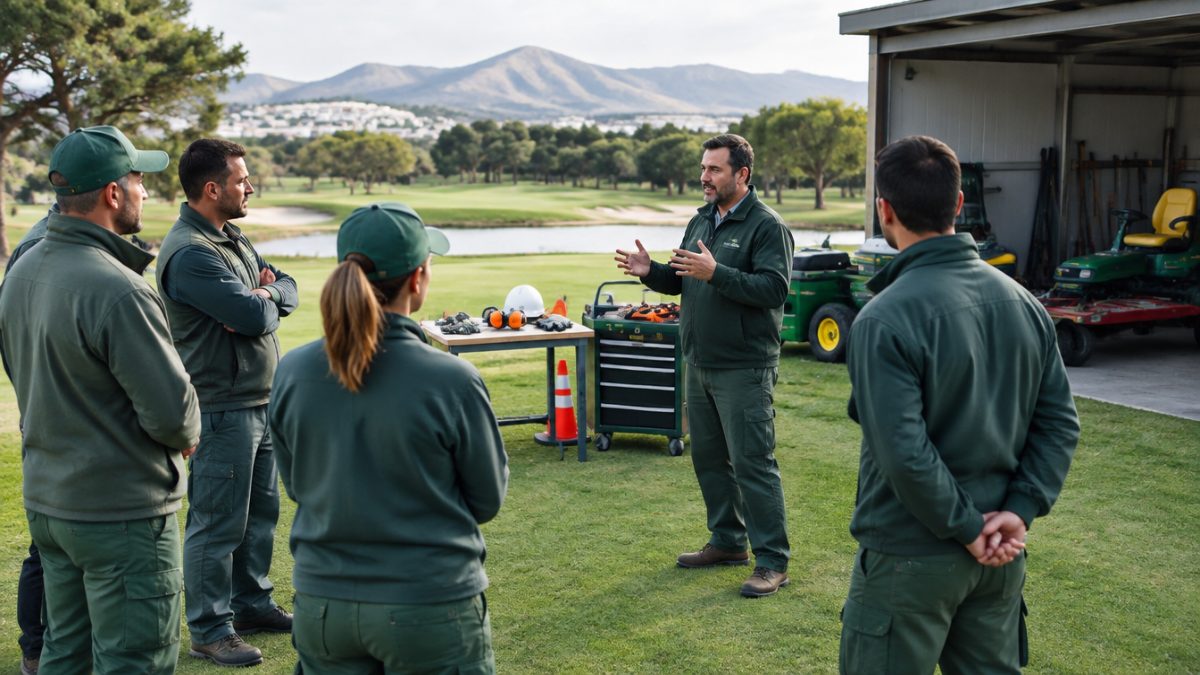
The last measure ties all the previous ones together. Train the team on the risks of their job, repeat the sessions when new staff join and whenever a different machine or procedure is introduced. Note who attended, when and on what topic.
Also record incidents and near misses, because they are the best source of learning. Review quarterly what keeps repeating and which measure addresses the cause. A risk prevention system in greenkeeping lives on that constant review, not on a document filed away.
Further reading: INSST (Spain's National Institute for Safety and Health at Work). To explore workplace safety criteria in more depth, the INSST offers reference guides and educational materials in Spain.
Frequently asked questions
Who is responsible for risk prevention in greenkeeping?
Responsibility lies with the club as employer, which must have the preventive organisation required by current regulations. The head greenkeeper plays a key role in applying the measures on the course, supervising procedures and reporting incidents. It is advisable to rely on a prevention service or competent technician for assessment and training.
What minimum training should the maintenance team receive?
As a minimum, general risks of the job, safe operation of the machinery each person uses, emergency procedures and basic first aid. Anyone working with plant protection products also needs the accreditation required by regulations. It is advisable to repeat training when new staff join and when machines or methods change.
How do I document risk prevention in greenkeeping without wasting time?
The most practical approach is to use short, repeatable formats: machine inspection checklists, training records, incident reports and product controls. If everything is always noted in the same place and in the same format, the documentation almost generates itself and becomes a useful tool for deciding on improvements.
Keep reading
- preventive maintenance of machinery Preventive Equipment Maintenance: 7 Key Tasks
- pesticide applicator licence Pesticide Applicator Licence: 5 Steps to Get It
- the greenkeeper's daily planning Daily greenkeeper planning: 6 effective steps