
Anyone who handles plant protection products on a golf course cannot do so on experience or confidence alone: they must prove their training. The pesticide applicator licence is the key to working safely and within the regulations, and also a guarantee for the club, for players and for the environment.
In this article we propose five steps to organise it in your team: identify who needs accreditation, choose the right level, prepare the training, control renewals and link the licence to a rigorous record of each application. For the exact details, always consult the regulations in force and the competent authority in your region (in Spain, the regional government, or comunidad autonoma).
Step 1: Decide who needs the pesticide applicator licence
The first common mistake is to think that only the head greenkeeper needs the pesticide applicator licence, when in fact everyone involved in the application must be accredited. Take an inventory of roles: who prepares the tank mix, who operates the application equipment, who supervises and who buys or stores the products. Each role may require a different accreditation, depending on what the regulations in force establish, and it is worth putting in writing which pesticide applicator licence corresponds to each position on the organisation chart.
To structure the analysis, answer these questions:
- Who physically carries out the applications on the course?
- Who mixes and loads the product into the machine?
- Who decides on the treatment and signs the record?
- Is there temporary staff or outside contractors who also apply?
If you work with a subcontracted company, ask them to prove their staff’s training. Shared responsibility means you must check that anyone walking your course with a sprayer is compliant.
Step 2: Choose the right level of training
The regulations distinguish different levels of qualification depending on the type of work and the hazard of the products handled. The aim is not to take the highest level by default, but the one that corresponds to each person’s real tasks, with the possibility of extending it in future.
As a rough guide, think in terms of three scenarios:
- Staff who help with basic handling tasks, who need initial training.
- Professional applicators who use the products routinely on the course.
- Managers and advisers, with planning, supervision or recommendation duties.
Before enrolling anyone in pesticide applicator licence training, check with the competent body in your region which level each role requires and which organisations are authorised to run the courses. Entry requirements and duration can vary, so assume nothing.
Step 3: Prepare the training so it works day to day
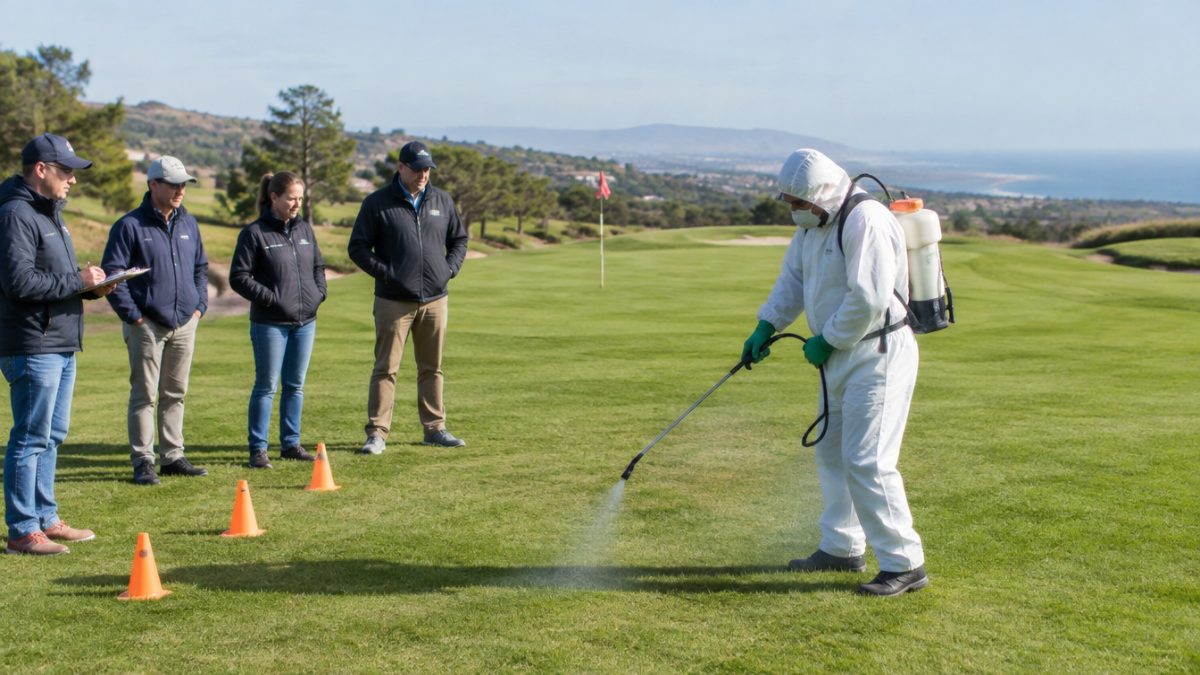
A course passed as a formality protects no one, and neither does a pesticide applicator licence kept in a drawer. Use the training so the team comes away with useful habits, and complete it with internal practice on the course itself. Typical content includes risks to health and the environment, reading labels, protective equipment, machinery calibration, waste management and first aid.
To help it sink in:
- Combine theory with a real demonstration of sprayer calibration.
- Practise how to read a label and what the pictograms and hazard statements mean.
- Review personal protective equipment together, including correct use and maintenance.
- Go over the procedure for cleaning equipment and managing leftovers and containers.
If the course includes a practical part, ask for it to be adapted to a golf course, because general agricultural cases do not always reflect your reality: small areas, player traffic and proximity to water and buildings.
Step 4: Control expiry dates and renewals
The pesticide applicator licence is not forever. It has a limited validity and must be renewed in line with the conditions set by the authority. Letting it lapse can mean taking a key person out of operations right in the middle of the treatment season, as well as creating a serious problem in an inspection.
A simple way to avoid surprises is to keep a table with:
- The name of each accredited person.
- The level and licence number.
- The issue and expiry dates.
- The deadline for starting the renewal process, with enough margin.
Set reminders several months ahead for each pesticide applicator licence, and bear in mind that renewal courses may not be available at all times. Planning the training for winter, when the course workload eases, is usually the most convenient for the team.
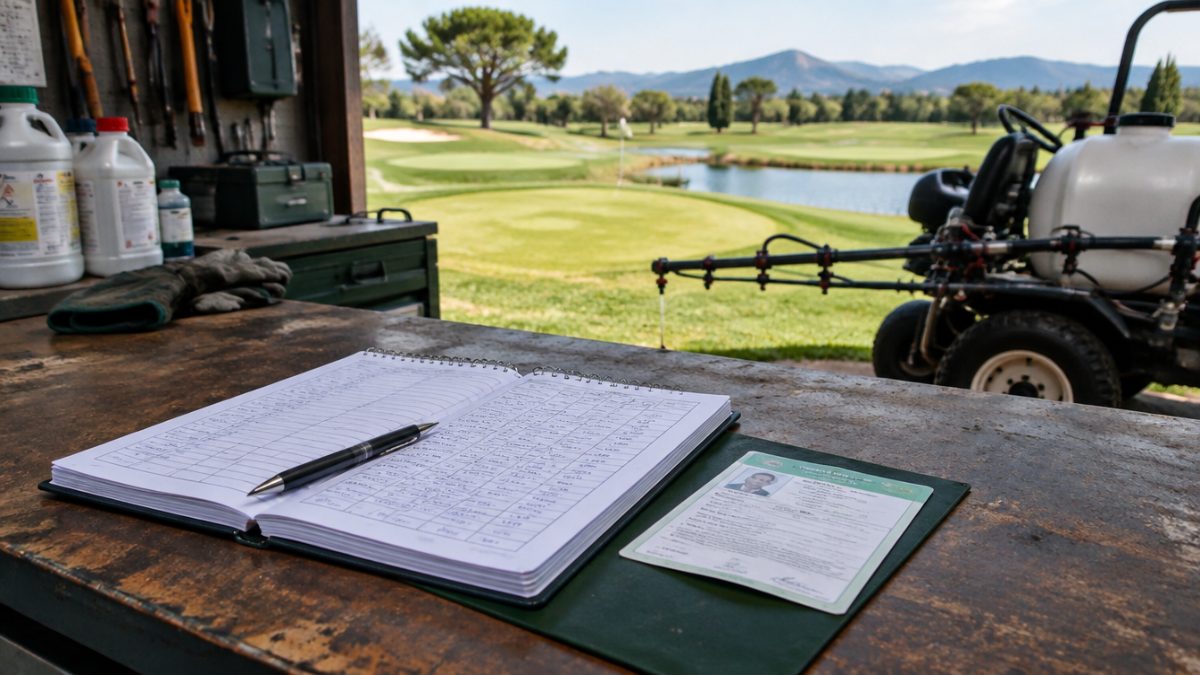
Also keep a copy of each pesticide applicator licence in the course file, accessible to management and to any inspection.
Step 5: Link the licence to the record of each treatment
The pesticide applicator licence and the treatment logbook are two sides of the same coin. Each application must be traceable to an authorised person, a product, an area and a date. If one day there is a complaint or a review, that traceability is what shows the work was done correctly.
A useful record includes, at a minimum:
- Date, time and weather conditions of the application.
- Area treated and surface.
- Product used and reason for the treatment.
- Person applying and their licence number.
- Equipment used and observations.
Remember that the decision to treat should rest on a clear diagnosis and, whenever possible, on the advice of an authorised technician. And that any product must be used only in accordance with the label and the regulations in force: applicator training is the foundation, and the pesticide applicator licence is its proof, but it does not replace professional judgement or checking the conditions of use of each product.
Further reading: Ministry of Agriculture, Fisheries and Food. Official information on training and the use of plant protection products can be checked with Spain's Ministry of Agriculture, Fisheries and Food.
Frequently asked questions
Who must hold the pesticide applicator licence on a golf course?
In general, the people who handle or apply these products and those who supervise or advise on their use, at the level appropriate to each role. The specific requirements are set by the regulations in force and the authority in your region, so check them and also review staff from outside companies.
What happens if an employee's pesticide applicator licence expires?
That person should not continue carrying out applications until it is renewed, which can leave the course without qualified staff in the middle of the season. In addition, an application without a valid accreditation can lead to penalties. The prudent course is to track the dates and start renewal months ahead.
Is having the licence enough to treat the turf?
No. The licence proves the applicator's training, but each treatment also requires a diagnosis, a product authorised for that use, compliance with the label and the regulations in force, and a record of the application. If in doubt, the right thing is to seek the advice of an authorised technician.
Keep reading
- how to keep pesticide application records Pesticide Application Records: 6 Key Data Points
- integrated pest management on golf courses Integrated pest management in golf: 6 key steps
- how to recognise and prevent Fusarium in turf Fusarium patch in turf: 5 winter measures