
Every greenkeeper knows the morning when three breakdowns arrive, an operator is missing and management asks about a tournament. Without a method, the day is decided by whatever is most urgent. Daily greenkeeper planning does not eliminate surprises, but it reduces their impact and ensures the important things get done first.
Let us look at six steps to organise the day: prepare the information the afternoon before, prioritise, allocate the work, coordinate with play, leave room for the unexpected and close with a simple record. These practices work the same on a nine-hole course as at a large resort; only the scale changes.
Prepare the daily greenkeeper plan the afternoon before
Daily greenkeeper planning is decided before dawn. Spend ten or fifteen minutes at the end of each day reviewing three things: the weather forecast, the play calendar and the pending jobs. With that information, sketch out the next morning’s plan and have the basic assignments ready.
Without daily planning, if you arrive first thing with nothing thought through, you will lose the most productive part of the day, when there are fewer players and the dew still lets you see the quality of the work. A whiteboard, a shared sheet or a digital system all work, and it is best to try one format for a month before changing it; what matters is that the team sees the same thing and does not depend on a message sent at dawn.
Prioritise with a simple, shared criterion
Not all tasks weigh the same. Sort them into three groups to decide what goes first:
- Essential: safety, mowing of greens and tee boxes, tournaments, critical irrigation and repair of breakdowns that stop play.
- Important: fairways, edges, bunkers, fertilisation or scheduled jobs that cannot be delayed for long.
- Deferrable: cosmetic improvements, tidying auxiliary areas and jobs that can wait for a quieter day.
When the whole crew knows this criterion, daily planning decisions no longer depend on the head greenkeeper’s intuition and are understood without argument. What is put off today must be noted for tomorrow, not lost. A task deferred more than three or four times in a row is no longer deferrable: either it is genuinely scheduled or it is dropped with a written reason.
Allocate work according to people, machines and time
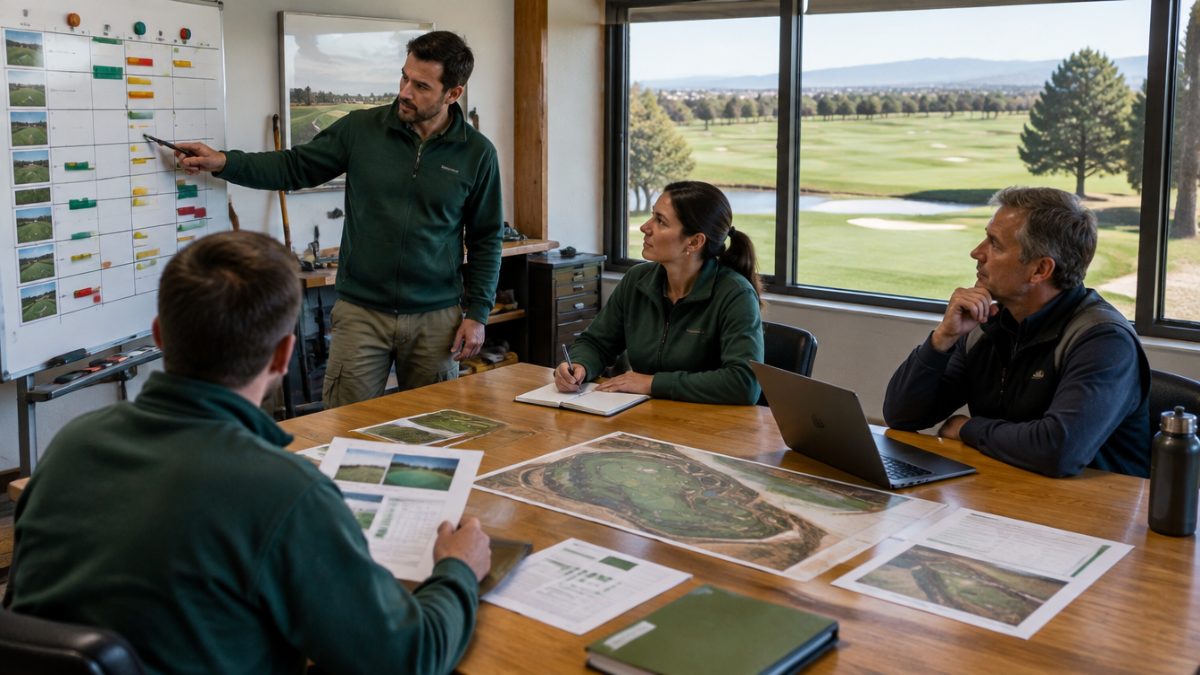
In daily greenkeeper planning, an effective allocation takes three variables into account at once: each person’s capacity, the machine available and the realistic time for each task. Two operators who work well together can do more than three who are poorly coordinated, and a mower that only runs at half power cannot take on the usual load.
Assign each task a clear owner and a duration estimate based on your history, not on optimism. If you are left with unfinished jobs every day, you are probably underestimating times. From time to time check how much each job really costs and adjust your estimates; that way, daily planning sharpens naturally.
Coordinate the plan with play and with reception
The course is a place of work and play at the same time. That is why daily greenkeeper planning must fit with tee times, tournaments, academies and events. Each morning, check with reception or the starter which holes will be busiest and where clashes with the crew might arise.
Schedule the noisiest or most intrusive jobs, such as noisy mowing, blowing or aeration, for the quietest stretches of play, and announce any restriction in advance. When the club knows what is happening on the course, complaints fall and the team’s image improves. Two minutes of coordination avoids misunderstandings that later consume hours. It also pays to agree on a single channel for alerts, so that an incident on the twelfth hole reaches the person responsible at the first attempt and not after three crossed calls, and so that everyone knows who decides when the plan changes mid-morning.

Leave room for the unexpected and define a plan B
Daily greenkeeper planning without slack breaks by mid-morning. As a rough guide, and depending on what your own history tells you, reserve between ten and twenty percent of the day for breakdowns, pipe bursts, weather incidents or absences. This is not about working less, but about making sure an emergency does not wreck everything else.
Also define an alternative plan for rainy or windy days, with tasks that can be done under cover or in less sensitive areas: workshop, store tidying, sharpening, training or checking materials. That way there will never be an idle crew not knowing what to do, nor a manager inventing tasks at nine in the morning, and bad weather days stop being lost days.
Close the day with a brief, useful record
The day ends when there is a record of what happened. Ask each person in charge to note what was done, what was left pending and any incident: a leak, a noisy machine, a damaged area. A short report is enough, as long as it is filled in every day and can be consulted.
That record feeds the next day’s daily greenkeeper planning and, in the long run, gives you real data on hours, tasks and costs to justify budgets and adjust staffing. It also protects the team: when someone asks why a sector was not mown, the answer is written down. After a few weeks, you will see clearly which tasks repeat, which fall behind and where to reinforce.
Further reading: GCSAA. If you want to compare organisational practices with other professionals, the GCSAA superintendents' association brings together management and training material.
Frequently asked questions
How long does daily greenkeeper planning take?
Once the team has the habit, ten or fifteen minutes in the afternoon to prepare the plan and five minutes in the morning to share it out are usually enough. If it takes much longer, perhaps organised information is lacking or the allocation is being built from scratch every day. With accumulated records it gets shorter.
What do I do if the plan breaks down every day?
Check two things: whether you are leaving room for the unexpected and whether the time estimates are realistic. A plan that always breaks is usually a plan that is too tight. Note the causes of each deviation for a few weeks and you will see which patterns repeat, so you can correct them in the allocation.
Is software necessary for daily greenkeeper planning?
It is not essential; a whiteboard and a notebook can work on small courses. But when there are several operators, many tasks and a need to report to management, a digital tool avoids duplicating information, makes follow-up easier and turns daily reports into usable data.
Keep reading
- Greenkeeper tasks in January: 7 key jobs Greenkeeper tasks in January: 7 key jobs
- How to prepare a golf course for peak season How to prepare a golf course for peak season
- Software for greenkeepers Software for greenkeepers: 3 keys to the importance of software in golf course and facility maintenance management