
The machine that cuts the green is probably the most important tool in the workshop. The quality of the surface where every match is decided depends on it, and its purchase, maintenance and replacement cost weighs heavily on the budget. That is why the choice of greens mowers should be taken seriously and not left to a one-off offer.
We review six criteria for comparing sensibly: machine type, cut quality, suitability for your turf, ergonomics and training, technical support and total cost. Without naming brands or models, so that you can apply them to any proposal on your desk.
Choose the type: walk-behind or ride-on greens mowers
The first thing is to decide your working philosophy. Walk-behind greens mowers give a very fine finish, good feel for the ground and less weight, but demand more time and effort. Ride-on machines, which are faster, are attractive on courses with a lot of surface or few staff, although they weigh more and need care on edges and slopes.
Points to consider:
- Total green area and the number of people available each morning.
- Slopes, edges and the size of the greens, which affect manoeuvrability.
- The level of demand in competitions or events.
- The possibility of combining both types, for example one for everyday use and another for specific care.
There is no universal answer: the right choice is the one that fits your real routine.
Cut quality: cylinders, bedknife and setting
To know what greens mowers offer in terms of cut, you need to look carefully at the cutting unit as a whole. The number of blades on the reel, the precision of the bedknife and the ease of adjustment determine the finish, the sharpening frequency and the tolerance for very low heights.
Ask for a trial on your own course and observe:
- That the cut is clean, with no torn strands or visible lines.
- That it holds the height consistently on slopes and undulations.
- That bedknife adjustment is simple and repeatable.
- That the grass box or collection system is practical and does not lose clippings.
Fine adjustments matter a great deal. An excellent machine that is poorly set cuts worse than a simple one that is well calibrated, so the team must know how to approach setting up methodically.
Match greens mowers to your turf species and programme
A bermudagrass, paspalum or bentgrass green is not mown in the same way. Some species tolerate very low heights and call for frequent cutting; others suffer more under stress and require flexibility. Before deciding, define the cutting height you are aiming for and how often you plan to mow.
Things worth asking the supplier:
- The real range of cutting heights the machine allows.
- The ease of changing the reel, adjusting the frequency of clip or swapping accessories such as brushes or combs.
- Options for complementary tasks, such as light verticutting or brushing, if they fit your programme.
- Behaviour in wet conditions and on turf with heavy growth.
If your plan includes smoothing rollers or brushing to improve speed, also check that the greens mowers you choose integrate well with that routine.
Ergonomics, safety and operator training
A good machine badly operated loses all its value. Greens mowers are used daily, often first thing, in a hurry and by different staff each week. If they are uncomfortable or confusing, the work comes out worse and the risk of mistakes increases.
Check during the trial:
- The comfort of the controls and the operator’s view of the cut.
- How easily it turns on the collar without damaging the turf.
- The clarity of the controls and indicators.
- The safety guards and stop systems.
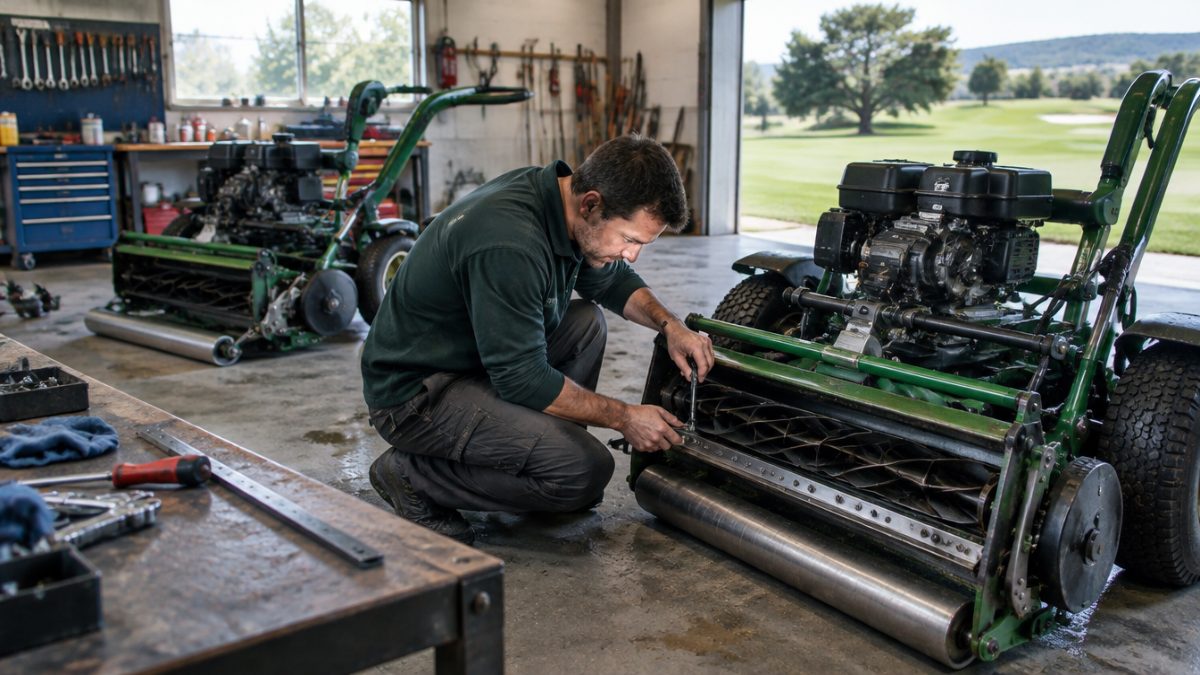
And do not forget training: ask the supplier to explain to the team the setting, cleaning and daily checks. A short written procedure, with photos of the correct setting, stops each operator from working their own way and guarantees a consistent finish.
Technical service, spare parts and lead times: what is not in the catalogue
When a machine fails in midsummer, the catalogue no longer helps. What counts is how long the technician takes to arrive, whether spare parts are available and whether a replacement machine exists. It is a decisive criterion and yet it is often left until after signing.
Before buying, ask clearly:
- Where the nearest technical service is and what response times it offers.
- Which wear parts are worth keeping in the workshop.
- What the warranty covers and how long it lasts.
- Whether periodic servicing can be contracted.
Also talk to other greenkeepers who use the same equipment. Their experience of breakdowns, sharpening and dealing with the supplier is usually more revealing than any brochure, and helps you decide with less risk.
Calculate the total cost of greens mowers over their whole life
The purchase price is only part of the expense. When comparing greens mowers, think about the cost over several years: fuel or energy, maintenance, sharpening, spare parts, staff hours and resale value. A cheap machine that demands more hours and more breakdowns can turn out very expensive.
A practical way to compare is to build a small table per machine with:
- Initial investment and payment or leasing terms.
- Estimated consumption and planned maintenance per hours of use.
- Expected service life and typical annual working hours.
- Estimated residual value at replacement.
This analysis lets you defend the investment to the committee with clear data. And once bought, the best way to get a return on it is to look after it: record hours, services, sharpening and breakdowns from day one, so you can decide with sound judgement when to repair and when to replace.
Further reading: STRI Group. To cross-check criteria on surface quality and sports turf management you can consult the technical resources of the STRI Group.
Frequently asked questions
Which is better, walk-behind or ride-on greens mowers?
It depends on your area, your staff and the level of demand. Walk-behind machines give great feel and a very fine finish; ride-on ones save time on large courses. Many teams combine both and reserve the most precise machine for competitions or the most delicate greens.
How often should greens mowers be sharpened?
There is no single interval: it depends on hours of use, the sand present on the green, the turf and the cut quality required. The usual approach is to check cut quality frequently, adjust the bedknife and sharpen or grind when the cut loses its cleanness.
Is it worth trying greens mowers before buying them?
Yes, and if possible on your own course, with your turf and at the height you normally use. A real demonstration lets you compare finish, ease of handling and ease of adjustment, and involves the maintenance team, who will be working with the machine every day.
Keep reading
- how to renew the machinery fleet Replacing the machinery fleet: 6 key decision factors
- reel sharpening step by step Reel sharpening: 6 steps for a clean cut
- preventive equipment maintenance Preventive Equipment Maintenance: 7 Key Tasks