

When the resource is scarce and restrictions tighten, many courses look to the nearest treatment plant. Reclaimed water for irrigation lets you keep playing through summer without competing with human consumption, but it is not just another tap: it changes what reaches the soil, the nozzles and the turf, and calls for a more methodical approach.
In this article we review six keys to bringing it in with good judgement: what you need to know about the water, how it affects the soil, what adjustments the system needs, how to adapt irrigation and fertilisation, what care it requires for people, and what records are worth keeping to stay in control.
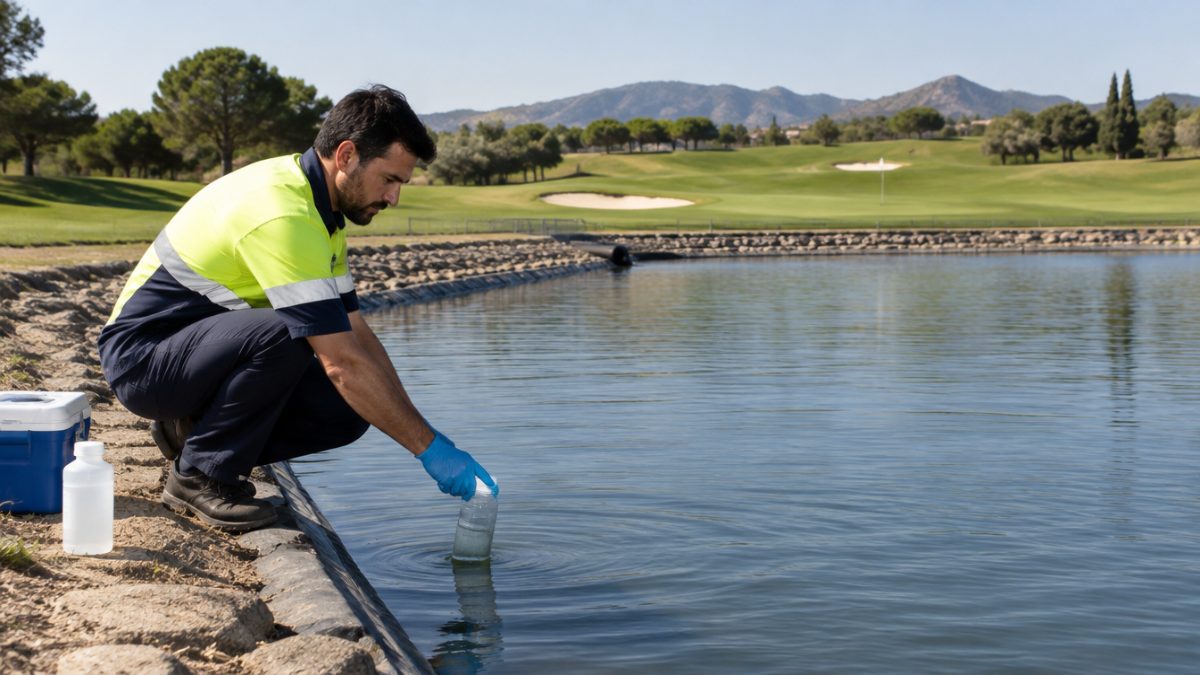
Know the real quality of the reclaimed water for irrigation before opening the valve
The first mistake is to assume that all reclaimed water for irrigation is the same. It depends on the treatment plant, the tertiary treatment, the source of the effluent and even the time of year. So before connecting the course, ask the supplier for the usual analyses and complete them with your own, taken from the tank or reservoir itself.
The parameters that matter most to the greenkeeper are usually:
- Electrical conductivity and total salts, which determine the turf’s tolerance.
- Sodium relative to calcium and magnesium, which indicates the risk to soil structure.
- Chlorides and boron, which can burn leaves and affect trees.
- Nitrogen and phosphorus, because the water already carries nutrients that must be deducted from the fertiliser plan.
- Suspended solids, relevant for filters and nozzles.
Do a baseline analysis and repeat it at a reasonable frequency, because quality fluctuates. A single report from months ago does not describe what is coming out of the sprinkler today.
Understand how the soil changes over successive seasons
The effect of reclaimed water for irrigation is not seen in a week but in the behaviour of the profile over several seasons. Salts and sodium tend to accumulate if they are not leached, and a sodic soil loses structure, waterlogs at the surface and becomes hard when it dries.
A good practice is to sample the soil in representative areas, always at the same points, and track the trend in conductivity and in the ratio of sodium to the other cations. If the trend rises, you need to react before the turf shows it.
Some common measures, always assessed with your technician:
- Maintain good drainage and sufficient porosity with regular aeration.
- Schedule leaching irrigation when the analysis advises it and drainage allows it.
- Consider calcium amendments if the analysis justifies it.
- Avoid light, frequent irrigation that only wets the surface and concentrates salts in the root zone.
Check the system: filters, nozzles and pipes
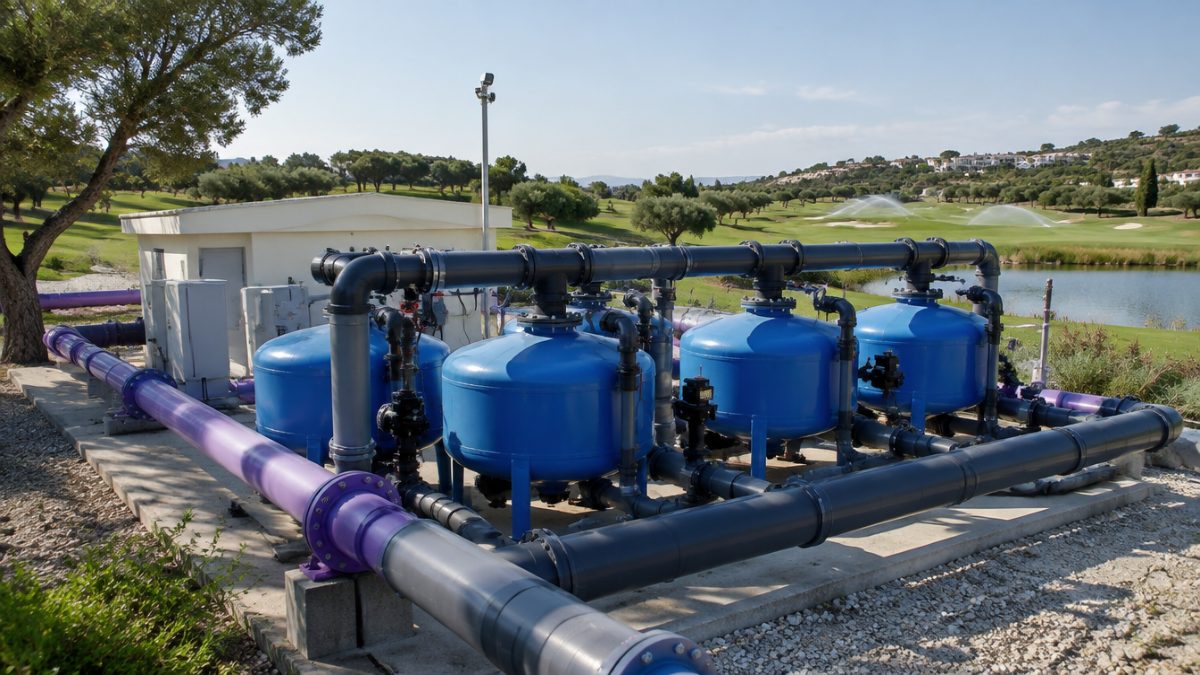
Reclaimed water for irrigation, with more organic matter and solids, is harder on the system. It is common for filters to saturate sooner, for nozzles to clog with precipitates or biofilms and for scale to appear in valves and solenoids. If you wait until you see bare patches in the turf, you have already lost weeks of uniformity.
It pays to get ahead with a simple routine:
- Clean or backflush filters more often than you did with conventional water.
- Inspect nozzles and emitters on a sample of circuits at regular intervals.
- Check the condition of seals and plastic or rubber parts in permanent contact with the water.
- Make sure the reclaimed water network is clearly identified and separate from any other.
That identification is no minor detail: pipes, hydrants, covers and signage must make the origin of the water clear to prevent misuse by third parties.
Adjust irrigation and fertilisation to what the water already brings
If the reclaimed water for irrigation carries nitrogen and phosphorus, part of the fertiliser is already in the tank. Ignoring it leads to excessive growth, more mowing, more thatch and, in the worst case, a nutritional imbalance. The sensible approach is to calculate the approximate input from the volume applied and subtract it from the fertilisation programme, fine-tuning with leaf and soil analyses.
As for irrigation itself, there is a delicate balance: irrigate just enough to cover evapotranspiration, but with the leaching fraction needed so that salts do not accumulate. Each species tolerates something different; paspalum and bermudagrass usually withstand salinity better than ryegrass or Poa annua, and bentgrass greens are the most sensitive.
That is why many courses combine sources: reclaimed water for irrigation on fairways and rough, and a blend or a higher-quality resource on greens and tee boxes. Deciding that split on data, and not out of habit, avoids problems where they hurt most.
Protect people: training and signage
Using this resource brings health obligations and good practices that the team must know. The aim is not to cause alarm but to make sure everyone knows what can and cannot be done with reclaimed water for irrigation: do not drink it, do not fill containers for other uses, avoid prolonged contact and respect the application conditions set by current regulations and the supply authorisation.
Some practical ideas for everyday work:
- A short safety talk for all staff, including temporary workers.
- Visible signage at water points, fountains and irrigation rooms.
- Clear guidelines to prevent irrigation from coinciding with play in busy areas.
- Basic hygiene after handling valves, pumps and filters.
Always check with the supplier and the competent authority which requirements apply in your case, because they may vary depending on the authorised use and the area.
Record consumption, analyses and incidents to demonstrate good use
When the course depends on reclaimed water for irrigation, a regulated resource, documentation weighs as much as the work on the course. An orderly history lets you justify the volume used, show that the conditions of the authorisation are met and spot trends before they become problems.
At a minimum, it is worth noting:
- Volumes received and applied by zone or circuit.
- Dates and results of each water and soil analysis.
- Leaching irrigations carried out and the reason.
- Filter cleanings and repairs to the network.
- Health incidents, complaints or odour episodes.
With that history, reclaimed water for irrigation stops being an unknown. It also lets you talk to the greens committee with data in hand: how much is being saved from other sources, how the soil is evolving and what investments are needed to sustain the system.
Further reading: Ministry for the Ecological Transition and the Demographic Challenge. To learn about the general framework for water reuse and water resource management, you can consult the information from Spain's Ministry for the Ecological Transition and the Demographic Challenge.
Frequently asked questions
Can greens be irrigated with reclaimed water?
It depends on its quality and the species. Bentgrass greens are sensitive to salts, so many courses reserve reclaimed water for fairways and rough, or blend it with another source. The prudent approach is to analyse, trial it on one area and decide with your technician and the water supplier.
Do I need to change my fertiliser programme if I use reclaimed water for irrigation?
Almost always, yes. The water can supply nitrogen, phosphorus and other elements, so fertiliser should be reduced accordingly. Calculate the approximate input from the volume applied and check it against leaf and soil analyses to avoid excess growth and nutritional imbalances.
What signs indicate the soil is becoming saline?
Typical signs are patches of dull turf or burnt leaf tips, surface waterlogging, white crusts after drying and soil that is hard to infiltrate. Confirm it with conductivity and sodium analyses, and react with drainage, aeration and leaching irrigation before the damage spreads.
Keep reading
- how to carry out an irrigation audit step by step Irrigation audit: 7 steps to detect water losses
- evapotranspiration and its role in irrigation Evapotranspiration in golf: 5 keys to watering just right
- soil moisture sensors for better irrigation Soil Moisture Sensors: 6 Key Uses in Golf