

October is a rewarding and treacherous month at the same time, and the greenkeeper tasks in October reflect that. Temperatures stop punishing the turf, dew now lasts until mid-morning and there is finally room to work without being up against the clock. But it is also the month that decides how the course will reach winter. The greenkeeper tasks in October are not spectacular, but they are decisive: what is done or left undone now will show in February.
In this article we review seven key jobs for a Mediterranean-climate course, with criteria for deciding when and how much to intervene, and a practical way of organising them so they do not clash with play or with end-of-season events.
Greenkeeper Tasks in October: Adjust Irrigation to Real Demand
The first of the greenkeeper tasks in October is to review the irrigation schedule, which is almost always still anchored to summer inertia. Evapotranspiration drops quickly and, if the water input is not reduced in the same proportion, moisture builds up at the surface, thatch stays waterlogged and ideal conditions for disease appear.
- Shorten run times by sector and check which areas still ask for more (knolls, south-facing exposures, sandy soil areas).
- Use the rains to space out cycles instead of irrigating “just in case”.
- Check the uniformity of the system now that there is no urgency: crooked heads, worn nozzles or leaks that summer heat was hiding.
- Switch to deep, infrequent irrigation on greens, monitoring moisture with a probe or by hand.
Overseeding and Turf Recovery After Summer
With the soil still warm and nights milder, October is one of the best windows of the year for overseeding. On bermudagrass courses where winter overseeding with ryegrass is carried out, it is the time to fine-tune what was done in late September; on cool-season turf, to fill bare patches and areas punished by the heat.
A few ideas to make the seed really take:
- Prepare the seedbed: mow short, then scarify or aerate beforehand to ensure seed-to-soil contact.
- Keep the surface constantly moist during germination, with light, frequent irrigation that is later spaced out.
- Avoid applying too much nitrogen in the first weeks: it favours the old turf, not the seedling.
- Protect newly seeded areas from traffic with ropes, rotating routes or moving pin positions.
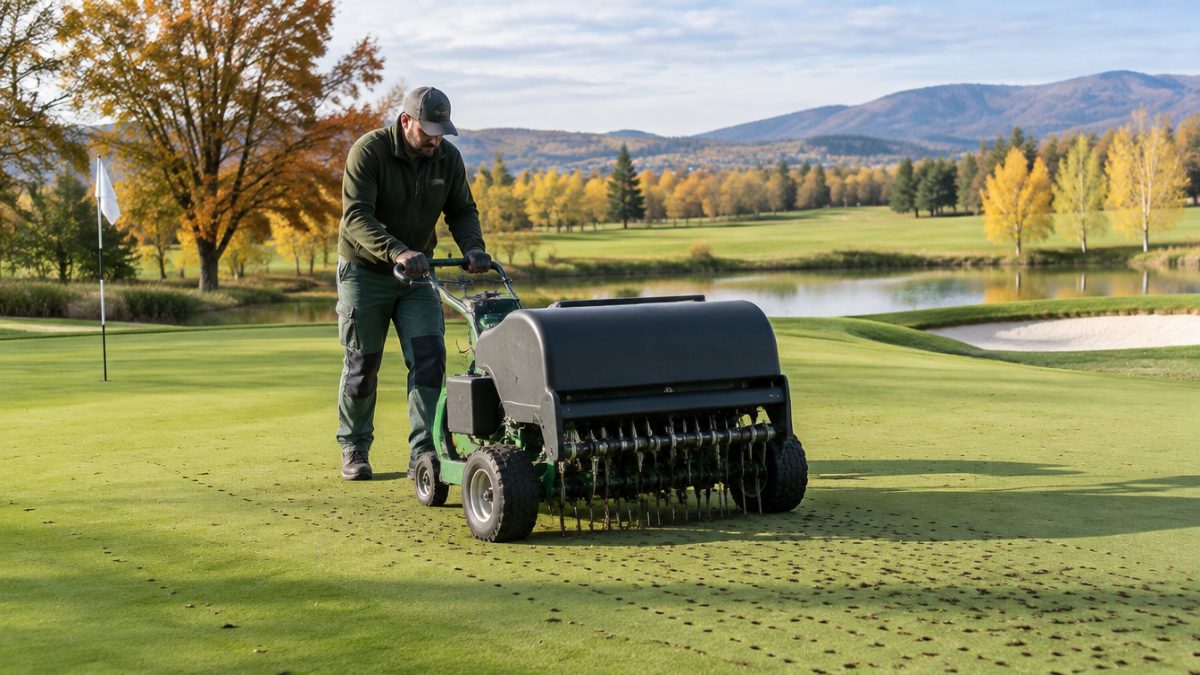
Aeration and Top-Dressing: October Greenkeeper Tasks for the Greens
When turf starts growing strongly again in October, it tolerates better the operations that would have been too aggressive in summer. That is why October is a good time to work the green profile: solid or hollow tining, depending on the state of compaction and organic matter, followed by top-dressing that fills the holes and keeps the surface smooth.
Ask yourself before going out with the machine:
- Is there a thatch layer beyond what is reasonable? Opening the profile with a probe confirms it in minutes.
- Has the surface dried enough to work without dragging mud?
- Are there tournaments or competitions in the following days? Poorly scheduled aeration generates unnecessary complaints.
It is preferable to tell management and players in advance which days aeration will take place, and to leave enough time for the surface to recover before demanding speed again.
Autumn Fertilisation: Feed Without Forcing
Among the greenkeeper tasks in October, autumn fertilisation aims for the turf to build up reserves and reach winter in good shape, not to grow more. In warm-season species, which slow down with the cold, it pays to reduce nitrogen and reinforce other elements that provide resilience, such as potassium. In cool-season species, October is usually one of the best times of year to feed, because the plant responds well.
- Base decisions on soil and tissue analysis, not just on last year’s habit.
- Choose formulations and release rates suited to the expected temperature.
- Adjust the input to each surface: greens, fairways, tee boxes and rough do not need the same.
- Record date, zone, product and amount applied so you can assess results in spring.
Any plant protection product or fertiliser must be applied following the label and current regulations, and with the advice of an authorised technician where applicable.

Watching for Disease: October Greenkeeper Tasks with Dew and Humidity
Humidity, cool nights and persistent dew are a combination that favours fungi. In October it pays to walk the greens first thing in the morning and look for patches, rings or areas with an oily appearance, especially in the shadiest and worst-ventilated areas.
Cultural prevention is usually the first line of defence: remove dew with light passes, keep thatch in check, avoid waterlogging and improve air movement by cutting back shading branches. If a chemical intervention is needed, an authorised adviser should decide it, it must comply with the label and current regulations, and it must be recorded.
Leaves, Trees and General Course Clean-Up
Among the greenkeeper tasks in October, falling leaves start to become a logistical problem. Leaves piling up on the green block light, hold moisture and complicate mowing. Plan blowing or vacuum routes that avoid freshly overseeded areas, and set a minimum frequency in the areas most exposed to trees.
- Check for dead branches or branches at risk of falling before the first strong storms.
- Clean drains, ditches, manholes and bunker edges so that water drains away without carrying sand.
- Check the condition of buggy paths after the rains.
It is also a good time to review the state of the trees and decide on pruning to be carried out in winter, when there is less activity on the course.
Machinery and Winter Planning
As the mowing pace slows, the greenkeeper tasks in October include getting the machinery ready, and a window opens up for it: sharpening cylinders, changing oil and filters, checking hoses and greasing. If you leave those jobs until the last moment, breakdowns will arrive just in the first week of strong spring growth.
Use October to sit down with the crew and decide:
- Which machines go into the workshop and when, so you are not left without mowing cover.
- Which winter jobs will be carried out: renovations, drainage, pruning, improvements to tee boxes or bunkers.
- What budget and staff hours will go to each.
Closing the month with a written plan avoids improvisation and makes it easier to explain to management what will be done and why.
Further reading: AEMET. To anticipate the rain, temperatures and humidity episodes that shape autumn work, it pays to follow the forecasts of the Spanish State Meteorological Agency (AEMET).
Frequently asked questions
What are the most urgent greenkeeper tasks in October?
The most urgent are adjusting irrigation to the lower demand, finishing overseeding while the soil retains warmth and scheduling green aeration. Next come autumn fertilisation, disease monitoring and clearing leaves and drains. It is best to put all of it in a calendar with owners and dates.
Should fertilising continue in October?
It depends on the species and conditions. On cool-season turf it is usually a good time to feed; on warm-season turf, nitrogen is reduced and other elements are reinforced. The ideal is to decide based on soil analysis, adjust by surface and always record each application to assess the result.
How do I organise the greenkeeper tasks in October without clashing with play?
Group intensive jobs, such as aeration or overseeding, on days of lower occupancy and warn management and players in advance. Split the crew by zones and shifts, leave recovery time before competitions and review the work report each week to correct deviations.
Keep reading
- What to do on the course during September Greenkeeper Tasks in September: 7 Key Jobs
- How to plan winter overseeding Winter overseeding: 6 steps for a green course
- Controlling thatch on greens Thatch in greens: 6 warning signs and how to reduce it