
Every greenkeeper has a feeling at the back of the neck: that warm, humid morning when they know something is brewing. Turf disease prediction tries to turn that intuition into a method: observe conditions, compare them with known risk thresholds and act before the symptom appears.
It is not magic and it does not replace a technician’s judgement, but it does bring order. In the following lines you will see five concrete advantages of working with risk models, what data is needed, what their limitations are and how to build them into the team’s routine without complicating the day to day.
What turf disease prediction really is
We are talking about estimating the probability that a pathogen will develop, based on environmental conditions and the condition of the turf. The most common models combine temperature, relative humidity, leaf wetness duration, rain, dew and, sometimes, the history of the plot.
The underlying idea is not new. Technicians have used rules of thumb for decades: mild, humid nights favour certain fungi, and hot periods with high humidity favour others. What turf disease prediction adds is systematising those rules, measuring them regularly and putting them in writing.
It is important to remember that a model signals risk, not certainty. The diagnosis on the ground and the decision to act are always made by a qualified person.
Advantage 1: seeing the problem coming instead of chasing it
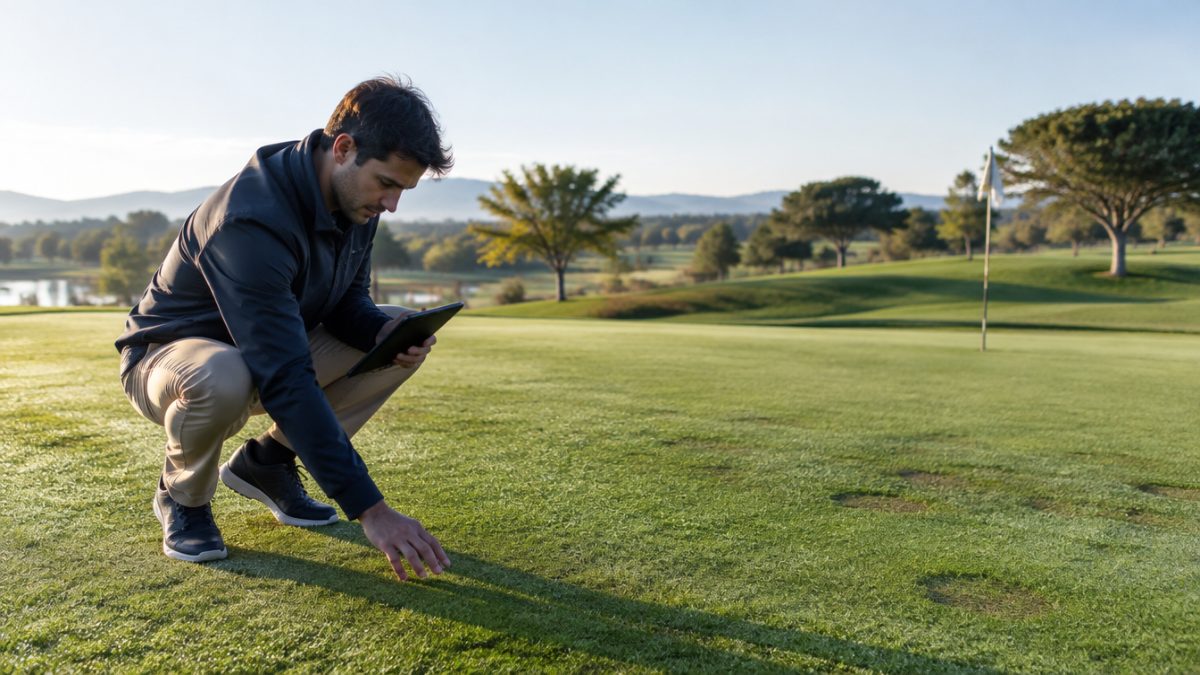
The biggest advantage is time. When conditions approach the risk zone, the team can step up monitoring on the most sensitive plots, review irrigation and mowing routines and prepare in advance whatever decisions are appropriate, always with the judgement of an authorised adviser.
Anticipating lets you move from emergency management to planned management. On bentgrass greens or Poa annua in transition, or on shaded bermudagrass, those days of margin often make the difference between a mild intervention and a long recovery.
Think of tournament week: if turf disease prediction warns four or five days ahead of a period of high night-time humidity, the team can reorganise shifts, check the most delicate greens at dawn and tell the sports director that the condition of the course needs special attention. Without that information, the problem is discovered on the very day when there is least margin.
Advantage 2: adjusting cultural management before turning to other measures
Many diseases are favoured by factors the greenkeeper controls: prolonged leaf wetness, excess nitrogen, compaction, thatch or poor aeration. If the prediction indicates that critical days are approaching, there are cultural options that can be brought forward.
- Remove early-morning dew by mowing or dragging.
- Adjust the timing and depth of irrigation.
- Moderate fertilising during risk periods.
- Increase aeration and ventilation in enclosed areas.
With this approach, turf disease prediction reinforces integrated management and reduces dependence on reactive measures.
Advantage 3: more rational, better justified decisions
When there is an objective reference, it is easier to explain why you intervene or why you wait. The green committee appreciates measurable arguments over impressions, and the team itself gains confidence by backing its decisions with course data.
Any plant protection application must follow the label, current regulations and the advice of an authorised technician. The advantage of the predictive approach is that it adds context to that decision: it helps distinguish when there is real risk and when an alert comes to nothing, avoiding unnecessary interventions and promoting more prudent use of resources.
In addition, turf disease prediction helps explain to members why maintenance routines are changed in certain weeks, for example with earlier mowing or shorter irrigation, and why this benefits the quality of the surfaces in the medium term.
Advantage 4: learning from the course's own history
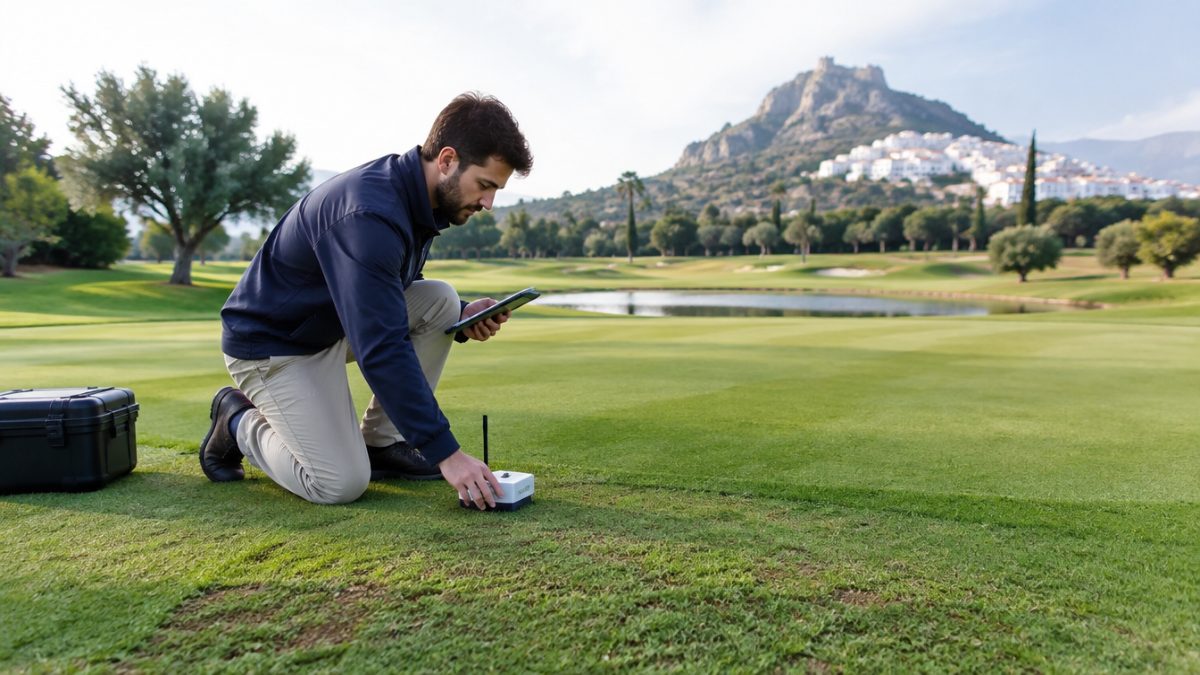
Every course has its microclimate, its damp areas and its problem plots. If you systematically record the conditions before each outbreak, with dates, areas and progression, you will have your own risk map, much more precise than any general rule.
Over the years patterns appear: the green that always suffers after three consecutive foggy nights, or the hole shaded by pines where the turf takes longer to dry. Turf disease prediction improves as it is fed by that memory, so it is worth starting to take notes as soon as possible, even in simple formats.
A good incident sheet captures the date, the area, the turf species, the conditions of the previous three or four days, what was observed on the course and the actions taken. After a season, that collection of sheets lets you validate or discard the thresholds you were using and refine turf disease prediction with your own data.
Advantage 5: clearer coordination and communication
A risk alert shared by the whole team organises the work: who checks which areas, which shifts are adjusted, which tasks are postponed and which are brought forward. It also makes it easier to explain to the manager or the sports director why the mowing routine is changed one day or heavy machinery is delayed.
Nor should the limits be forgotten. Every turf disease prediction system works with imperfect data, does not capture every variable and can fail in local microclimates. That is why it works best as a complement to daily visual inspection, never as a substitute. And that is why turf disease prediction should be treated as a support tool, with periodic review of how accurate it has been.
If you want to start without big investments, begin by noting every day the temperature, humidity, hours of dew and visual observations, and compare that information with what happens afterwards.
Further reading: STRI. STRI, a leading turfgrass research organisation, offers technical information on turf health and disease management.
Frequently asked questions
Is turf disease prediction reliable?
It is useful as a risk indicator, but not infallible. Its reliability depends on the quality of the data and on how well it is adjusted to the course's microclimate. It should be cross-checked with daily visual inspection and the team's experience, and its accuracy reviewed at the end of each season.
What data do I need to get started with turf disease prediction?
The basics: temperature, relative humidity, rain, hours of leaf wetness or dew and a record of incidents by area. With a few months of your own data you can already identify useful patterns. A weather station on the course improves accuracy, but it is not essential to get started.
Does prediction replace a technician's decision?
No. It provides information to decide better, but the diagnosis and any treatment are for an authorised technician or adviser, always following the label and current regulations. The tool helps prioritise monitoring and document the team's decisions.
Keep reading
- Fusarium in turf: causes and management Fusarium patch in turf: 5 winter measures
- Dollar spot: how to recognise and prevent it Dollar Spot: 6 Keys to Detect and Stop It Early
- A weather station on the golf course Weather Station on a Golf Course: 6 Data Points That Save Water