
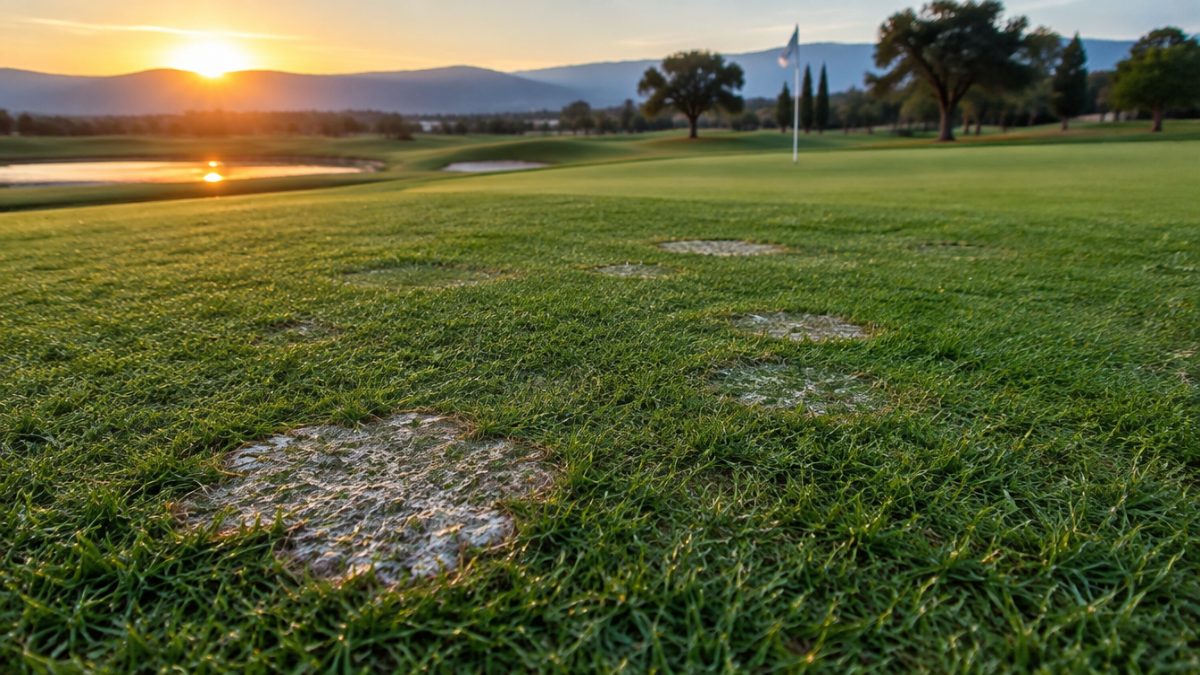
Small straw-coloured spots the size of a coin that multiply and merge into irregular patches: this is how dollar spot usually begins, one of the most common foliar diseases on greens, tee boxes and fairways. Although it rarely kills the turf, it degrades playing quality and can ruin the look of the course within a few weeks.
Stopping it is above all a matter of anticipation. In this article you will find six keys: how to identify it with confidence, which conditions favour it, how to adjust irrigation, nutrition and mowing, and how to decide whether a treatment is needed, with technical advice and a record afterwards.
Key 1: recognise the symptoms of dollar spot in time
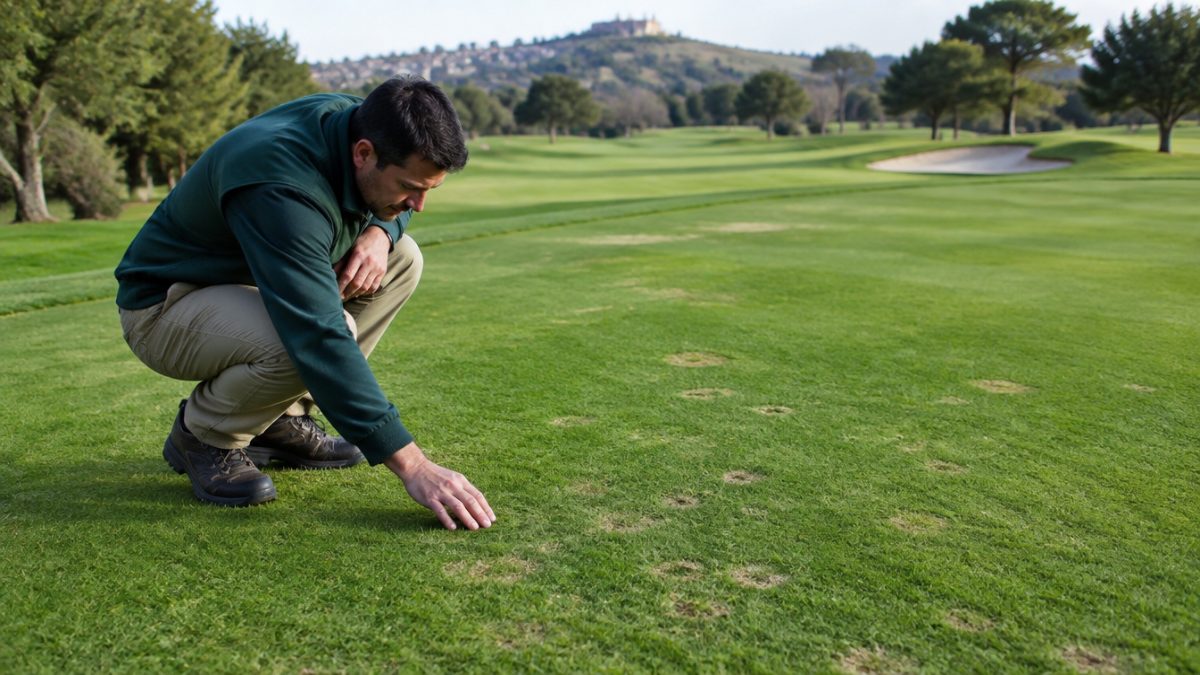
On short turf such as greens, dollar spot shows up as small, sunken spots of a straw or whitish colour. On fairways and at greater heights, the spots tend to be larger and more irregular. It is in the early morning hours, with dew, that it is easiest to see.
Two clues help confirm the suspicion:
- Leaf lesions with light brown bands and a darker border, which often cross the leaf from side to side.
- White, cottony mycelium visible over the spots in high humidity at dawn.
Take care not to confuse it with localized drought, animal urine or other diseases such as Fusarium. If in any doubt, send a sample to a laboratory or consult a technician before deciding what to do about dollar spot.
Key 2: understand when dollar spot appears
The causal fungus develops in mild temperatures, warm days and cool nights, and above all with long periods of leaf wetness. In a Mediterranean climate, peaks usually coincide with spring and autumn, although on courses with heavy dew it can appear in almost any month of activity.
The most common risk factors are:
- Wet leaves for many hours due to dew, night irrigation or lack of air movement.
- Nitrogen deficiency in the turf.
- Drought stress or very shallow, frequent irrigation.
- Excessive thatch and compacted soils.
Keeping track of the weather, with temperature, humidity and leaf wetness hours, helps predict the onset of dollar spot and organise the work before the spots spread.
Key 3: adjust irrigation to reduce leaf wetness hours
A large part of preventing dollar spot comes down to water. The longer the leaf stays wet, the more opportunities the fungus has. That is why it is worth reviewing the irrigation schedule, avoiding wetting in the late afternoon or early evening.
Practical measures:
- Irrigate in the last hours before dawn, so that the leaf dries quickly in the sun.
- Prefer deep, less frequent watering to light, daily watering.
- Remove dew with a light pass of a hose or mower on critical mornings.
- Improve air movement by pruning trees that cut the green off from the air.
Well-aerated turf with balanced irrigation gives the disease fewer opportunities and is easier to manage throughout the season, with or without treatments. On courses with a lot of perimeter trees, this simple air-movement measure can be more noticeable than any other decision in the programme.
Key 4: maintain nutrition to stop dollar spot
It is one of the most repeated observations among greenkeepers: turf hungry for nitrogen is much more susceptible to this disease, and it usually shows it in the poorest parts of the course, such as green edges or fairways with the worst soil. This does not mean fertilising without limit, but avoiding deficits during risk periods.
Some general guidelines:
- Support the fertiliser programme with soil and tissue tests.
- Split applications into moderate doses instead of large one-off inputs.
- Also watch the balance of other nutrients, such as potassium.
- Avoid extremes: neither deficit nor excess, which causes soft growth and other diseases.
When dollar spot has already appeared, a small, well-calculated nitrogen input, together with improved leaf drying, usually helps the turf recover and fill in the damaged areas.
Key 5: reduce thatch and stress with cultural practices
Maintenance operations play a preventive role. Thick thatch retains moisture at the base and harbours the fungus, while compacted soil limits roots and makes turf more vulnerable to dollar spot.
A sensible cultural plan includes:
- Aeration and spiking to improve infiltration and oxygenation.
- Regular sanding to dilute organic matter.
- Light, frequent verticutting instead of aggressive scarifying in the middle of the risk season.
- Mowing with a sharp blade, so as not to open wounds through which the fungus enters.
Avoid heavy work when a dollar spot outbreak is active, because weakened turf recovers worse. Coordinate operations with the weather forecast and the tournament calendar, and leave a recovery window before important events so that the turf arrives in good condition.
Key 6: decide wisely whether a treatment is needed
If, despite cultural measures, dollar spot keeps advancing, a fungicide treatment may be necessary. The decision belongs to an authorised technician or adviser, who will weigh the damage threshold, the timing, the rotation of active ingredients to avoid resistance and the usage restrictions. The label and current regulations must always be followed.
Before applying, it is worth setting:
- The threshold at which you act, agreed with the team and management.
- The priority areas, such as greens, and those that can wait.
- The record of date, product, equipment and conditions for each application.
Noting dollar spot outbreaks year after year, with their weather, lets you anticipate the next one and reduce the number of interventions. Whoever keeps good records treats less and better, and can also justify to the committee every decision taken during the season.
Further reading: USGA. The USGA publishes technical material on turf diseases and integrated management that supports the greenkeeper.
Frequently asked questions
How do I tell dollar spot apart from other patches in the turf?
Look at the size of the spots, the leaf lesions with brown bands and the white mycelium with dew. Even so, other causes can look similar, such as drought, urine or Fusarium. If in doubt, it is best to send a sample to a laboratory or ask a technician for a diagnosis before acting against dollar spot.
Does dollar spot kill turf?
It does not normally kill the plant, because it mainly affects the leaves, but it weakens it and leaves sunken patches that damage the surface and are slow to recover. With repeated attacks or stressed turf, losses of density can be significant, so it is best to prevent and act early.
Can dollar spot be controlled without fungicides?
In many cases it is greatly reduced by cultural measures: early-morning irrigation, balanced nutrition, thatch control, good air movement and mowing with sharp blades. When that is not enough, the use of fungicides must follow the label, current regulations and the advice of an authorised technician, with a record of each application.
Keep reading
- strategies for controlling turf pests and diseases Strategies to control pests and diseases in golf turf
- steps of integrated pest management in golf Integrated pest management in golf: 6 key steps
- key data for plant protection treatment records Pesticide Application Records: 6 Key Data Points