
Trees are one of a golf course’s great assets, and also one of its biggest sources of conflict: shade over greens, roots that lift paths, branches that encroach on fairways, and members who want to fell or keep trees with equal vehemence. Good tree management on golf courses replaces arguments with clear, repeatable criteria.
Below you will find six pruning criteria you can apply on your course: from the initial inventory to seasonal planning, including safety, competition with the turf and communication with the club. These are general guidelines; decisions about specific species are best validated with an arboriculture specialist.
Start tree management on your golf course with an inventory
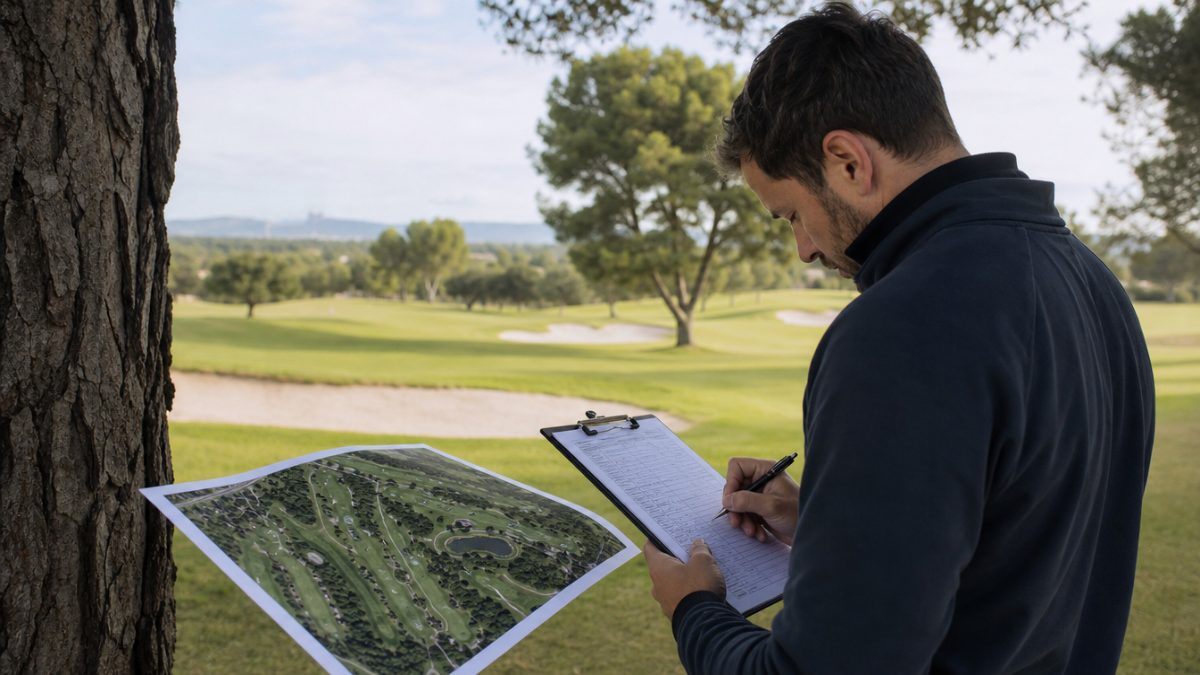
You cannot manage what you do not know. The first criterion is to build a simple inventory: species, approximate size, health status, location on the course and notes. It does not need to be a scientific study; a table with codes and a map will do.
To make it useful, classify each tree with three questions:
- Does it have any structural risk: dead branches, decay, lean or cracks?
- Does it interfere with play, with a green, with a tee box or with facilities?
- Does it have a landscape, ecological or historical value that justifies keeping it?
With this base, updated each season with just a few minutes of work per area, tree management stops being reactive: you will know which trees need attention this year and which can wait.
Put the safety of people and facilities first
In any tree management programme on a golf course, the criterion that overrides all others is risk. A dead branch over a buggy path or a tee bench is an emergency, however beautiful the tree. Inspections after storms, heavy rain or prolonged drought can reveal damage that cannot be seen at a glance.
Set up a simple scale, for example urgent, short term and plannable, and assign response times to each. Trees with significant structural risk should be assessed by a professional, and work at height should be carried out only by trained staff with appropriate safety equipment.
Measure competition with the turf: light, roots and air
Golf turf needs sun, and plenty of it. As a general guide, greens and fine-turf tee boxes suffer when they receive few hours of direct light, and prolonged shade encourages moss, disease and thin turf. Trees also compete for water and nutrients with shallow roots that invade the edges of greens and fairways.
Before deciding on any pruning, as part of your tree management, look at:
- Which hours of the day the tree shades each critical area, especially in winter, when the sun is low.
- Whether roots are surfacing at the edge of the green or weakening drainage.
- Whether the tree restricts air movement, which prolongs leaf wetness.
Often it is enough to thin the crown, raise the crown base or carry out controlled root pruning, with no need to fell.
Prune with technique, not with a chainsaw and in a hurry
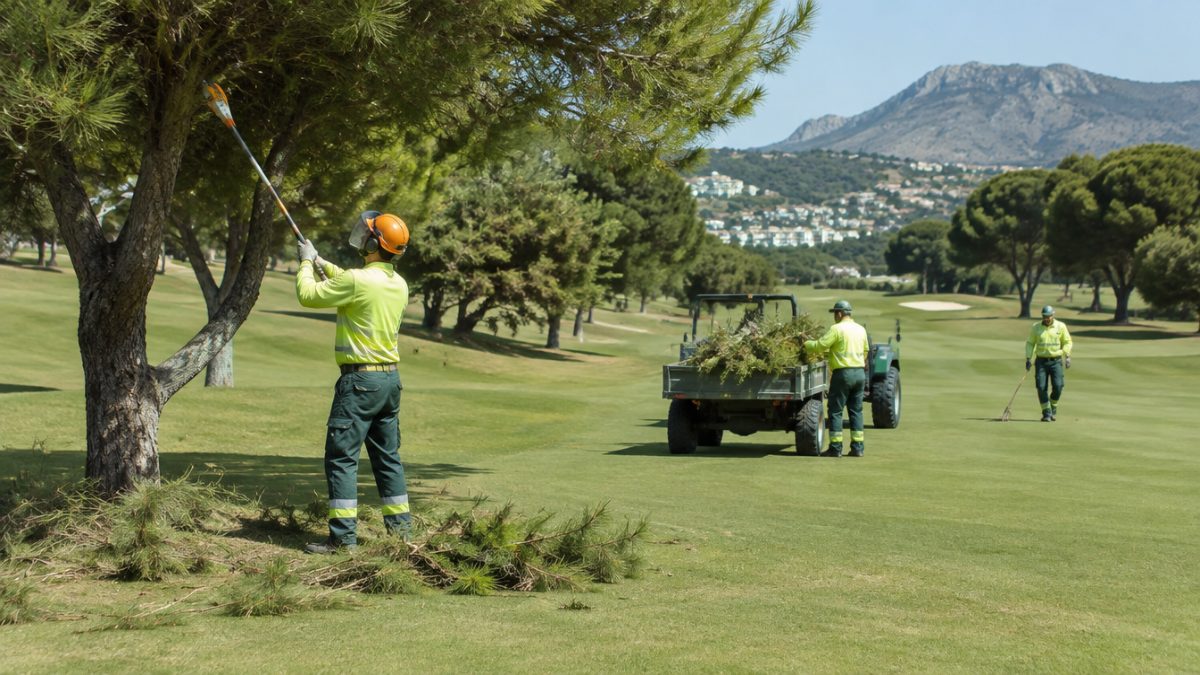
Bad pruning damages a tree for years, and in tree management on golf courses it is a mistake paid for in shade, regrowth and complaints. Cuts should be clean, made at the correct point and leave no stubs or tears. Avoid excessive pruning, which weakens the plant and causes vigorous, poorly anchored regrowth, and do not remove more than a moderate share of the crown in a single intervention.
Distinguish between types of pruning according to the objective: maintenance and removal of dead branches, thinning to let light through, crown raising for play and machinery, and occasional reduction. Each species has its most favourable season, and for those that bleed sap or are sensitive to certain diseases, timing matters. If in doubt, consult an arborist.
Plan replacement so you do not empty the course
Tree management on golf courses is not only about removal. A course that takes out trees without replacing them ends up losing character, shade for players and refuge for wildlife. Every time you fell a tree, ask yourself what you will plant, where and why.
In tree management it pays to think twenty years ahead. Choose species suited to the climate and water availability, with a mature size compatible with the space, and avoid planting near greens or bunkers trees that, over the years, will recreate the same problems. Mixing species also reduces the risk of a single pest hitting all the trees at once, and favours the biodiversity that the club can proudly communicate.
Communicate the criteria to the club and document every intervention
Few decisions generate as much argument as felling a tree. If the club understands the criteria behind decisions, the debate becomes technical rather than emotional. Prepare a short explanation, in writing and with photos if possible: the tree is a risk, blocks the sun from a green or competes with the playing area, and this is what will be done and replaced.
Keep a record of each action: date, tree or area, type of pruning, reason, staff, hours and cost. That history lets you justify the budget, plan the cycles and show that tree management follows a criterion rather than a whim. On a course with many trees, it is what separates pruning in response to complaints from professional management.
Further reading: FAO. If you are interested in the role of trees in biodiversity and the environment, the FAO publishes reference material on forest management.
Frequently asked questions
How often should a course's trees be inspected?
A general review at least once a year is reasonable, plus targeted checks after storms, snowfalls or severe droughts. Large trees near paths, tee boxes and facilities deserve more attention. Effective tree management combines that fixed calendar with the crew's daily observation.
Can you fell a tree that shades a green?
Sometimes felling is the solution, but it is best to try thinning or crown raising first and estimate how many hours of sun are gained. You must also check the permits and local or regional rules that apply to felling. The decision should be technical, documented and communicated to the club.
Who should handle the more delicate pruning?
Large-scale pruning, work at height or work on trees with structural risk should be entrusted to trained professionals with suitable equipment. The maintenance team can take on low pruning and cleaning. What must never be missing is the inventory and the record, because they are the basis of tree management on golf courses.
Keep reading
- Pine processionary moth on golf courses: safe measures Pine processionary moth on golf courses: 5 safe measures
- Complete guide to turf maintenance on golf courses Complete guide to turf maintenance on golf courses
- How to control pests and diseases in golf turf Strategies to control pests and diseases in golf turf