
White nests among the needles and lines of caterpillars coming down a pine are a familiar scene on many coastal and inland courses. The pine processionary moth on golf courses is, before anything else, a safety issue rather than a cosmetic one: its urticating hairs cause reactions in the skin, eyes and airways, and can be dangerous for dogs.
This article proposes five safe measures for dealing with the pine processionary moth on golf courses: understand its life cycle, inspect, protect people, intervene with advice and keep a record of everything done. It does not replace an authorised technician, but it helps you organise the work.
Know the life cycle of the pine processionary moth to know when to look
Understanding the pest’s life cycle is the best prevention tool and the basis of any plan against the pine processionary moth on golf courses. In very brief terms, adults fly in summer, females lay eggs on the needles, the caterpillars hatch and feed through autumn and winter inside silky nests, and in late winter or early spring they descend in a procession to bury themselves and pupate.
Dates vary a lot with climate and altitude, so trust your own observation more than a generic calendar. The key point is that the pine processionary moth on golf courses calls for two monitoring windows: autumn, to spot the first nests, and late winter, when the caterpillars come down to the ground and the risk of contact increases.
Inspect the pines with a systematic round
Against the pine processionary moth on golf courses, a well-defined inspection round detects problems earlier and costs less than an emergency intervention. You do not need to walk past every tree every week; setting priorities is enough.
- Highest-risk areas: tee boxes, practice areas, buggy paths, the clubhouse and car parks.
- Isolated and edge pines, which tend to get more sun and be the first affected.
- Trees affected in other years, because the pest tends to return to the same spots.
Note on a map or in a list the number of nests seen per tree and their location. With that information you will know whether pressure is rising or falling from year to year and can prioritise with data rather than impressions.
Protect people and animals first
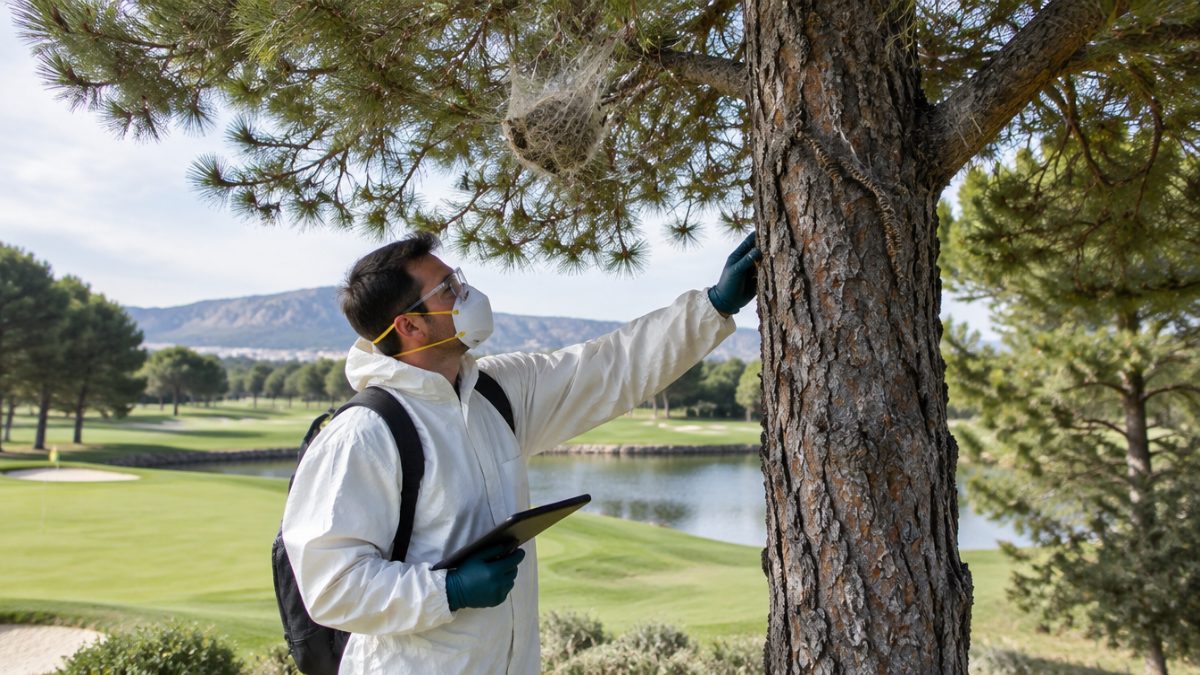
When managing the pine processionary moth on golf courses, the priority is the risk to people. The caterpillars’ hairs come off easily and the wind spreads them; even the remains of old nests or dead caterpillars remain urticating. That is why staff safety is the first measure, ahead of any treatment.
- Inform staff about what the pest is and how to recognise it.
- Equip anyone working nearby with suitable protection: long sleeves, gloves, goggles and a mask.
- Avoid mowing, blowing or brush-cutting under affected pines when there are caterpillars on the ground, because it lifts the hairs into the air.
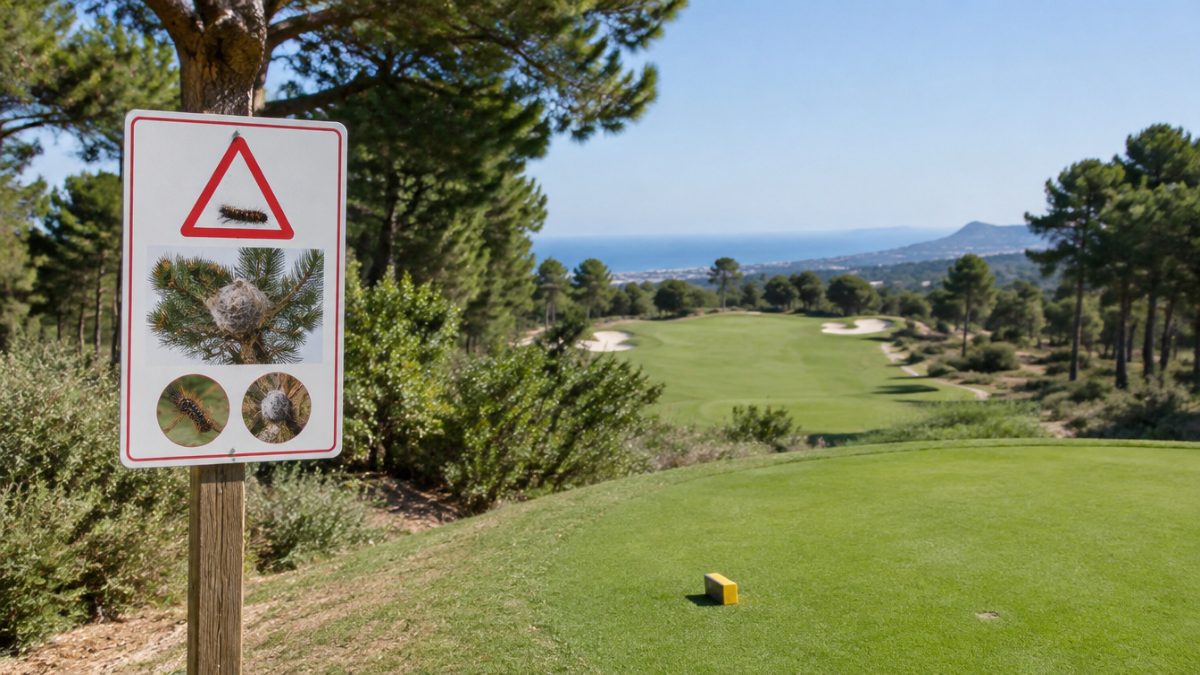
- Signpost the affected areas and tell players and members not to touch the caterpillars and to keep dogs away.
If someone has severe symptoms, they must receive medical attention; this is not something to be solved in the workshop.
Choose the intervention with technical judgement and respect for the surroundings
There are several ways to control the pine processionary moth on golf courses, and the choice depends on the level of infestation, how accessible the trees are and how sensitive the surroundings are. Common options include mechanical removal of nests in winter, pheromone traps to capture males, collar traps on the trunk to intercept the descent of caterpillars, and targeted biological or chemical treatments.
Any plant protection treatment must be applied following the label, current regulations and the advice of an authorised technician or adviser, paying special attention to water bodies, the presence of the public and bees. A golf course has more sensitivities than a farm, with players, members, neighbours and wildlife sharing the space every day, and the intervention must be proportionate, selective and documented.
Work at height only with trained staff
Cutting nests by hand from a platform or a ladder seems simple, but it combines two risks: working at height and contact with the hairs. This task should be assigned only to trained and equipped staff, or to a specialist company if the course lacks the means.
After removing nests in a pine processionary moth episode, they must be handled carefully, placed in sealed bags and disposed of as the technician or waste manager indicates, never left on the ground or shredded. No saving is worth an accident caused by a poorly planned intervention. One practical tip: schedule the work for the quietest hours of play and tell reception, so the whole team knows where work is happening and when.
Keep a record of what was done and monitor how things develop
Good management of the pine processionary moth on golf courses ends in a record. Without one, it is impossible to know whether a measure worked, to justify the required budget to management or to show that you acted diligently if there is a complaint or an incident.
It is worth noting the date, location and number of affected trees, the measure applied, the staff involved, the protective equipment used, the product or method and any later observations. Repeat the inspection a few weeks later and compare with the initial round, tree by tree. If pressure does not fall, check whether the timing, the treatment coverage or the choice of measure failed, and adjust next year’s plan.
Further reading: MITECO. For the general framework on plant health and the environment, you can consult Spain's Ministry for the Ecological Transition (MITECO).
Frequently asked questions
Is the pine processionary moth on golf courses dangerous for players?
It can be if the urticating hairs are touched or breathed in. They cause itching, hives, eye irritation and, in sensitive people, breathing problems. Dogs are especially vulnerable if they lick or sniff a caterpillar. The prudent approach is to signpost affected areas, ask players not to touch the caterpillars and avoid intense activity under infested pines.
Can the pine processionary moth be eliminated from a golf course completely?
It is very hard to eradicate, because adults fly in from nearby pine woods. The realistic goal is to keep the population at tolerable levels by combining monitoring, nest removal, traps and, where appropriate, treatments with technical advice. Consistency year after year is more effective than a one-off intervention.
Who should decide on the treatment?
The decision should rely on an authorised technician or adviser who knows current regulations and the specific restrictions of a course with public access, water and wildlife. The greenkeeper contributes knowledge of the terrain and the records from previous years, which are the basis for choosing the right method and timing.
Keep reading
- Strategies to control pests and diseases in turf Strategies to control pests and diseases in golf turf
- Complete guide to turf maintenance on golf courses Complete guide to turf maintenance on golf courses
- How to prepare a golf course for peak season How to prepare a golf course for peak season