
Few problems frighten a greenkeeper in summer as much as Pythium in turf. It appears when the heat tightens, nights do not cool down and the profile holds water, and its speed can turn a small patch into a large stretch of green within days.
Here you will find five warning signs that help detect it early, the management factors that favour it and general guidelines to reduce its impact. All with one clear principle: when Pythium in turf is suspected, the confirmed diagnosis and the decision to treat always belong to a competent technician.
What Pythium in turf is and why it is feared in summer
Pythium in turf is caused by fungus-like organisms called oomycetes, which thrive in very wet environments. They develop with high temperatures, high ambient humidity and saturated or poorly drained soils, and can attack roots as well as leaves depending on the species involved.
Cool-season species such as bentgrass or ryegrass, and areas with Poa annua, are particularly sensitive in the warm months. The disease spreads with water and with machinery, so outbreaks can extend in the direction of drainage or mowing.
The key is speed: by the time damage is visible, progress is already considerable. That is why so much emphasis is placed on scouting, and on understanding which conditions precede each outbreak. A team that knows the history of its course knows which greens, and in which weeks, to watch most closely.
Sign 1: Dark spots or a water-soaked look on the leaf
One of the first signs is the appearance of small dark spots, with leaves that look greasy or water-soaked. If you squeeze a leaf between your fingers, it sometimes feels soft and gives off water. Symptoms can start in low areas or where water collects.
Visit the greens first thing in the morning, when dew and low light make the sheen of the lesions easier to see. A walk with a record of sensitive spots helps you avoid overlooking the corners where the problem has historically started. At the slightest suspicion of Pythium in turf, photograph, locate and alert your technician before the focus grows.

Sign 2: Cottony growth in the early hours
On very humid mornings, with heavy dew and high night temperatures, a whitish, cottony mycelium may be seen over the affected areas. It usually disappears once the leaf dries, so it pays to look early.
Do not confuse this appearance with other causes, such as grass clippings, spider webs or dew loaded with organic matter. A laboratory diagnosis or confirmation from a competent adviser avoids mistakes, because management and decisions differ greatly from one pathogen to another. Also note the weather conditions that night: they will help identify future patterns of Pythium in turf on your course.
Sign 3: Patches that follow the flow of water
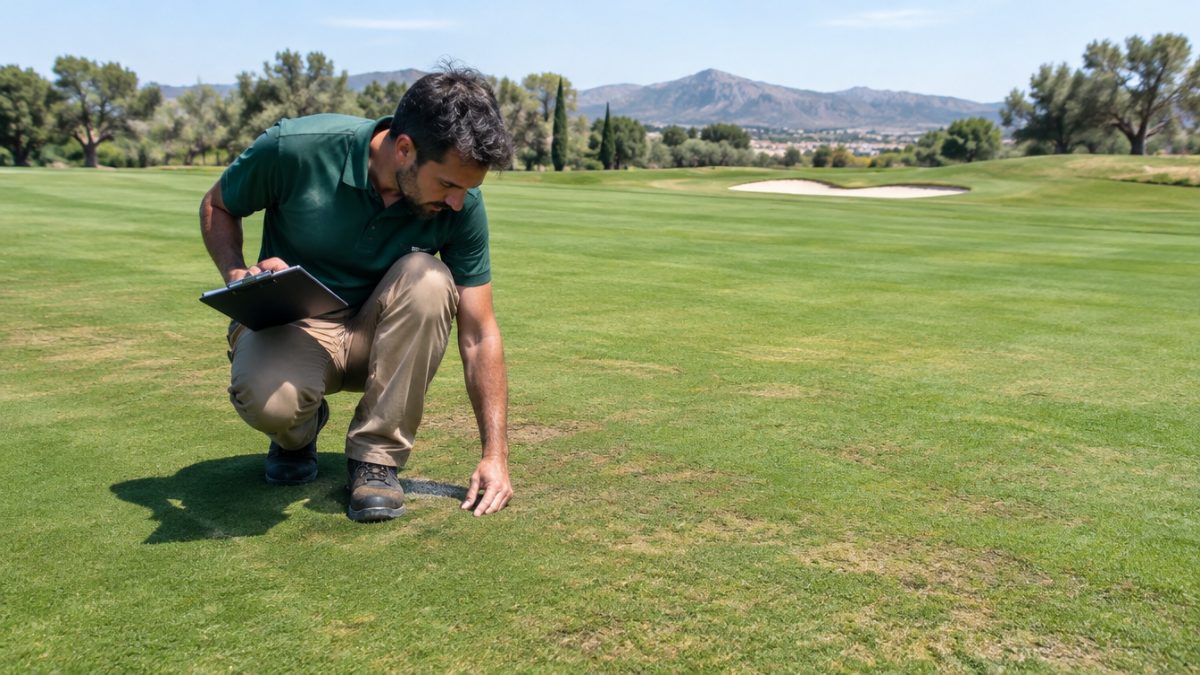
A characteristic clue of Pythium in turf is that the damage tends to line up with the paths water takes: runoff lines, swales, machinery tracks or mowing directions. Elongated, winding streaks may appear instead of regular circles.
If you see streak-shaped patches behind a mower or along the route water takes after irrigation, suspect mechanical or water-borne spread. It is a good reason to clean machinery often during the risk period, mow the healthy areas first and leave the doubtful ones for last, and check the surface drainage of the green.
Sign 4: Areas with poor drainage, shade and little air movement
This is not a symptom of the turf, but it is a warning sign about the course: spots where water is slow to drain, where shade prevents drying or where air circulation is poor are the most likely candidates for an outbreak. If a green combines those characteristics, it deserves reinforced scouting.
- Improve drainage with aeration and, if needed, structural solutions.
- Open air corridors by removing obstacles or pruning with judgement.
- Control compaction and the build-up of organic matter.
The faster the surface dries, the fewer chances Pythium in turf has to take hold.
Sign 5: Spells of heat and humidity with no relief
The fifth sign is meteorological. Several nights in a row with high temperatures, high humidity and little air movement make up the perfect scenario. When the forecast announces that kind of episode, the team should activate a reinforced scouting plan.
Cultural management measures, always subject to a technician’s judgement:
- Irrigate only what is essential, pre-dawn and without leaving the profile waterlogged.
- Avoid excess nitrogen in the critical weeks.
- Reduce mechanical stress: mowing heights that are not too low, fewer roller passes and cutting with blades in good condition.
If a fungicide needs to be applied, the decision belongs to an authorised technician or adviser, following the label and current regulations, with applicators who hold the required training.
Record every outbreak to get ahead of the next one
Every episode of Pythium in turf teaches something. Document the date it appeared, the conditions in the preceding days, the greens affected, the cultural measures applied and the result at seven and fourteen days. Add dated photographs and a note on who made each decision.
With two or three summers of data, patterns start to show: the holes that fail first, the number of warm nights that precede an outbreak or the real effectiveness of certain management routines. That written memory of Pythium in turf turns emergency reaction into a strategy, and lets you explain to the greens committee why certain scouting is prioritised during the highest-risk weeks.
Further reading: USGA. The USGA offers technical information on turf diseases and green management under stress conditions.
Frequently asked questions
How do you recognise Pythium in turf?
By dark spots, water-soaked leaves, sometimes a cottony mycelium on humid mornings and damage that follows the flow of water. Because other diseases look similar, the prudent course is to photograph, locate the focus and ask a technician or a laboratory for confirmation.
When is Pythium in turf most likely?
In summer or warm spells with mild nights, high humidity, saturated soils and little air movement. It is more common in cool-season species and in areas with poor drainage or shade. Watching the weather and the condition of the profile helps anticipate episodes.
Can Pythium in turf be prevented with cultural management?
To a large extent, yes. Good drainage, moderate pre-dawn irrigation, air movement, balanced nitrogen and less mechanical stress reduce the risk. If pressure is high, an authorised technician will assess other measures, always following the label and current regulations, with a complete record of every intervention.
Keep reading
- Fusarium in turf: causes and management Fusarium patch in turf: 5 winter measures
- Dollar spot: how to recognise and prevent it Dollar Spot: 6 Keys to Detect and Stop It Early
- Brown patch in turf: control guidelines Brown Patch in Turf: 5 Control Guidelines