
It all starts with a warm, humid night, a leaf blade that never dries and a circle of turf that looks dull at dawn. Brown patch is one of the most common fungal diseases in the hot months, and it becomes a real headache when it coincides with excess irrigation, too much nitrogen or dense turf with poor air movement.
Here are five guidelines that help control brown patch through day-to-day management: how to recognise it, which factors favour it, how to adjust irrigation, mowing and fertilization, and why recording every decision matters as much as the intervention itself.
Guideline 1: Recognise brown patch early
The disease is caused by fungi of the genus Rhizoctonia, which live in the soil and in the thatch and become active when high temperatures, high ambient humidity and leaves that stay wet for many hours occur together. It affects several species, especially cool-season grasses in summer, although it also shows up in warm-season turf under specific conditions.
A few signs that help identify it:
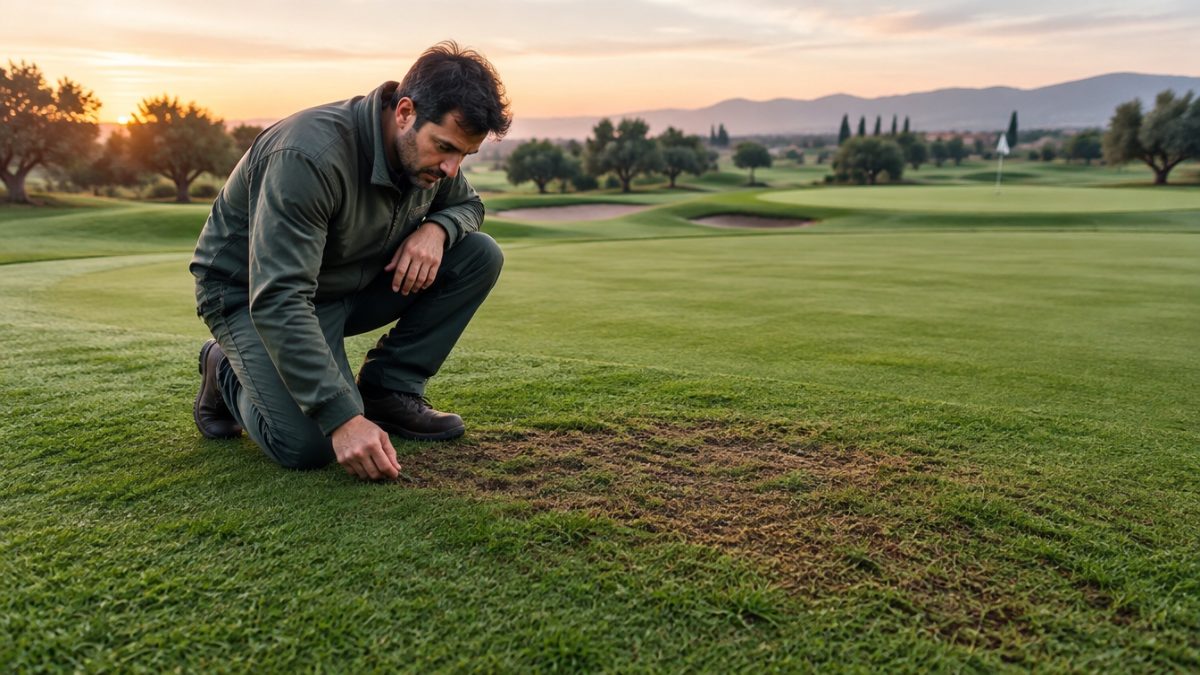
- Circular or irregular patches of tan or brown turf, of very variable size.
- On dewy mornings, a dark halo may be visible at the edge, which some call a smoke ring.
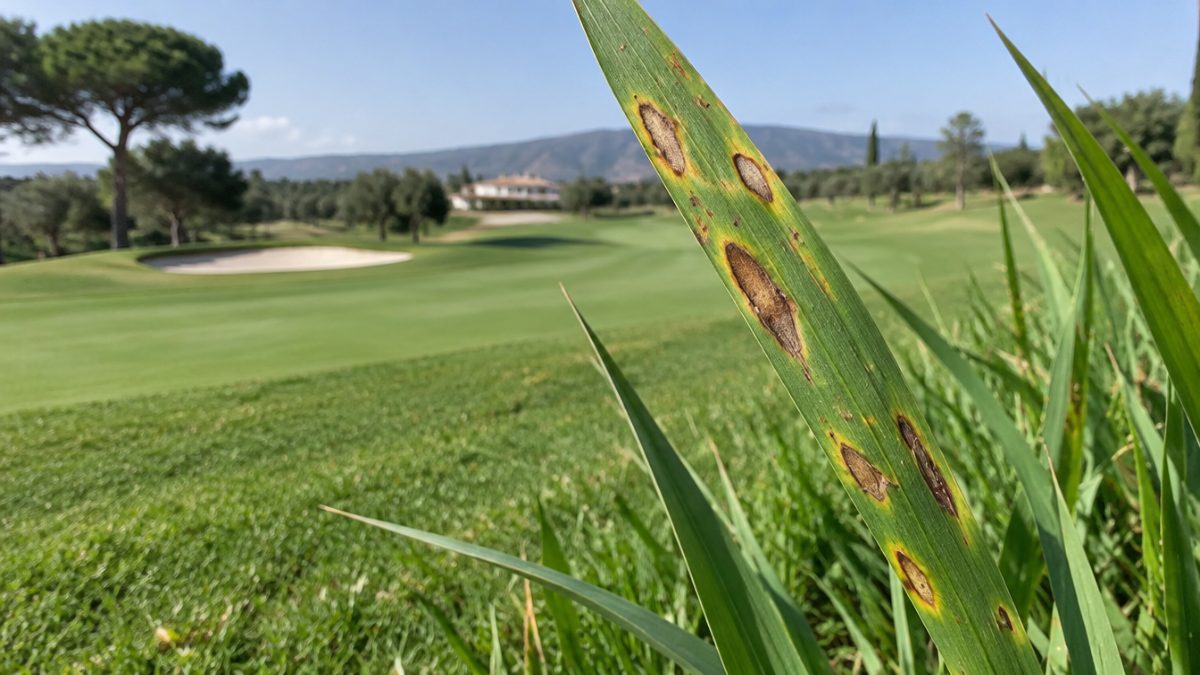
- Leaves with elongated lesions, brown margins and a paler centre.
- Low areas with poor air circulation or a lot of organic matter are the most affected.
If in doubt, ask a technician to confirm the diagnosis: other diseases look similar and need different management.
A simple way to sharpen identification is to walk the greens at dawn, while the dew is still present, during the weeks of risk. Lesions and halos are much easier to see on a wet leaf in low-angle light, and spotting brown patch in its first hours lets you outline the focus and protect the rest of the surface.
Guideline 2: Adjust irrigation to shorten leaf wetness
Water on the leaf is the fuel of the disease. The longer the leaf stays wet, the more likely infection becomes, so changing irrigation is the measure with the best effort-to-result ratio against brown patch.
Prioritise pre-dawn irrigation, which finishes before sunrise and lets the leaf dry quickly, and avoid watering in the late afternoon, when the turf will stay wet all night. Space out irrigation events but apply deeper volumes, to encourage rooting and avoid constant surface moisture. Remove morning dew by mowing early or dragging, which cuts the hours of leaf wetness.
If the course has several irrigation zones, check that run times do not overlap and that sprinklers on the edges do not over-wet low areas. On sloping greens, water tends to collect in the depressions, exactly where brown patch usually starts. Adjusting the distribution with selective hand watering, instead of irrigating the whole green equally, saves water and lowers the risk.
Guideline 3: Balanced fertilization in summer
Excess nitrogen, especially fast-release nitrogen, produces soft, dense turf that favours the disease. In periods of risk it is wise to moderate inputs and prioritise a balance with potassium and micronutrients, based on the soil test and the needs of the species.
Too little is also a problem: hungry turf recovers worse. That is why brown patch should be tackled with a coherent fertilization plan, not with drastic cuts. Schedule applications from data rather than impulse, and avoid fertilizing right before a spell of hot, humid weather if you have already detected earlier outbreaks.
Another overlooked point is the pH and salinity of the soil and the water: imbalances stress the turf and make it more vulnerable. An annual soil test, interpreted with a technician’s help, avoids blind corrections and reduces the brown patch episodes that keep recurring for no apparent reason.
Guideline 4: Reduce density, thatch and retained moisture
Very dense turf, with excess thatch, holds moisture and hinders air movement, creating the perfect microclimate for the fungus. Aeration, light scarifying, gentle verticutting and regular top-dressing help keep a healthier profile and let the surface dry sooner.
Also check the surroundings: trees and shrubs that block the wind or cast shade in the early hours can keep the leaf wet for longer. Selective pruning or opening air corridors improves chronic brown patch areas that no treatment solves durably.
On mowing height, avoid lowering it abruptly in the middle of the risk period, and clean the blades often so the fungus is not spread by the machine. It also pays to mow the healthy areas first and leave the affected ones for last, or dedicate a separate mower to them, so spores are not carried from one green to another.
Guideline 5: Act with technical judgement and record everything
If cultural management is not enough, the decision to apply a fungicide belongs to a technician or authorised adviser, who will weigh the diagnosis, the disease pressure and the right product. Any application must follow the label and current regulations, and be carried out by personnel with the required training.
Regardless of the treatment, record everything: outbreak date, areas, weather in the preceding days, cultural measures applied, products used and the outcome. That history shows whether brown patch always appears on the same holes or after certain combinations of weather and management.
- A dated photograph of each focus.
- Follow-up at seven and fourteen days on how it evolves.
- Notes on what worked and what did not.
With a few seasons of data, the team can anticipate, prioritise scouting and avoid knee-jerk interventions.
Further reading: GCSAA. The GCSAA gathers practical information on turf diseases and integrated management that can complement this guide.
Frequently asked questions
When does brown patch appear?
It usually appears in warm, humid periods, with mild nights, heavy dew or long irrigation cycles that keep the leaf wet. It is more common in dense turf with excess nitrogen and poor air movement. In a Mediterranean climate, late summer and early autumn call for special vigilance.
Can brown patch be controlled without fungicides?
Cultural management greatly reduces the pressure: early irrigation, fewer hours of leaf wetness, balanced fertilization, aeration and good air movement. If damage still occurs, the decision on a treatment belongs to an authorised technician, who will indicate when it is needed and how to apply it in compliance with regulations.
Does brown patch kill the plant?
It usually damages mainly the leaves, and the turf tends to recover if growth continues and the causes are corrected. In severe attacks or on weakened turf there can be significant loss of density, so it pays to act early and monitor the recovery of the affected areas.
Keep reading
- Fusarium in turf: causes and management Fusarium patch in turf: 5 winter measures
- Dollar spot: how to recognise and prevent it Dollar Spot: 6 Keys to Detect and Stop It Early
- Pesticide application records in golf Pesticide Application Records: 6 Key Data Points