

Among the biodiversity measures a club can adopt, few combine so much impact with so little cost as nest boxes on golf courses. They give insect-eating birds a place to raise their young, add to the well-kept image of the course and are an excellent way to explain the club’s environmental commitment to members and visitors.
That said, a box hung at random rarely works. For nest boxes on golf courses to be genuinely useful, you need to pick the right model, place them with care and look after them every year. Here are the five steps we recommend, with practical details for the maintenance team.
Step 1: define the objective and consult a local expert
Before buying anything, decide what you want to achieve: favour common insect-eating birds, support the nocturnal raptors that control rodents, or simply increase wildlife in one particular area. Each objective calls for a different type of box.
Talk to a local ornithological society, a biologist or the municipality’s environmental officer. They will know which species are common in the area, which models work and what care they need. This first conversation prevents mistakes and often opens the door to very valuable collaborations for the club. Anyone who has already installed nest boxes on golf courses knows that the support of an experienced local volunteer is worth more than any catalogue.
- Note the species already seen regularly on the course.
- Ask about protection restrictions or nesting-season dates.
- Decide how many boxes your team can realistically maintain.
Step 2: choose suitable models for nest boxes on golf courses
The size of the entrance hole, the depth of the box and the material determine which species will use it. Boxes made of untreated wood, or with exterior treatments that are safe for wildlife, are usually a good option; the inside should be left unpainted. Models that can be opened for annual cleaning are also recommended.
- Entrance hole sized for the target species.
- Sloped roof with good thermal insulation.
- Drainage and ventilation holes in the base.
- Removable lid or front panel so you can inspect without damaging the box.
If the club has its own workshop, it can even build the boxes with maintenance staff, a project that also involves the team and lowers the cost.
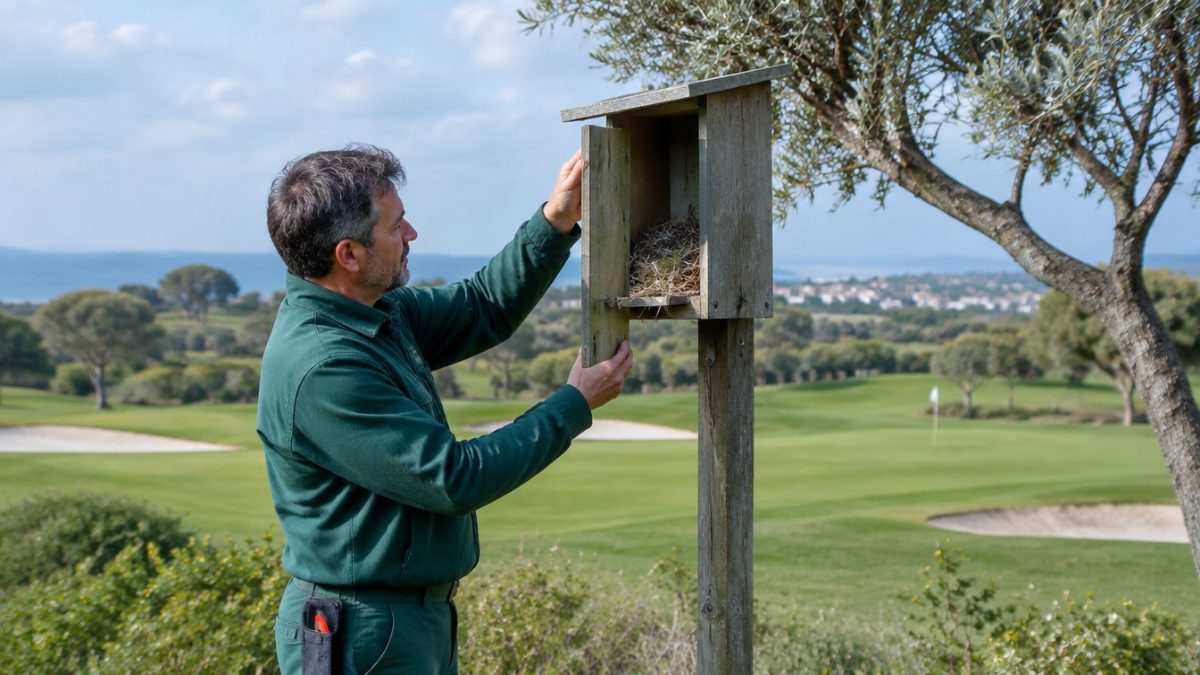
Step 3: place boxes in quiet, well-oriented areas
Location decides success. Look for mature trees or posts in areas with little traffic from players and machinery, close to vegetation and food sources. Avoid spots next to heavily played holes, where stray balls or machinery noise can disturb nesting.
Orient the entrance so that it is sheltered from prevailing winds and from direct sun during the hottest hours. In a Mediterranean climate, excess heat inside the box is a real problem, and good shade can make all the difference.
- Mark candidate areas on a map, away from the line of play.
- Check orientation and shade on foot throughout the day.
- Space the boxes far enough apart from one another.
- Avoid placing them near cat feeding points or areas with frequent predators.
Step 4: install nest boxes on golf courses safely
When installing the boxes, the priority is not to harm the tree or the people. Use fixings that do not strangle the trunk, such as straps or suitable hardware, and check that the support can withstand wind and weight. A box that falls or tilts is a hazard and a waste of resources.
Working at height means following the club’s occupational safety rules: a stable ladder, a colleague to help and the right equipment. A good nest box programme on a golf course never puts its staff at risk. Choose a reasonable height that lets you inspect the box without risky effort, but keeps it out of reach of curious visitors and predators.
- Fix the box firmly, tilted slightly forward.
- Number each box and mark it on the map.
- Install outside the nesting season to minimise disturbance.
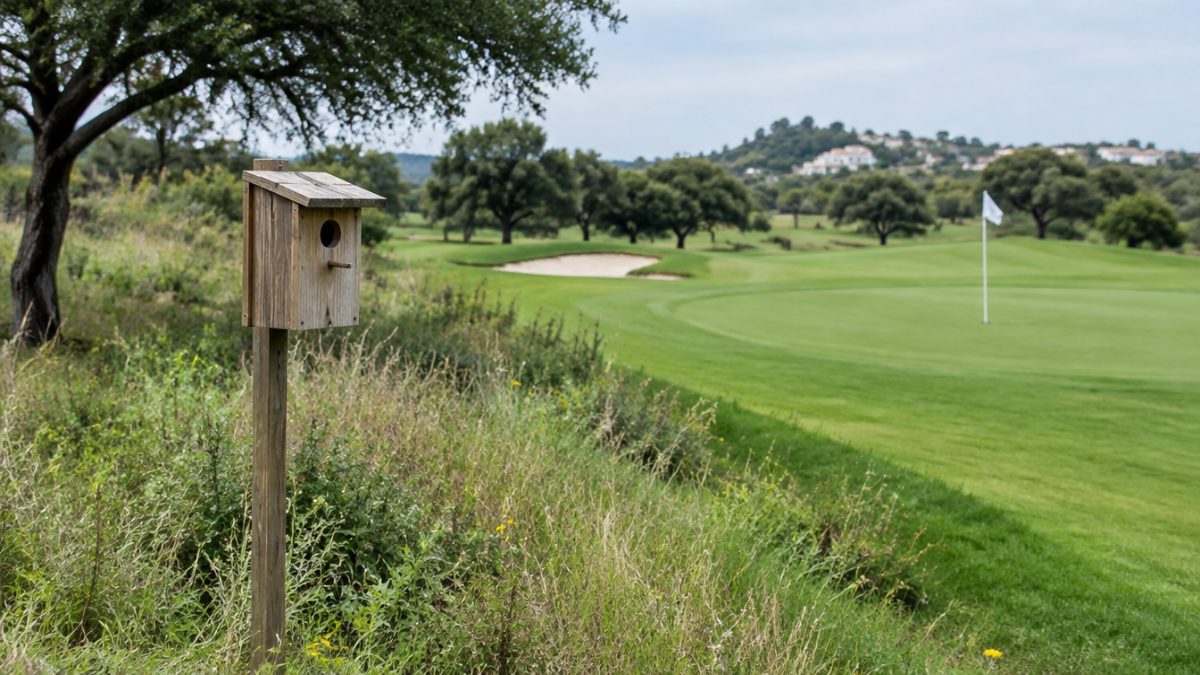
Step 5: check and clean nest boxes on golf courses every year
A nest box needs maintenance. At the end of the nesting season, open it, remove the old material and check the condition of the wood, the roof and the fixing. An annual check prevents parasites, damp and deterioration, and extends the life of the box for many years.
Use these visits to note whether the box was occupied, by whom and with what result, always without disturbing the occupants during nesting. With a few years of data you will know which locations work best, be able to adjust the model and report results to members. Nest boxes on golf courses that are recorded consistently end up becoming a small wildlife database for the club itself, very useful for any certification or environmental report.
- Check and clean after the nesting season.
- Repair or replace damaged boxes.
- Record occupancy and observations for each box.
Communicate the project and measure its impact
Nest boxes on golf courses have an added advantage: they are visible and easy to explain. A map of their locations, photographs from each season and a small information panel help members and visitors understand the value of the course’s biodiversity. It is a great resource for activities with schools, local associations or volunteer days.
Also measure the impact with simple indicators: number of boxes installed, percentage occupied, species observed and staff hours spent. These data are cheap to obtain and fit into any environmental or sustainability report for the club.
Further reading: SEO/BirdLife. For advice on species and models, you can turn to SEO/BirdLife, Spain's leading ornithological society.
Frequently asked questions
How many nest boxes on golf courses should be installed?
There is no universal number; it depends on the area, the trees and the time your team has to maintain them. It is better to start with a few well-placed, well-checked boxes than with many abandoned ones. With the experience of the first seasons, you can expand the programme with good judgement.
When should nest boxes be put up?
Ideally they should be installed before the nesting season, in late autumn or during winter, so the birds have time to get used to them. If they go up later, they may not be occupied that year. Avoid handling them while there are active nests, because you could disturb the occupants.
Who is responsible for checking nest boxes on golf courses?
It is best to assign the task to a specific person on the maintenance team, with support from an ornithological society if possible. The annual check should be in the work calendar, along with cleaning and repair, so that nest boxes on golf courses are not forgotten as the seasons go by.
Keep reading
- Tree management on golf courses Tree management on golf courses: 6 pruning criteria
- Biodiversity on golf courses: where to start Biodiversity on Golf Courses: 7 Practical Actions
- Naturalised areas in golf: how to design them Naturalised Areas in Golf: 6 Management Keys