
Treating by the calendar, just in case or under pressure from members is an expensive and unsustainable recipe. Integrated pest management proposes the opposite: know what is happening on the course, prevent with cultural practices and turn to a treatment only when justified and in the most selective way possible.
In this article we break down six steps to implement that approach on your golf course, which tools you need for it and how to document each decision, something increasingly important for management, for the club and for the environment.
Step 1: integrated pest management starts with knowing the course
Integrated pest management starts with a baseline diagnosis: which turf species are present, which problems recur, in which areas and in which seasons. Make a map of the historical hotspots of disease, weeds and insects; it will show you that many incidents always appear in the same places, usually because of shade, poor drainage or excess moisture.
Then define, together with your adviser, what level of damage is tolerable in each area. A green allows less than a rough, and a tee box less than a bank. Those thresholds avoid both inaction and unnecessary treatment.
It is useful for the threshold to be written in observable terms: percentage of surface affected, number of outbreaks or sustained presence over several days. That way, any member of the team can apply the same integrated pest management criterion without depending on the opinion of one person.
Step 2: prevent with cultural practices
The first line of defence is not chemical, but cultural. Healthy turf resists better and recovers sooner. The measures with the most impact are usually:
- Improve drainage and reduce persistent surface moisture.
- Control organic matter with suitable aeration and top-dressing.
- Adjust fertilisation to avoid excess nitrogen that softens tissue.
- Irrigate at the times and frequency that least favour pathogens.
- Keep a suitable mowing height and well-sharpened blades.
- Encourage air movement and light, by pruning or removing obstacles.
Each of these measures seems small, but together they greatly reduce disease pressure. A course with good drainage, little organic matter and air circulating between fairways needs far fewer interventions: that is the real foundation of integrated pest management.
Step 3: monitor with method and regularity
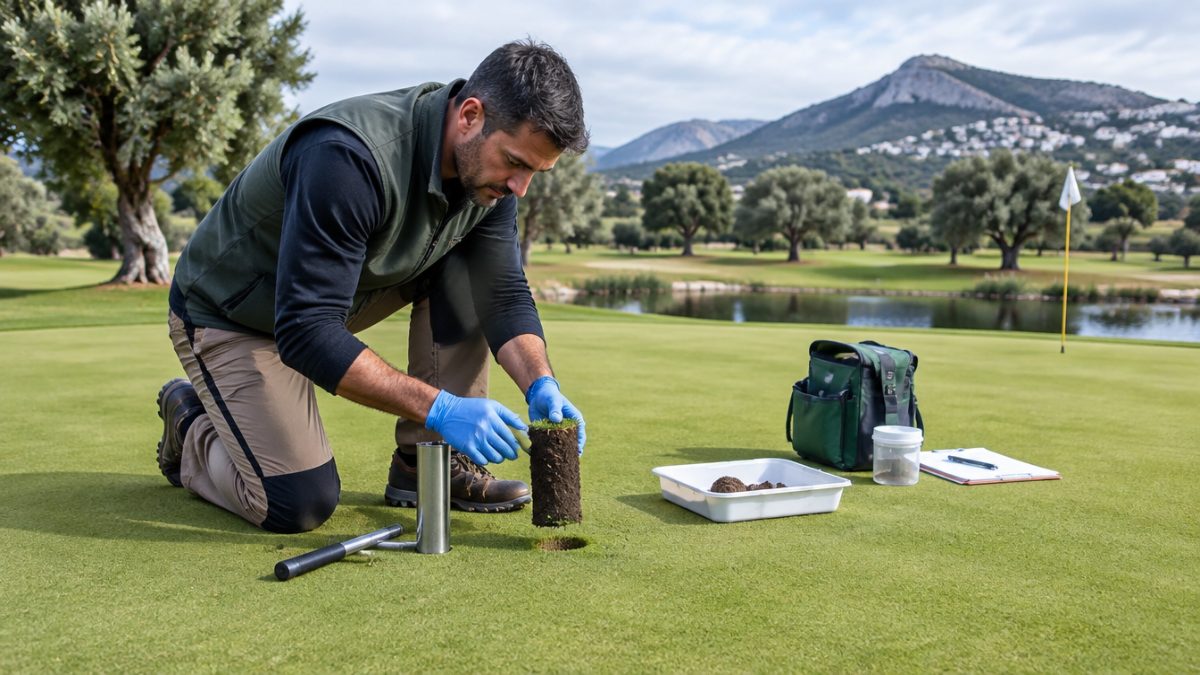
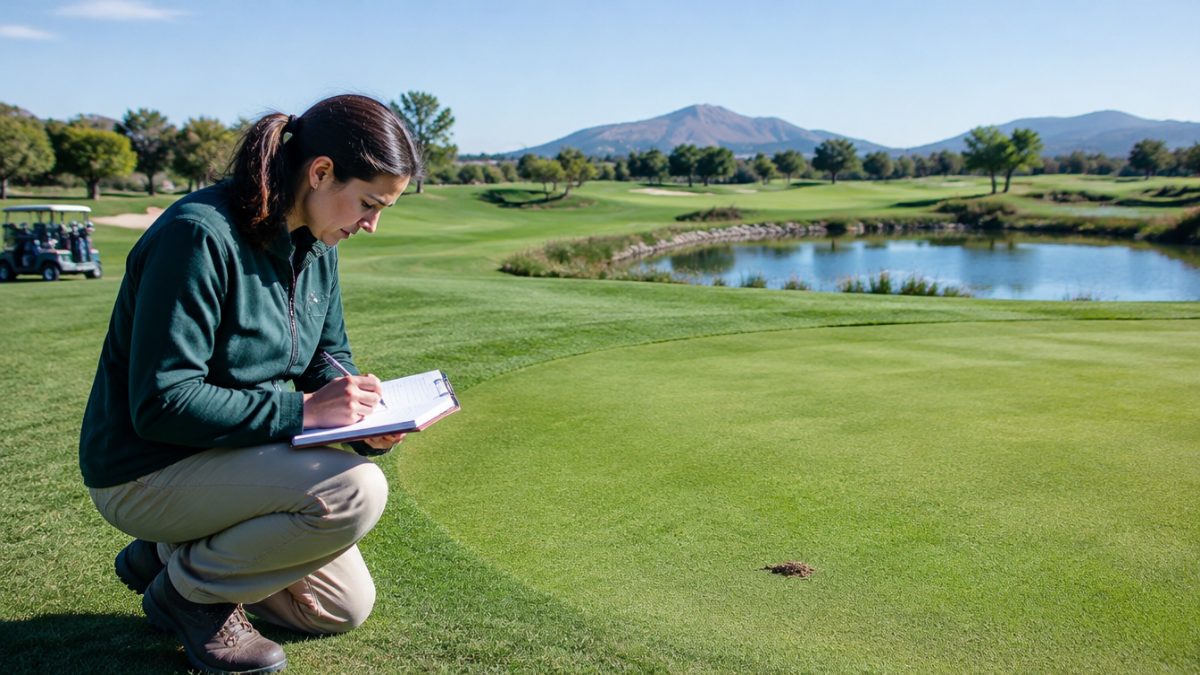
You cannot manage what you cannot see. Systematic monitoring is the heart of integrated pest management. Define inspection routes, frequency and observation points, and write down what you see even when there is no problem, because “nothing to report” is also information.
- Walk sensitive areas first thing, when there is dew and symptoms are easier to see.
- Take dated photographs with the same framing.
- Use simple sampling to estimate the presence of insects in the soil.
- Note conditions: temperature, humidity, rainfall and recent irrigation.
With a few weeks of data you will begin to detect patterns that previously went unnoticed.
Involve the whole team: the operator who mows every day is the first to see a colour change or an area that does not respond. If they know what to look for and whom to tell, integrated pest management stops depending on a single weekly inspection.
Step 4: identify correctly before deciding
Acting against a wrongly identified problem is throwing money away. A yellow patch may be due to disease, an irrigation fault, a fuel spill, insect damage or a nutritional imbalance. Before deciding anything, confirm the cause.
To do so, rely on detailed observation, the history of the area and, when needed, laboratory analysis or consultation with a specialist technician. A correct identification lets you choose the most selective measure and avoids broad treatments that harm beneficial organisms.
Step 5: choose the most selective and safe intervention
When monitoring confirms that the threshold has been exceeded and cultural measures are not enough, it is time to consider an intervention. Integrated pest management advises a ladder:
- Additional cultural and physical measures.
- Biological or low-impact methods, where feasible.
- Plant protection products, only if authorised and the situation requires it.
In the latter case, the decision belongs to an authorised adviser, and application must follow the product label, current regulations and safety measures for people and the environment. It is advisable to rotate modes of action to avoid resistance, always under technical advice.
Timing and conditions should also be considered: do not apply in wind, avoid water bodies and protect operators with the right equipment. Responsible integrated pest management always takes people and the environment into account.
Step 6: record, evaluate and learn from every intervention
The cycle does not close when the treatment ends, but when you check whether it worked. Record what the problem was, where, with what threshold, what measure was taken, who applied it, under what conditions and what the result was in the following weeks.
That information serves three purposes: demonstrating regulatory compliance, optimising future decisions and communicating transparently with the club. With your own data you will be able to answer confidently when someone asks why an area was treated or why it was not.
Benefits and obstacles of adopting this approach
Adopting integrated pest management brings clear advantages: less reliance on products, a better image with the community, greater biodiversity on the course and more defensible decisions. In return, it requires consistency in record keeping, team training and patience, because the results of cultural measures show over time.
The most common obstacles are pressure for a perfect appearance, lack of time to monitor and the absence of historical data. They are overcome by starting small: a pilot area, an inspection route and a simple record sheet. After a couple of seasons, the team sees that treatments happen less often and with more judgement, and the green committee itself often becomes the method’s best advocate.
Further reading: MITECO. For the general framework on the sustainable use of plant protection products you can consult Spain's Ministry for the Ecological Transition and the Demographic Challenge.
Frequently asked questions
What is integrated pest management on a golf course?
It is a strategy that combines monitoring, prevention through good cultural practices and treatments only when defined thresholds are exceeded. It prioritises cultural measures and lower-impact methods, and reserves plant protection products for when they are necessary, with technical advice and in compliance with regulations.
Does integrated pest management eliminate chemical treatments completely?
Not necessarily. It seeks to reduce them to the essential and to use them more selectively. When a product has to be applied, an authorised adviser must decide, the label must be followed and current regulations respected. The aim is to treat less often and with better judgement, not to ban outright.
Where do I start implementing integrated pest management?
Start with a map of historical hotspots, a regular inspection route and a simple record sheet. Choose a pilot area, define thresholds with your adviser and review results at the end of the season. Going step by step makes it easier for the team to adopt the routine without feeling it is an excessive burden.
Keep reading
- strategies to control pests and diseases Strategies to control pests and diseases in golf turf
- winter measures against Fusarium Fusarium patch in turf: 5 winter measures
- pine processionary moth: safe measures Pine processionary moth on golf courses: 5 safe measures