

Few breakdowns cause as much grief on a course as an oil spill on a green. Behind it there is almost always a part that gave warning for days: a damp hose, a dripping fitting, a falling oil level. Hydraulic leaks rarely appear all at once; they almost always announce themselves, and whoever can read those warnings saves repairs, fines and a great deal of recovery work.
In this article we review five signs to act in time, a simple daily inspection procedure, and what to do if the spill has already happened. The aim is for the mechanic and operators to share the same language when faced with any suspicious symptom.
Sign 1: stains and dampness on hoses, fittings and cylinders
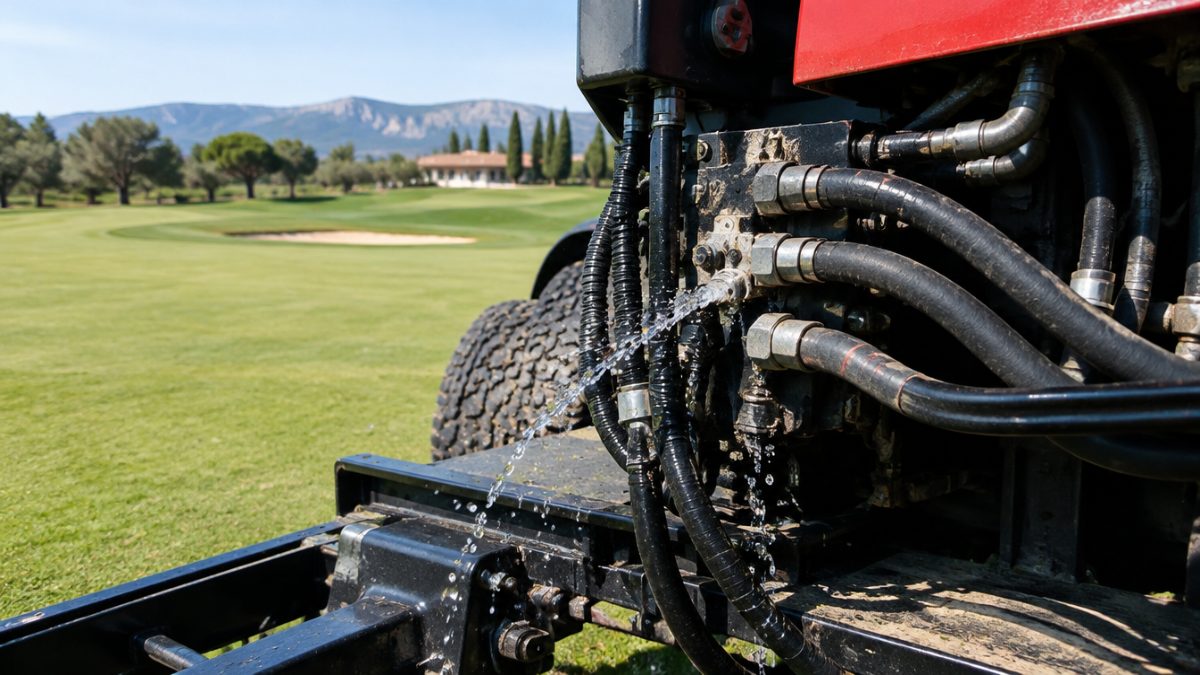
The most obvious sign of hydraulic leaks is oily dampness at any point in the circuit. A fitting that shines, dust stuck to part of a hose or a cylinder with a film of oil on the rod indicate that the seal is starting to fail.
During the machine’s daily cleaning, pay attention to:
- Joints between hoses and metal pipes.
- Areas where hoses rub against the chassis or each other.
- The seals of the lift cylinders on the cutting units.
- Plugs, filters and gaskets on the pump and the reservoir.
A clean machine lets you see these signs; a dirty machine hides them. That is why washing at the end of the shift is not just cosmetic, but part of controlling hydraulic leaks.
Sign 2: the oil level drops for no apparent reason
If the reservoir has to be topped up more often than usual, something is being lost. Hydraulic oil consumption in a healthy machine is minimal, so a repeated drop in level deserves immediate investigation, even if no puddle is visible.
To detect it rigorously:
- Check the level with the machine on level ground and the oil at the temperature indicated by the manufacturer.
- Note the amount you add and the date on the machine’s record sheet.
- Compare consumption with that of similar machines in the fleet.
Sometimes the leak is internal or hidden under guards and covers. A continuous record of top-ups is the best tool for revealing small hydraulic leaks that would otherwise go unnoticed for weeks.
Sign 3: loss of power, sluggishness or abnormal noises
The hydraulic system transmits power through pressure. When there are internal or external hydraulic leaks, that pressure drops and it shows in the machine’s behaviour. The symptoms can be subtle at first.
Look out for situations like these:
- The cutting units lift or lower more slowly than normal.
- The traction loses push on slopes it used to climb without trouble.
- Whistles, knocking or vibrations appear when a control is activated.
- The oil gets hotter than usual during work.
The operator who uses the machine every day is the one who best perceives these changes. It is worth creating a culture where any odd feeling is reported without hesitation, because stopping in time costs far less than dragging a fault along until it immobilises the machine.
Sign 4: marks on the turf and soil after the machine has passed
When hydraulic leaks are already visible on the course, the turf gives them away. A continuous drip leaves a trail of dark or yellowish patches that burns the leaf and damages the soil. If it appears at the turning points of a green, it usually corresponds to a burst hose or a leaking cylinder.
If it happens, act quickly:
- Stop the machine and avoid continuing to work with the fault.
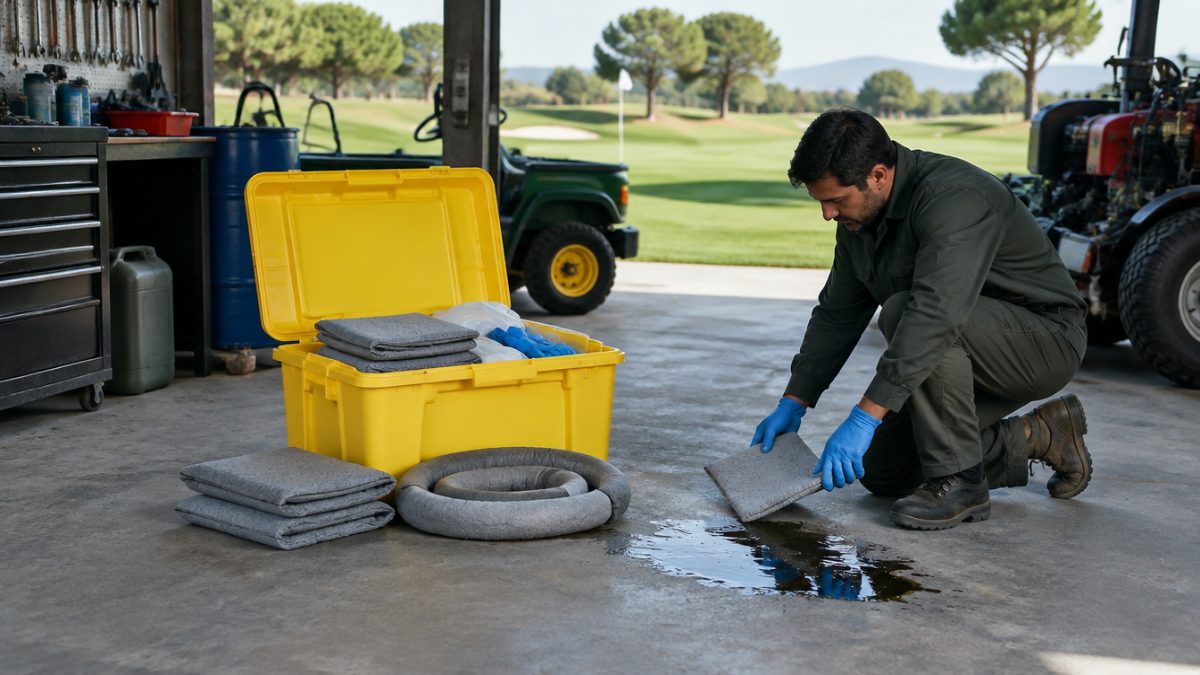
- Cover the spill with absorbent material, without spreading it with water.
- Remove the contaminated turf and soil according to the club’s protocol.
- Manage the waste in accordance with current regulations on hazardous waste.
The surface then has to be repaired with reseeding or sod. The best medicine against this damage is prevention: keep spill kits on the machines and train staff to use them.
Sign 5: cracked, hardened or very old hoses
Hydraulic leaks are not always a sudden problem; often they are the natural result of wear. Hoses crack through heat, solar radiation, rubbing and working pressure. When they harden, they lose flexibility and end up bursting.
Check periodically for:
- Cracks or blisters in the outer cover.
- Hoses that are crushed, twisted or have bends that are too tight.
- Loose fixings that allow vibration and rubbing.
- The manufacture or installation date, if shown on the hose.
Replacing critical hoses preventively, according to the manufacturer’s recommendations and the condition observed, is almost always cheaper than a breakdown in the middle of the season. Noting the date of each change lets you plan replacements calmly.
Inspection routine to detect hydraulic leaks every day
The five signs above become effective when they are built into a routine. A visual inspection of a few minutes before and after work detects most hydraulic leaks at an early stage.
A practical sequence is:
- Check the oil level before starting.
- Look under the machine for drips or marks on the workshop floor.
- With the machine running, observe hoses and cylinders during manoeuvres.
- When finished, wash and inspect again with the machine clean.
- Note and report any anomaly to the mechanic.
Ideally, that information is recorded in the machine’s service history, together with repairs and oil consumption. Over time, that history shows which machines cause the most problems and when it is more worthwhile to replace them than to keep repairing them.
Further reading: EPA. The US Environmental Protection Agency (EPA) offers general guidance on preventing and cleaning up petroleum spills.
Frequently asked questions
What do I do if I detect hydraulic leaks in the middle of the shift?
Stop the machine safely, avoid continuing to work and contain the oil with absorbent material before it reaches the turf or a watercourse. Inform the mechanic and note what happened. Contaminated waste must be managed in accordance with current regulations, with an authorised handler where applicable.
How often should hydraulic hoses be checked?
A reasonable approach is a daily visual inspection during cleaning and a more detailed check within the preventive maintenance plan, following the manufacturer's guidelines. Hoses exposed to a lot of heat, rubbing or pressure may need replacing sooner, so their actual condition matters more than a fixed calendar.
Does a biodegradable oil eliminate the risk of hydraulic leaks?
No, it reduces the environmental impact of a spill, but it does not prevent one from happening. Hydraulic leaks still cause turf damage, loss of performance and breakdowns. That is why prevention, maintenance and spill kits are still necessary, and the compatibility of the oil with the machine should be checked before changing it.
Keep reading
- key tasks in the preventive maintenance of machinery Preventive Equipment Maintenance: 7 Key Tasks
- reasons to use biodegradable hydraulic oil Biodegradable Hydraulic Oil: 5 Reasons to Use It
- steps for reel grinding that cuts cleanly Reel sharpening: 6 steps for a clean cut