

The greenkeeping workshop is where it is largely decided whether the course is ready each morning. A mower that arrives unsharpened, a part that cannot be found or a tool out of place can delay the whole team. And when there is also a rush, the risk of accidents goes up.
Here are seven practical keys to order and safety that you can apply without major works: how to lay out the space, manage oils and waste, protect staff and keep a record of what is done to each machine.
Zone the greenkeeping workshop according to workflow
Before buying shelving, sketch how a machine moves from the moment it comes in dirty until it leaves ready. From that route, define clear zones: washing, inspection and repair, grinding, parts and consumables store, and an orderly parking area.
Separating the dirty area (mud, clippings, grease) from the clean one (spare parts, precision tools, documentation) avoids contamination and lost time. If space is tight, mark the floor with lines and signs: a few visual rules work better than many written ones.
Think about lighting and ventilation too: a dark greenkeeping workshop encourages mistakes when adjusting blades and increases the risk of knocks, while good natural and artificial light improves precision and the crew’s morale.
A place for every tool: boards, outlines and people in charge
A board with outlines of each tool shows at a glance what is missing. It is a simple, cheap solution that cuts searching and losses. If the team is large, assign someone to check the board at the end of the day.
- Everyday tools within easy reach.
- Special tools kept locked away with a loan record.
- Electrical and measuring equipment in a place protected from knocks and damp.
When something breaks, it is removed and tagged. A greenkeeping workshop where doubtful tools are mixed in with good ones ends up causing errors and injuries.
A practical detail: label spare parts by machine and by part number, not just by type of part. That way the mechanic instantly finds what is needed and the manager sees what must be reordered before it runs out.
Safety in the greenkeeping workshop: protection and basic rules
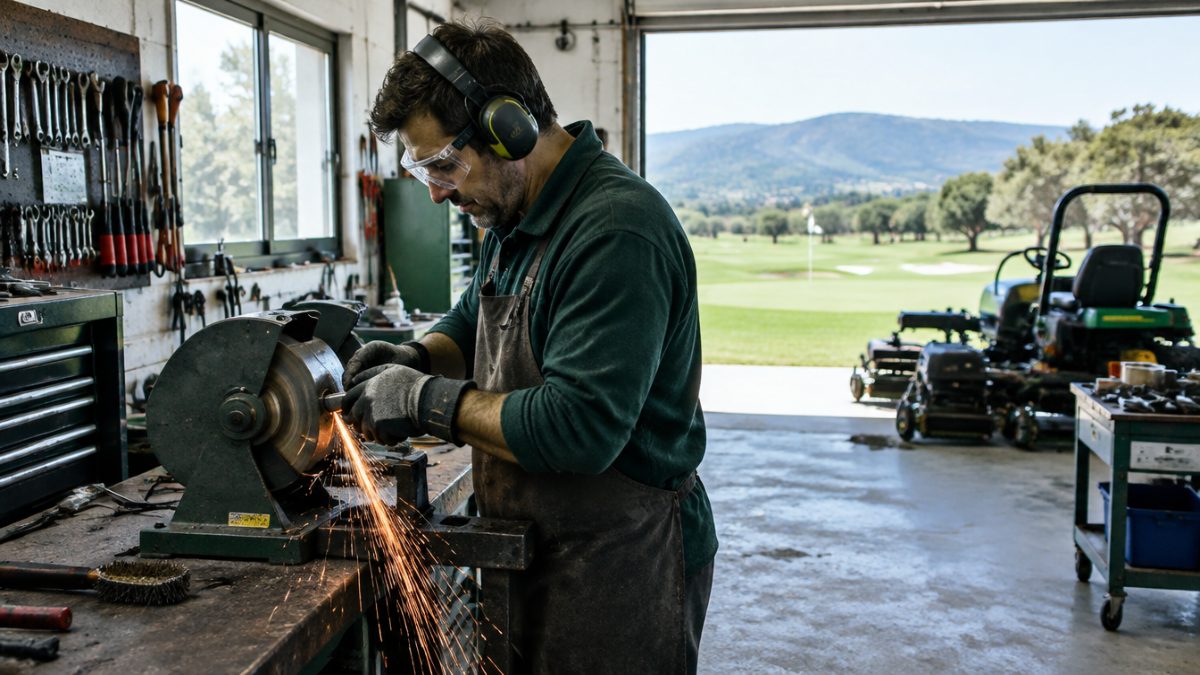
Safety starts with the obvious and is maintained through consistency: goggles, gloves, suitable footwear, hearing protection and clothing that cannot snag. Every risky task (grinding, welding, handling blades, lifting machines) must have its procedure and equipment.
Also check fixed items: accessible extinguishers, a fully stocked first-aid kit, clear exits, sufficient lighting and non-slip floors. Training staff in prevention, following current regulations and with the support of a prevention service, is an obligation and also an investment that avoids sick leave and downtime.
Lifting, supports and safe work with blades
Many accidents happen when working under a poorly supported machine or handling reels and blades without protection. Use supports and lifts in good condition, never improvised substitutes, and check that the machine is chocked and de-energised before working on it.
With cutting units, wear suitable gloves, remove the key and disconnect the battery or power supply where relevant. Grinding and blade adjustment must be done in a clear area, with good light and without interruptions. If something is unclear, stop and ask. In a greenkeeping workshop where there is pressure to have everything ready before the crew heads out, that pause is what prevents the accident.
Put the lockout and tagging procedure for machines out of service in writing, so nobody starts a unit under repair by mistake.
Oils, fuels and waste: orderly and legal management
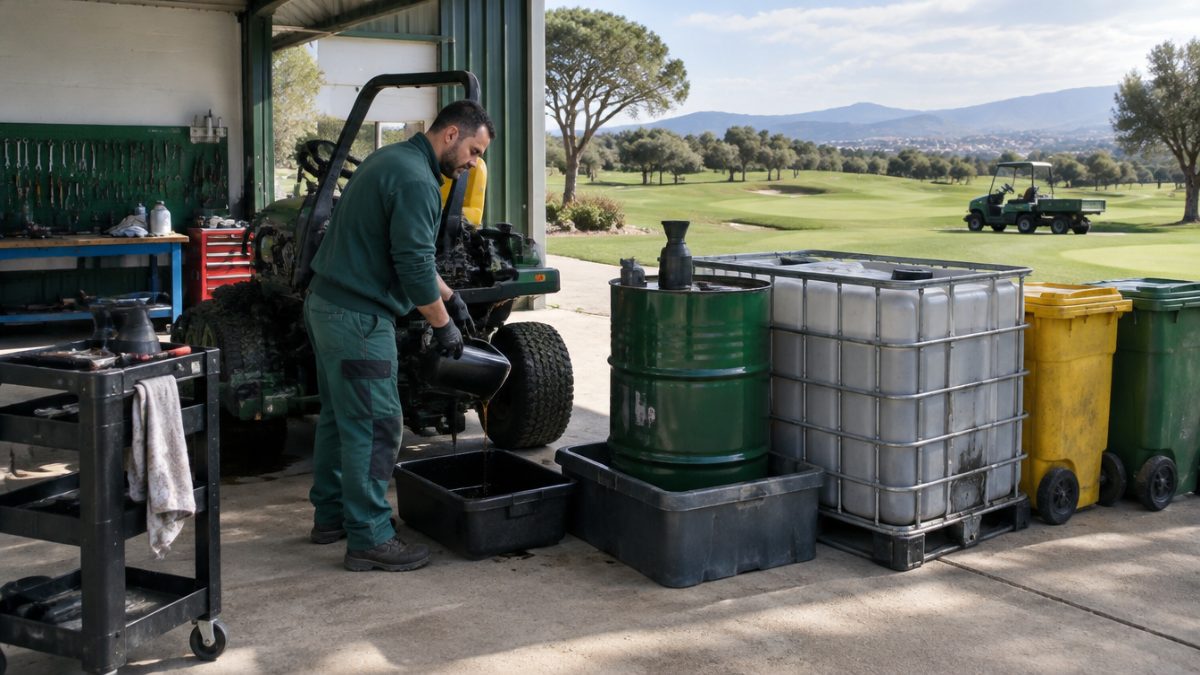
Used oils, filters, batteries, greasy rags and containers are part of daily life in the workshop. Their handling must comply with current regulations: labelled containers, spill trays, a covered area and collection by an authorised waste handler.
- Each waste type in its own container with a visible label.
- Absorbents and a spill kit close at hand.
- Fuel stored away from sources of heat.
- A record of collections and the waste handler’s documents.
A workshop free of stains and odours inspires confidence, and avoids an environmental problem that would be serious for the club’s image. It is part of the culture of a good greenkeeping workshop that everyone knows what to do about a spill, however small.
A service history for each machine and planned maintenance
In the greenkeeping workshop, every machine should have a service history: hours of use, inspections carried out, parts replaced, breakdowns and associated costs. With that information you know when oil, filters or belts are due for replacement, and you can see which machines cause the most trouble.
Planned maintenance reduces breakdowns in the middle of the season. Schedule inspections by hours or by calendar, keep pending jobs visible and record who carries them out. That way the greenkeeping workshop moves from firefighting to working with foresight, and the green committee better understands the value of renewing or repairing.
Add safety incidents to the service history: removed guards, noises, leaks or damaged parts. These are warnings that, properly recorded, help decide when a machine stops being cost-effective or safe.
Daily tidiness and periodic review of the workshop
Tidiness is not a one-off effort but a habit. In the greenkeeping workshop, five minutes at the end of the day to sweep, return tools and note incidents are worth more than a deep clean every quarter. Define who does what and stick to it.
Complement that routine with a more thorough periodic review of the greenkeeping workshop: condition of extinguishers, first-aid kit expiry dates, spare parts order, lighting, ventilation and signage. Record the findings, assign owners and deadlines and check that they are closed. A printed or digital checklist turns good intentions into a stable practice.
Further reading: Instituto Nacional de Seguridad y Salud en el Trabajo (Spain's National Institute for Occupational Safety and Health). For occupational risk prevention guides, you can visit the website of Spain's National Institute for Occupational Safety and Health (INSST).
Frequently asked questions
What should I tidy first in a greenkeeping workshop?
Start with the flow of machines: where they are washed, inspected, repaired and stored. In a greenkeeping workshop, then organise tools and spare parts with boards and labels, and finally mark out risk zones. This order saves time, reduces losses and makes it easier for the whole team to follow the same rules.
How should oils and workshop waste be managed correctly?
By identifying each waste type, storing it in suitable containers on spill trays and handing it to an authorised waste handler, in line with current regulations. Keep the collection documents and review the condition of the area regularly. For specific doubts, consult the prevention service or an environmental technician.
What records should be kept for each machine?
A service history with hours of use, inspections, replaced parts, breakdowns and costs. With that history you can plan maintenance, compare machines, justify replacements to the committee and know which machine is ready each morning without relying only on one team member's memory.
Keep reading
- Preventive maintenance of machinery Preventive Equipment Maintenance: 7 Key Tasks
- Occupational risk prevention in greenkeeping Risk Prevention in Greenkeeping: 7 Practical Measures
- Hydraulic leaks: warning signs to act in time Hydraulic Leaks: 5 Warning Signs to Act in Time