
May is a bit like an advance exam. The turf grows strongly, play intensifies and the heat starts to appear, but there is still room to correct what is not working. The greenkeeper tasks in May are, to a large extent, preparation for summer: what you do now will show in July.
We propose seven key jobs to organise the month, with practical criteria for a Mediterranean climate and advice to keep the team from scattering between emergencies. Adjust each point to your species, your area and your tournament calendar.
Why greenkeeper tasks in May shape the summer
In May three factors coincide: good soil temperature for growth, peak spring play pressure and the approach of intense heat. A course that enters June with deep roots, a reviewed irrigation system and machinery in good order withstands the hard weeks much better.
Conversely, problems carried over from spring, such as poorly distributed irrigation or turf with too much organic matter, are amplified by heat. That is why it is worth treating this month as a window of opportunity and not as just another month of routine maintenance.
A practical way to start is to do a full walk-round at the beginning of the month with the team and note, zone by zone, what is fine, what is a concern and what can be left for later. That short list becomes the real plan for the greenkeeper tasks in May, and stops day-to-day emergencies from eating up your priorities.
Mowing: rhythm, height and cut quality
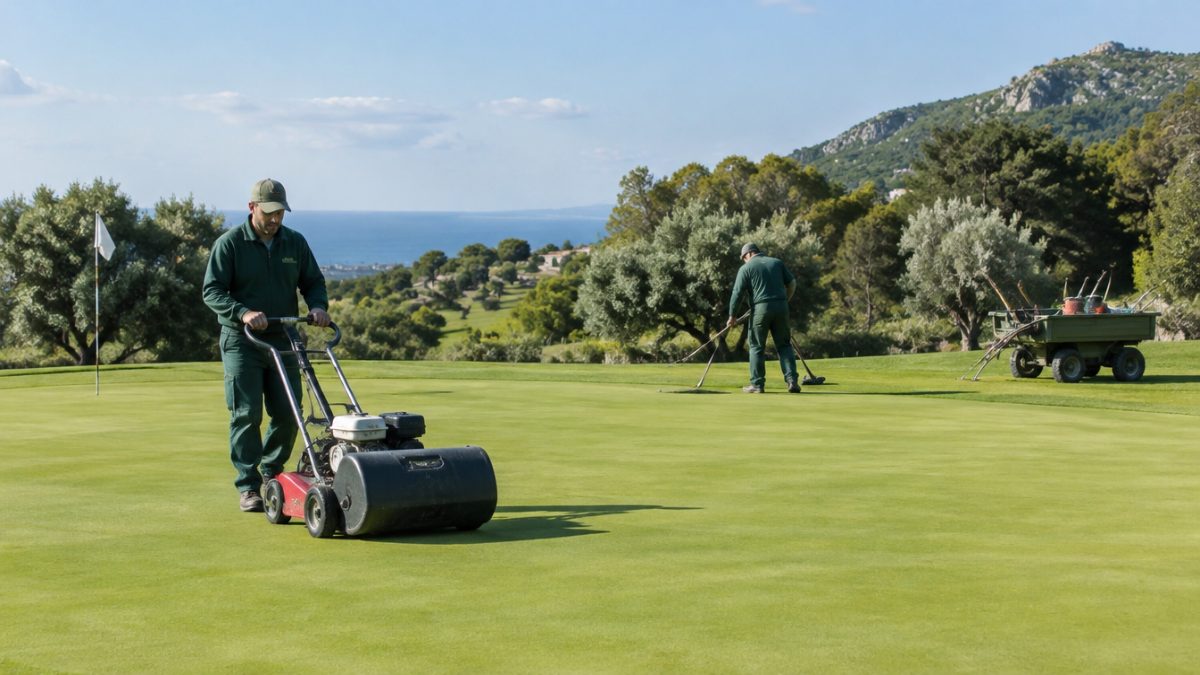
Among the greenkeeper tasks in May, mowing is the most visible: with growth at its peak, frequency rules. Mowing late and then dropping the height sharply stresses the plant and scalps the surface. Some useful criteria:
- Keep up the frequency on greens and tee boxes, without cutting mowing days for lack of staff.
- Avoid removing more than a third of the leaf in a single pass in rough and fairway areas.
- Check the sharpening and the bedknife adjustment, because a torn cut leaves the door open to disease.
- Alternate the mowing direction to avoid grain and striping marks.
If you plan to lower heights ahead of a tournament, do it gradually. It is also worth agreeing a target height per zone with the golf department, so that expectations for speed and firmness are realistic and do not force last-minute cuts that weaken the plant just when it needs strength most.
Irrigation: moving from correction to strategy
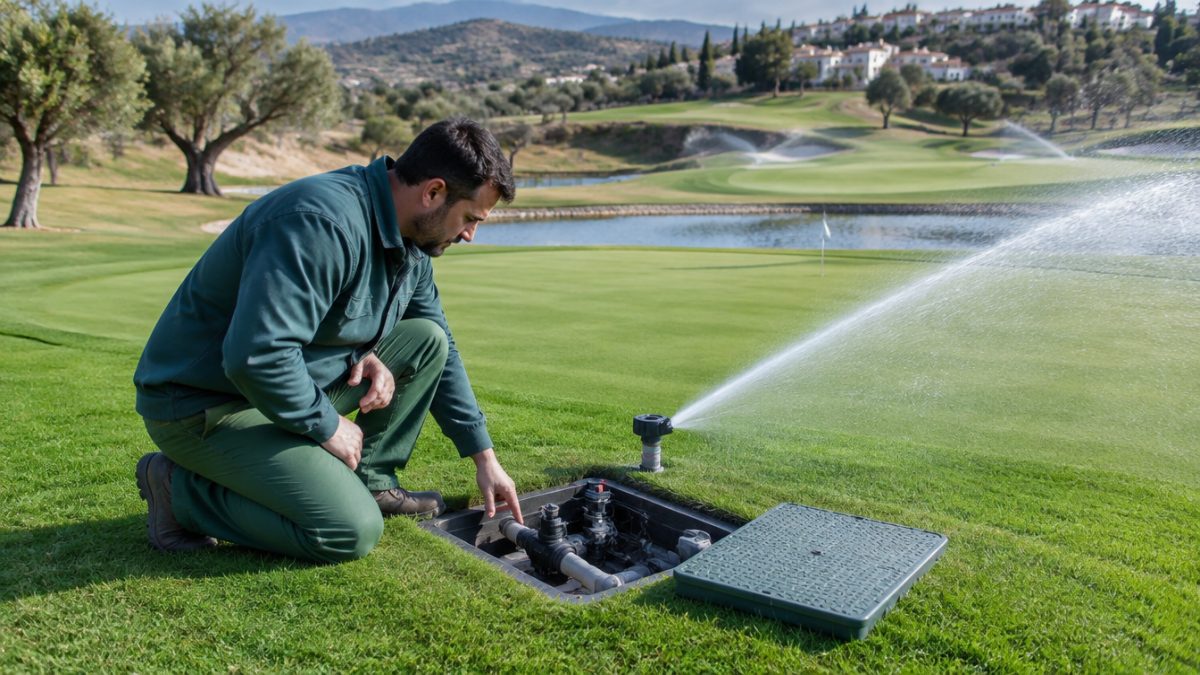
In May you are not yet irrigating at the limit, and that allows a thorough review of the system. It is the time to check pressures, overlaps, nozzles and programmes, and to detect areas that already show signs of water shortage.
Among the greenkeeper tasks in May, fine-tuning irrigation is usually the most profitable: starting to water less often but more deeply encourages roots that later cope better with heat. Recording times, volumes and areas watered from now on lets you compare with the following months.
- Walk the course with the irrigation running to find clogged or tilted heads.
- Check that distribution is uniform on the greens, where a fault shows immediately.
- Look for visible leaks and waterlogged areas that point to a break.
Fertilisation and nutrition to arrive with reserves
Nutrition should support growth without forcing it. In warm-season species, such as bermudagrass or paspalum, May is usually a month of strong take-off and high demand. In cool-season species such as bentgrass, it is best to avoid excesses that predispose the turf to summer stress.
General good practice:
- Base the plan on soil analysis and observed needs, not on inertia.
- Split applications and tie them to the planned irrigation.
- Watch the balance between nitrogen, potassium and micronutrients.
A simple rule: if the turf is growing well and the colour is right, there is no rush to increase the rate. The nutrition side of the greenkeeper tasks in May should build up reserves for summer, not produce lush growth that is then hard to sustain.
Surface work on greens: spiking, verticutting and top-dressing
Within the greenkeeper tasks in May, green maintenance has a special place. May is often a good time for light operations that keep the surface firm and infiltration healthy without penalising play for too long. Notable among them are fine spiking, light verticutting and top-dressing with sand in small, more frequent doses.
The key is judgement: schedule the work when recovery is quick and avoid clashing with important tournaments. Recording date, zone and conditions helps you repeat what works and justify the calendar to members and management. Telling players in advance what is being done and why reduces complaints and builds trust in the team’s work.
Health monitoring and machinery
With mild temperatures and variable humidity, some diseases and pests can appear without warning. Prioritise daily observation, especially on greens and shaded areas, and rely on an authorised adviser for any plant protection intervention, always following the label and current regulations.
In parallel, the machinery is working at full capacity. Among the greenkeeper tasks in May, it is worth including:
- Checking levels, filters and hydraulic hoses.
- Checking the sharpening of the cylinders before cut quality drops.
- Planning critical spare parts so you do not stop in the middle of the season.
Team planning and internal communication
The last of the seven jobs among the greenkeeper tasks in May cannot be seen from the buggy, but it makes the difference: organising the team. In May holidays, tournaments and extra-staff contracts often coincide, and poor scheduling leads to overtime and tasks left undone.
- Assign the weekly jobs in advance and communicate them clearly.
- Leave room for the unexpected, such as an irrigation breakdown.
- Coordinate the tournament calendar and course closures with the golf department.
- Close the week with a review of what was done and what is pending.
A team that knows what is on and why works with less friction and better quality.
Further reading: AEMET. Checking the forecasts and seasonal outlooks from AEMET, Spain's State Meteorological Agency, helps you adjust the work and irrigation calendar to the actual weather.
Frequently asked questions
What are the most urgent greenkeeper tasks in May?
They are usually mowing at the right frequency, a full review of the irrigation system and daily health monitoring. On that base you add adjusted fertilisation and light surface work. Prioritising according to the real condition of the course avoids spending hours on jobs that can wait.
Can deep work be done on greens during May?
It depends on the species and the expected recovery. Light, frequent operations usually fit better than aggressive ones, because the heat is approaching and the surface should heal soon. If in doubt, plan with a margin ahead of tournaments and consult your technical adviser.
How do you organise the greenkeeper tasks in May with limited staff?
Set weekly priorities, assign the jobs by zone and always leave a gap for the unexpected. Documenting what has been done shows where hours are lost and lets you adjust the plan. If staff are short, it is better to do fewer jobs well than many halfway, always protecting mowing and irrigation.
Keep reading
- Greenkeeper tasks in April: key jobs Greenkeeper tasks in April: 7 key jobs
- Greenkeeper tasks in March: key jobs Greenkeeper tasks in March: 7 key jobs
- The importance of efficient irrigation in course care The importance of efficient irrigation in golf course care