

March marks a change of pace on any Spanish golf course. Soil temperature rises, the light increases and the turf starts to demand attention. The greenkeeper tasks in March lay the foundations for what happens in spring and summer, which is why they are best approached with a clear plan and not under the pressure of urgency.
Below are seven key jobs, with practical criteria to organise the month’s agenda, share tasks across the team and keep a record of what is done. Adjust the dates to your area, the course’s altitude and the species you manage: the greenkeeper tasks in March are not identical on the coast and inland.
Greenkeeper tasks in March: watch the turf wake up
The first of the greenkeeper tasks in March is not about doing, but about looking. Warm-season species, such as bermudagrass or kikuyu, come out of dormancy when the soil warms steadily, not when a couple of sunny days mislead you. Cool-season species, such as ryegrass or bentgrass, resume more active growth.
Measure soil temperature at root depth over several days and note the condition of the turf by area. That observation tells you when to scarify, fertilise or raise mowing frequency, and avoids getting ahead of a late frost.
Having this criterion in writing helps make the greenkeeper tasks in March depend not on one person’s instinct, but on a protocol any team member can follow.
Tune up and test the irrigation system
Before heavy demand arrives, check the installation calmly:
- Test each sector and make sure all sprinklers rotate and cover their radius.
- Locate leaks, clogged nozzles and sunken or tilted heads.
- Verify controllers, sensors and the weather station.
- Adjust pressures and clean filters.
Repairing in March is cheaper and less traumatic than doing it in midsummer, with the course demanding water every night. Note each incident with its sector, so you can prioritise and later check that it has been resolved.
Among the greenkeeper tasks in March, this is the one that offers the most reward: an orderly irrigation check saves hours of urgent work and prevents faults from appearing in the weeks of highest demand.
Aeration and organic matter control
With the turf regaining activity, it is a good time to think about aeration and organic matter control, always according to the condition of each area. An intense operation done when recovery is slow can leave greens damaged for longer than desired; done when the turf is growing, it heals in a few weeks.
- Check soil profiles at different points to assess compaction and organic layers.
- Decide the type of operation (spiking, coring, light scarifying) based on that diagnosis.
- Plan the dates with management, so that the impact on play can be announced.
- Record which area was worked and with what result.
Prior communication to members reduces many complaints that would otherwise arrive as soon as the first marks appear.
Start-up fertilisation with judgement
The initial feeding should respond to an analysis and not to habit. If you have recent soil results, review nutrient levels, pH and salinity; if not, consider doing them now. Then choose a programme consistent with the species, the cutting height and the quality level demanded.
Keep three practical ideas in mind:
- An excessive push of nitrogen causes soft growth and more mowing work.
- Low temperatures slow uptake, so timing matters.
- Every product must be applied following the label, current regulations and the advice of an authorised technician.
Noting the date, area and reason for each feeding lets you compare next year with data and not memories. That traceability also simplifies communication with management when they ask why feeding is done on one date and not another.
Adjust mowing and frequency to the new demand
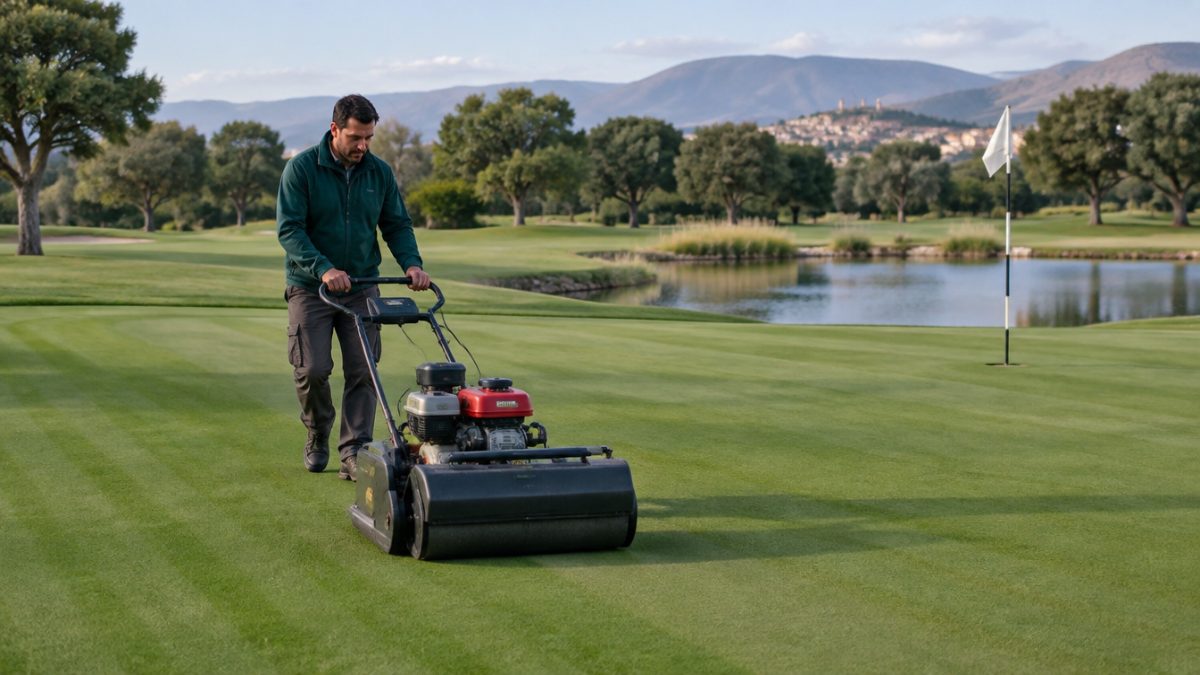
As growth increases, the mowing routine changes. Among the greenkeeper tasks in March is gradually raising frequency and lowering the cutting height step by step to the in-season height, without abrupt jumps that stress the newly active turf.
Check the reels, the contact with the bedknife and the condition of the rotary blades. A clean cut from the start reduces the risk of tearing and makes later work easier. And do not forget to schedule regular cleaning of the machines, especially if clippings are abundant.
Monitoring for disease, weeds and pests
March combines humidity, mild temperatures and turf in transition, a scenario in which disease and weeds can easily appear. Walk the course regularly, identify the outbreaks and compare with records from previous years.
The most sensible approach is integrated management: cultural measures first (aeration, irrigation balance, cutting height, air movement) and only afterwards, if necessary, plant protection interventions decided with an authorised adviser and applied according to label and regulations. Always note the reason for each decision.
Plan machinery, staff and communication with the club
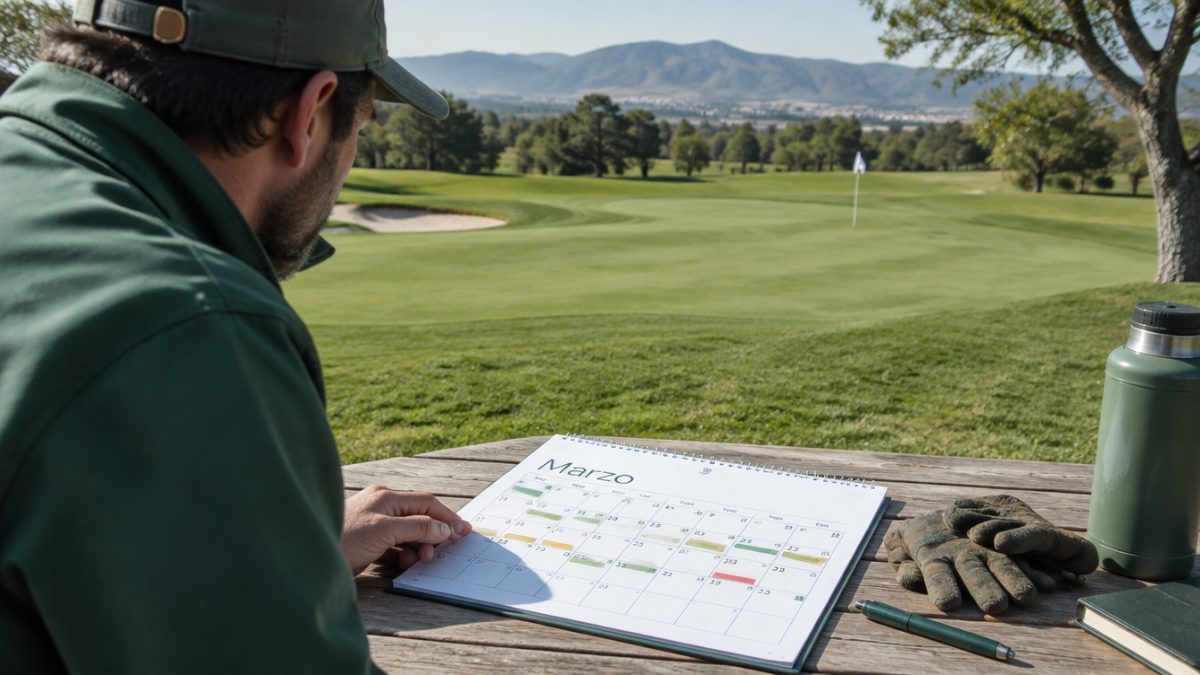
The last of the greenkeeper tasks in March looks ahead. Check the condition of the fleet and prepare the spare parts list before work gets busy. Calculate the expected working hours for the coming weeks and confirm whether extra staff are needed for spring.
Also communicate the work calendar to the club: partial closures of areas, aeration, planned events and higher-impact jobs. When members know what is being done and why, they value the team’s work more and complain less. Summarising the greenkeeper tasks in March in a note for the green committee is a simple way to win support.
A useful last step is to spend half an hour closing the month with a review: what was done, what was left pending and what is carried over to April. This simple habit stops tasks dragging on without an owner. Repeating that close-out every month turns the greenkeeper tasks in March, and those of every other month, into a cycle of continuous improvement.
Further reading: AEMET. To anticipate late frosts and rainfall episodes you can consult the forecasts of Spain's State Meteorological Agency.
Frequently asked questions
What are the main greenkeeper tasks in March?
Checking irrigation, watching the turf wake up, planning aeration, adjusting start-up feeding, resuming mowing frequency, monitoring disease and weeds, and organising machinery and staff. The order and dates depend on the area, the species and the trend in soil temperature.
Is it a good idea to do heavy aeration in March?
It depends on the species and the climate. An intense operation recovers better when the turf is growing actively. With warm-season species, it is usually safer to wait for the soil to warm up. What matters is to diagnose the condition of the profile, plan with the club and avoid working while the turf is still dormant.
How do I organise the greenkeeper tasks in March if I am short of staff?
Prioritise what has the greatest impact on turf health and later cost: irrigation, mowing and health monitoring. Spread the rest over the weeks, assign an owner to each task and record what is done. If you expect work peaks, plan temporary reinforcement in advance.
Keep reading
- greenkeeper tasks in February Greenkeeper tasks in February: 7 key jobs
- key jobs for January Greenkeeper tasks in January: 7 key jobs
- irrigation audit to detect losses Irrigation audit: 7 steps to detect water losses