
In April the turf finally responds: the soil is warm, the days are long and growth accelerates. It is also a month full of play, visits and tournaments. The greenkeeper tasks in April must balance two opposing pressures: making the most of the recovery window and keeping the course in condition for those who play it every day.
We review seven key jobs, the most common greenkeeper tasks in April in a Mediterranean climate, and propose a way to organise them so that none gets left behind when the agenda tightens.
Greenkeeper tasks in April: set priorities before the peak of play
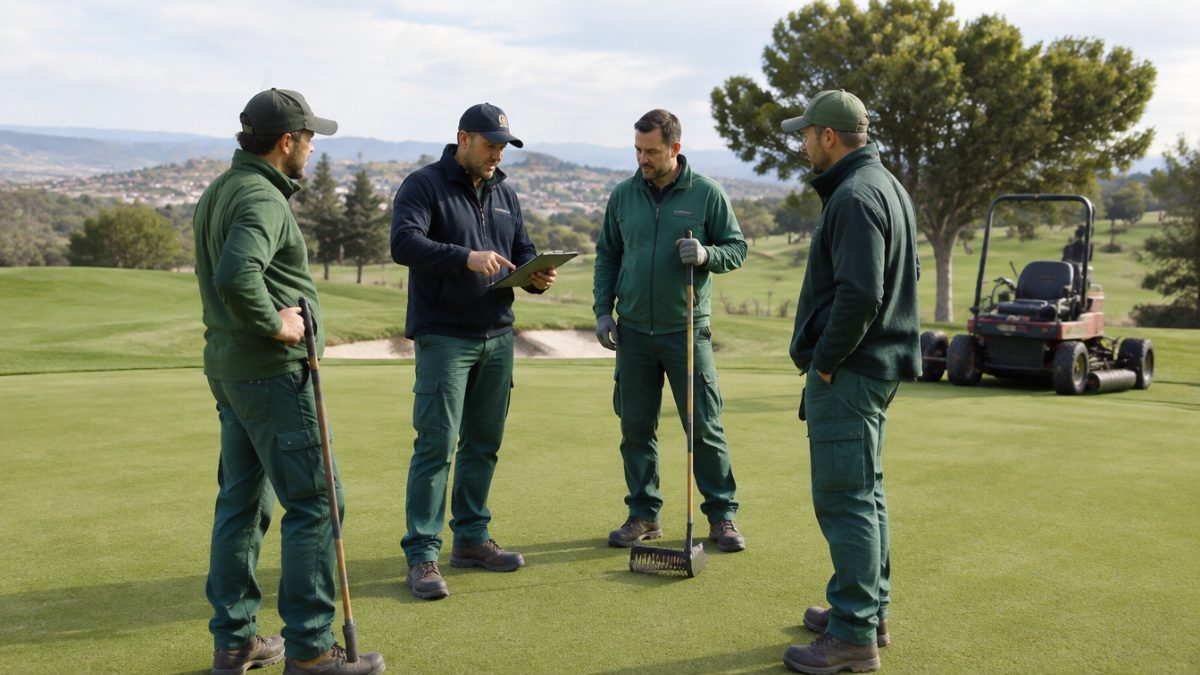
April is usually the month with the best ratio of growth to temperature: the turf heals wounds quickly, which is why it is the time for the most demanding jobs. But the sporting calendar also tightens, so it pays to set an order.
- What protects the turf’s long-term health (irrigation, mowing, aeration).
- What affects immediate playability (quality of greens, bunkers, tee boxes).
- What improves the course’s appearance (edges, rough, overall finish).
With this hierarchy, when hands are short you will know what gets postponed and what does not.
Write the list somewhere visible and review it every Monday. The greenkeeper tasks in April tend to pile up because everything seems urgent; putting a name and a date on each one stops the most uncomfortable ones being pushed forever to next week.
Recover bare patches, tee boxes and worn areas
Winter leaves its marks: bare patches on fairways, battered tee boxes, weakened green edges and compacted traffic areas. With favourable temperatures, April is a good time to repair.
- Identify and mark the areas, photographing them with a date.
- Choose between overseeding, sod or natural recovery according to species and extent.
- Protect recovering areas with ropes or signs and tell the club about the closure.
- Irrigate lightly and often until the turf establishes.
Warm-season species respond better when the soil is warm; do not rush if nights are still cold. Among the greenkeeper tasks in April, repairing tee boxes is the one most appreciated: they are the first impression of the hole, and a good finish changes the perception of the whole course.
Aeration, top-dressing and thatch control
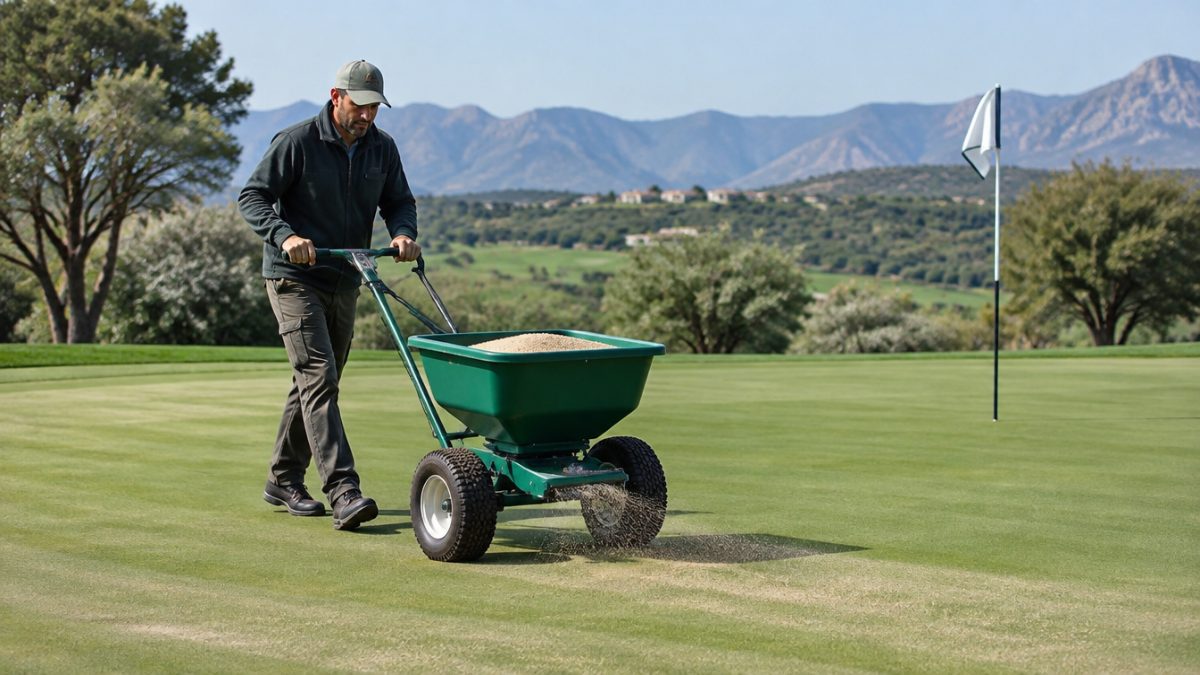
With the turf in active growth, aeration and sand top-dressing recover quickly. The aim is to keep an open profile, control organic matter and smooth the surface of the green.
Some practical criteria:
- Diagnose with profile samples before deciding the intensity.
- Avoid scheduling aggressive work to coincide with tournaments or major events.
- Apply sand in thin, frequent layers rather than all at once, and work it in with brushing.
- Assess the turf’s response at seven days and adjust the next step.
Recording the dates and area of each task will let you, in next year’s greenkeeper tasks in April, repeat what worked and correct what left a mark on play.
Spring fertilisation and nutrition
Among the greenkeeper tasks in April, feeding deserves a plan, not a generic recipe. Turf in full growth demands nutrients, but excess causes soft tissue, more clippings and greater susceptibility to disease.
Rely on soil analysis, the condition of the turf and the programme set for the species. Spread applications in moderate, spaced doses, avoid applying before heavy rain and note each intervention. As always, products are used following the label, current regulations and the advice of an authorised technician.
Adjust irrigation to rising demand
Water demand rises every week, and scheduling mistakes start to show. This is the time to check the evapotranspiration calculation against observation of the course, to check sprinkler uniformity and to adapt run times by sector.
A good practice is to irrigate less often and deeper when the soil and species allow it, because it encourages deep roots and reduces the surface moisture that favours disease. On greens, keep hand watering as support at dry spots. And write down consumption: it will be your reference for assessing the summer.
If you find that an area uses much more water than its neighbours, do not simply increase the run time: first check for leaks, worn nozzles or a different soil profile. That early check is another of the greenkeeper tasks in April that saves headaches in July.
Mowing, rolling and surface quality
With accelerated growth, mowing frequency increases and the cutting height settles at the in-season value. It is time to check that each machine delivers the planned height, that blades are sharp and that the mowing pattern is alternated to avoid ruts.
Rolling and brushing help gain speed and uniformity without lowering the height, which is especially valuable in a month when the turf is still consolidating its recovery. Measure green speed regularly and with the same method, to make decisions with data. A single operator should not change a machine’s setting on their own; any change must be noted and communicated.
Health monitoring, bunkers and communication with the club
The last of the greenkeeper tasks in April connect monitoring and management. Walk the course frequently looking for outbreaks of disease, weeds or pests, and apply cultural measures before chemical ones. If a plant protection intervention is needed, decide it with an authorised adviser and comply with the label and current regulations.
Also check the bunkers after the spring rains: displaced sand, blocked drains and eroded edges. And give the club a monthly summary of work done and planned. An informed member tolerates an aeration or a temporary closure better, and understands that the greenkeeper tasks in April are an investment in the summer.
Close the month by noting what was achieved and what is pending. That review turns the greenkeeper tasks in April into a clear starting point for May.
Further reading: AEMET. Before scheduling sensitive work, check the forecast from Spain's State Meteorological Agency for your area.
Frequently asked questions
What are the most important greenkeeper tasks in April?
Repairing damaged areas, keeping up aeration and top-dressing, adjusting feeding, adapting irrigation to rising demand, looking after mowing and watching turf health. The priority is to protect turf health and then playability and appearance, always according to species and area.
Is April a good time to overseed?
It depends on the species. Warm-season species need warm soil and nights without cold to establish well, while cool-season species usually respond more easily in spring. Assess soil temperature, the weather forecast and irrigation availability before deciding, and announce closures.
How do I organise the greenkeeper tasks in April with tournaments on the calendar?
Put the events on the calendar first and plan around them the tasks that disturb the surface. Schedule aeration after tournaments and keep the weeks before for fine-tuning mowing and speed. Inform the club of each change to avoid surprises and complaints.
Keep reading
- greenkeeper tasks in March Greenkeeper tasks in March: 7 key jobs
- warning signs of thatch in greens Thatch in greens: 6 warning signs and how to reduce it
- evapotranspiration to water just right Evapotranspiration in golf: 5 keys to watering just right