

Every greenkeeper knows the dilemma: a well-kept lake edge looks spectacular, but mowing on a slope next to water is one of the riskiest tasks on the course. Lake banks on golf courses demand technique, suitable machinery and a plan that balances aesthetics, ground stability and staff safety.
In this article we review five maintenance techniques that reduce accidents and erosion without giving up good presentation. You will see how to choose the species and cutting height, how to protect the edge and how to organise the work so that lake banks on golf courses stop being a black spot on the calendar.
Assess lake banks on golf courses before maintaining them
Not all lake banks on golf courses are the same. Before setting any routine, walk the perimeter and classify each stretch by slope, soil type, aspect, exposure to wind and depth of the water next to the edge. That classification determines which machines can be used and with what precautions.
A gentle slope with dense turf allows regular mechanised mowing. A steep slope, with loose soil or a vertical edge, may require a remote-controlled mower, a hand-held brushcutter with a harness or, quite simply, a change of management towards taller, more stable vegetation.
- Approximate slope and soil type.
- Depth and condition of the edge.
- Presence of wildlife, nests or aquatic vegetation.
- Access for machinery and escape routes.
Technique 1: safe mowing on slopes
Safety comes first. Set an indicative maximum slope for each type of machine according to the manufacturer’s instructions, and do not exceed it however much of a hurry you are in. Prefer mowing up and down the slope or with equipment designed for it, and avoid sharp turns near the water.
Some practical guidelines from course crews:
- Work in pairs or with radio communication on risky stretches.
- Belts and harnesses when using hand-operated machinery on a slope.
- No mowing when the ground is very wet: it increases the risk of slipping.
- Prior check of brakes, stabilisers and tyres.
Document the procedure and train staff. On lake banks on golf courses, the best technique is the one that any operator can repeat without risking anything.
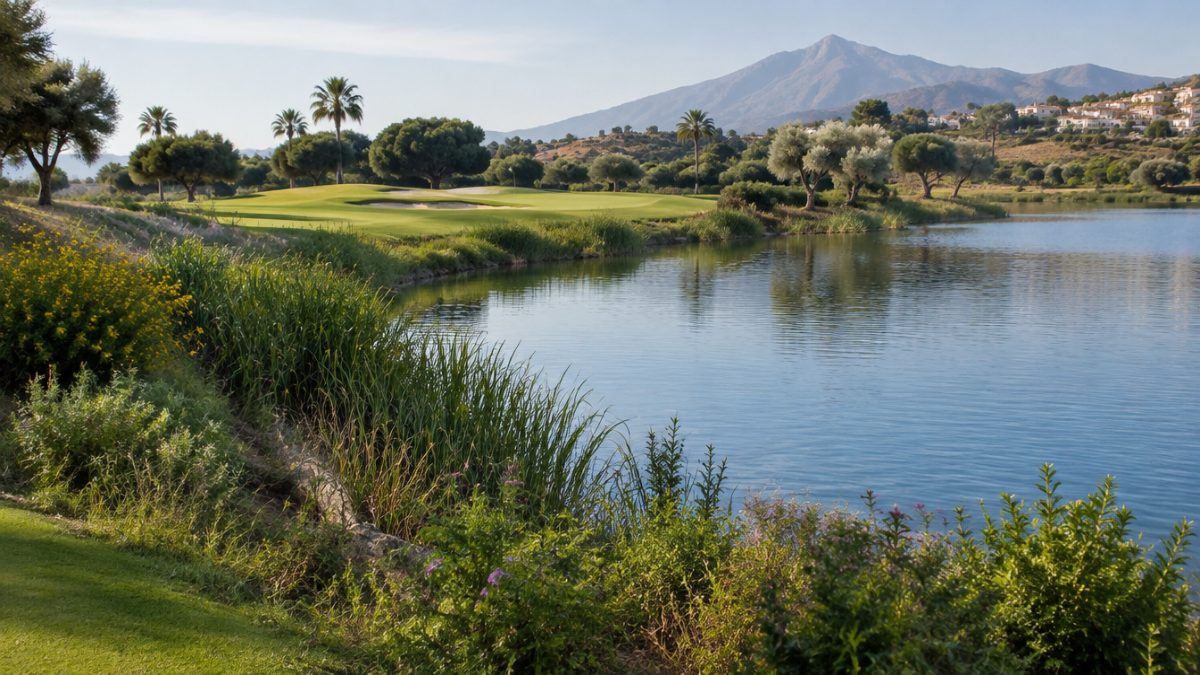
Technique 2: the right cutting height and species
On lake banks on golf courses, cutting too low weakens the roots and encourages erosion. On edges prone to breaking away, it is usually more sensible to raise the cutting height, leave a strip of denser vegetation next to the water and space out the mowings. A slightly taller sward protects the soil from rain and wave action.
In choosing the species you need to look at the whole picture, because not everything suits all lake banks on golf courses: bermudagrass and kikuyu form stolons that carpet well, but become aggressive and can invade the water surface; other hardy grasses or riparian plants provide a deep root structure. Adjust fertilisation and irrigation to a moderate profile: too much growth means more mowing and therefore more exposure.
Technique 3: erosion control and edge reinforcement
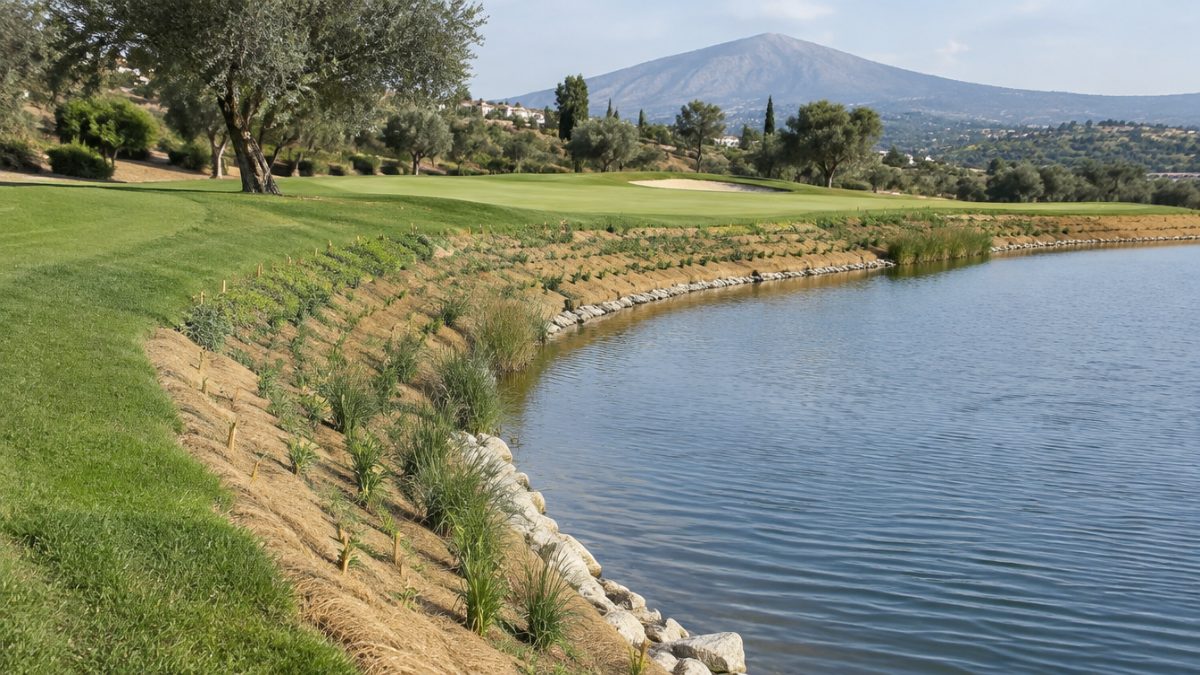
Erosion appears where slope, heavy rain and bare soil come together. To stop it, the first thing is to maintain continuous vegetation cover: a bank with bare patches erodes sooner. Reseed or replant degraded stretches at the right time and protect them with mats or geotextiles while the vegetation takes root.
If the edge regularly retreats, consider structural solutions: riparian vegetation strips, light rock armour or bioengineering techniques. Any work on the edge of a lake may be subject to authorisation, so check before acting.
Also watch the runoff: a poorly channelled outlet can cut gullies in just a few storms. Directing the water with vegetated swales or small dikes greatly reduces the problem. After every episode of heavy rain, set aside a morning to check all the lake banks on golf courses: a small crack spotted in time can be fixed with a shovel and a little sod, whereas a large slip requires machinery, days of work and, sometimes, closing a hole.
Technique 4: riparian vegetation and extensively managed areas
Not every bank has to be mown short. A strip of riparian vegetation of reasonable width filters runoff, stabilises the soil, offers shelter to wildlife and discourages the waterfowl that foul the fairways. It also cuts mowing hours, money and risks on the most difficult lake banks on golf courses. And it pays to explain the decision to members and players with a sign or an information note: a more natural edge is usually better accepted when it is understood to serve an environmental and safety function.
Plan these areas with playability in mind: they should be where they do not unfairly penalise the player and with a clear transition that avoids constant lost balls. Choose native species adapted to the climate and the salinity of the water, and control invasive ones. A written plan of selective mowing, for example one or two passes a year on the outermost strips, keeps a tidy appearance without compromising stability.
Technique 5: water quality and recording of tasks
What happens on the bank ends up in the water, and maintenance of lake banks on golf courses directly affects its quality. Avoid blowing clippings towards the lake, keep a buffer strip free of fertiliser and plant protection products next to the edge, always following the label, current regulations and the advice of an authorised technician, and remove accumulated debris. Fewer nutrients in the lake means fewer algae and fewer problems with smell and appearance.
Finally, keep records: mowing dates, hours spent, incidents, stretches repaired and condition of the edge after each storm. With that history you can show management which lake banks on golf courses consume the most resources, prioritise investments and spot any deterioration early. A dated photograph of the same spot every quarter is worth a thousand descriptions.
Further reading: MITECO. To learn about the obligations for work on banks and bodies of water, consult Spain's Ministry for the Ecological Transition (MITECO).
Frequently asked questions
What machine is used to mow lake banks on golf courses?
It depends on the slope. On gentle inclinations conventional equipment is fine; on steep stretches, remote-controlled mowers, harnessed brushcutters or equipment designed specifically for slopes are used, always respecting the limits set by the manufacturer and with prior operator training.
How can I stop lake banks on golf courses from eroding?
By maintaining continuous vegetation cover, with deep roots and a moderate cutting height, and by channelling runoff properly. On edges that regularly retreat, it may be necessary to reinforce with riparian vegetation or bioengineering solutions, checking the applicable regulations first.
Is it a good idea to leave tall vegetation next to the water?
Yes, in many cases. A strip of riparian vegetation protects the soil, filters nutrients, helps wildlife and discourages waterfowl. It should be designed without unfairly penalising play and maintained with selective mowing and control of invasive species.
Keep reading
- Golf course drainage: design and maintenance keys Golf Course Drainage: 6 Effective Solutions
- Algae in golf course lakes: causes and control Algae in Golf Course Lakes: 5 Causes and Solutions
- Irrigation reservoirs: maintenance and safety Irrigation Reservoirs in Golf: 6 Keys to Management