
When the heat arrives, the whole course depends on an infrastructure that almost nobody looks at: the irrigation reservoirs. If the level drops more than expected, if the water fills with algae or if a bank gives way, the problem stops being technical and becomes a problem for the entire course.
In this article we review six keys to managing irrigation reservoirs on a golf course: what to monitor, how often and how to document everything. These are general criteria, meant to be adapted to each facility and to the regulations that apply to it.
Irrigation reservoirs: capacity, inflows and outflows
It seems basic, but many teams work without being clear about how much usable water their irrigation reservoirs actually store. It pays to keep a record sheet for each reservoir with the key data and keep it up to date.
- Real usable capacity, excluding the dead volume at the bottom.
- Water source: well, mains, reclaimed water, runoff or a mix of several sources.
- Inlet points, spillways, drains and connection to the pumping station.
- Date of construction, type of waterproofing and latest inspections.
With that information you can calculate how many days of irrigation each reservoir covers in the most demanding weeks and make decisions ahead of time, rather than reacting when the level is already critical. A typical case: a course with two reservoirs of different sizes that empty at different rates because one supplies more sectors. Knowing this lets you spread demand better and avoid one being at its minimum while the other has plenty in reserve.
Look after the immediate surroundings of the basin
What happens around the reservoir ends up inside it. Leaves, dust, clippings or sediment washed in by rain bring organic matter and nutrients, and feed algae and sludge. Maintaining a well-managed strip around the basin, with no dumping of pruning or mowing waste, noticeably reduces the load the water receives and makes later cleaning easier. It is a simple task that belongs in the work calendar.
Measure level and consumption with a fixed routine
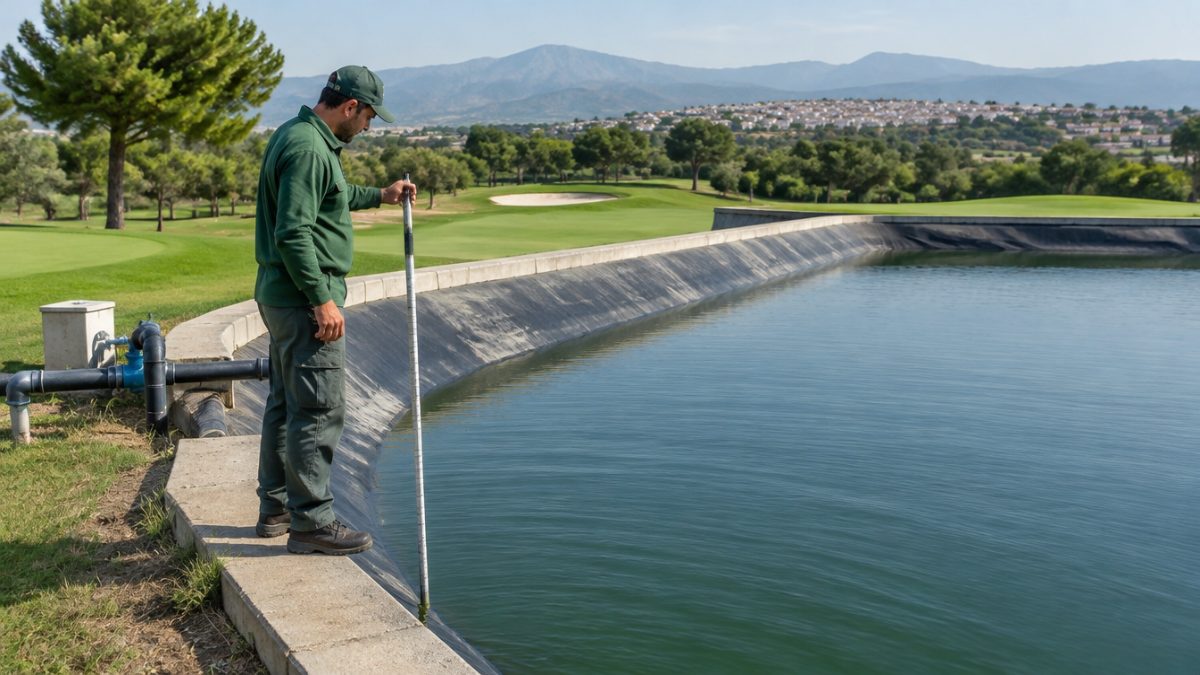
One of the keys to managing irrigation reservoirs is knowing how much comes in and how much goes out. A visible level gauge, together with a regular reading, is enough on many courses. If the course has flow meters, even better, but they are not essential to get started.
- Record the level at the same time, for example every morning during the irrigation season.
- Compare the drop with the scheduled volume: large differences point to leaks, high evaporation or unplanned irrigation.
- Set alert levels: one for planning and one for acting.
As a rough guide, in a Mediterranean summer evaporation from an open water surface can be significant, so it should be factored in when planning reserves.
Monitor water quality and algae
Stored water changes over time. Heat, light and nutrients trigger algae and organic matter, which ends up as clogged filters, blocked sprinklers and pumps with more wear. There is a direct link between the quality of irrigation reservoirs and the uniformity of application on the course.
- Regularly observe colour, smell and the presence of scum or foam.
- Check conductivity and other relevant parameters with periodic analyses, in a laboratory where appropriate.
- Control the input of nutrients from runoff, nearby fertilising or treated wastewater.
- Keep up aeration or recirculation if the reservoir tends to stratify.
Reservoir treatments must always be carried out with authorised products, following the label, current regulations and the advice of an authorised technician.
Protect banks, waterproofing and structures
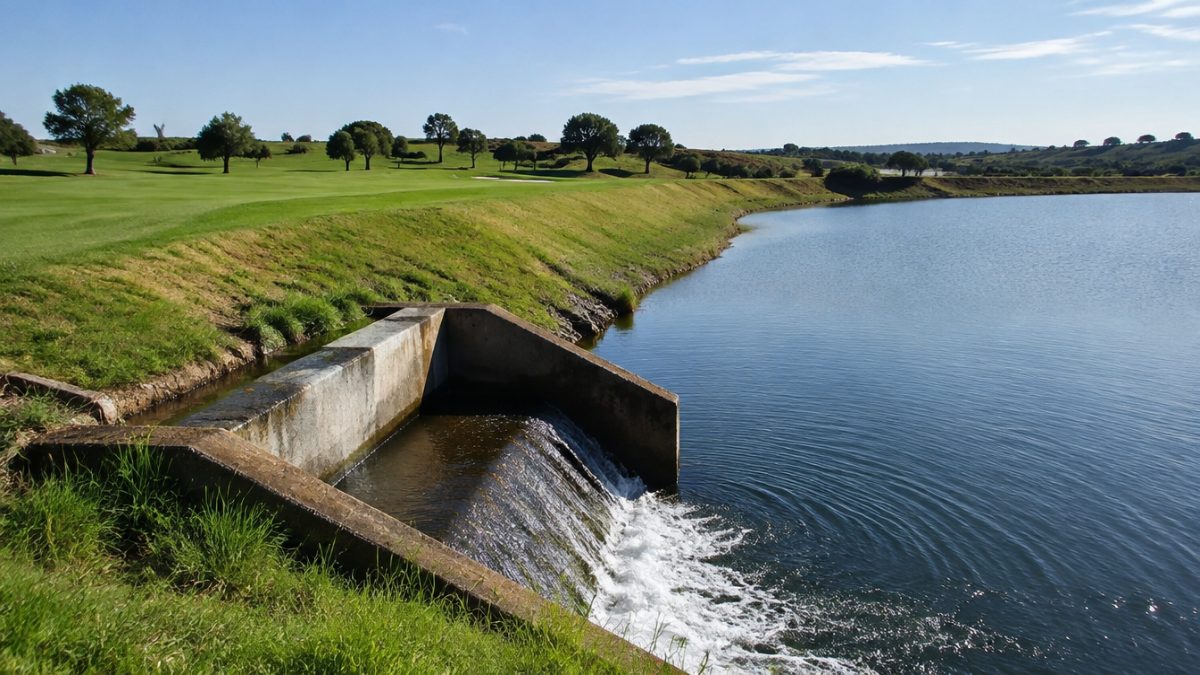
A reservoir is a civil engineering work and as such needs periodic inspections. Damage usually gives warning before it gets worse, if someone knows how to look.
- Walk the perimeter after heavy rain and look for cracks, slips or erosion.
- Check the condition of the liner or basin in visible areas and the perimeter anchoring.
- Make sure spillways and drains are clear of vegetation and sediment.
- Inspect the fence, signage and access points.
If you notice unusual dampness at the base of the bank or an unexplained drop in level, tell a competent technician as soon as possible rather than waiting for it to get worse.
Put the safety of people and wildlife first
Irrigation reservoirs on golf courses are attractive places for birds, amphibians and, sometimes, for people who should not be there. Safety is not a formality: it is a responsibility of the club.
- Perimeter fence in good condition and clear signage about the drowning risk.
- Accessible rescue equipment, such as life rings and exit ladders on the banks.
- A procedure for staff working near the water, including risk training.
- Ramps or escape routes for wildlife that falls into the basin, especially in liners with smooth walls.
All of this should be included in the course’s occupational risk prevention plan and reviewed with the team periodically.
Document inspections and plan the cleaning
Experience shows that irrigation reservoirs that are not cleaned end up losing usable capacity to sediment. A scheduled bottom clean, coordinated with the irrigation calendar, is cheaper than an emergency in the middle of July.
- Plan partial drawdowns or cleaning in periods of lower demand, with authorisation if needed.
- Record each inspection: date, person responsible, observations and pending actions.
- Keep photos of the condition of banks, inlets and outlets to compare year on year.
- Define who alerts whom, and how quickly, when an anomaly is detected.
Ongoing management of irrigation reservoirs avoids costly surprises and makes investment decisions easier. This history is also valuable to the owners, to environmental audits and to the competent authority.
Further reading: MITECO. Spain's Ministry for the Ecological Transition (MITECO) gathers general information on water management and the obligations of owners of hydraulic infrastructure.
Frequently asked questions
How often should irrigation reservoirs be checked?
During the irrigation season you should read the level daily and carry out a visual inspection at least weekly. After heavy rain, storms or strong wind, check banks, spillways and inlets. More thorough technical inspections of irrigation reservoirs must follow the applicable regulations and the recommendations of a competent technician.
How do I prevent algae in irrigation reservoirs?
Algae are prevented by reducing nutrient input, encouraging water circulation or aeration and avoiding the build-up of organic matter. Once a bloom has appeared, any treatment must be carried out with authorised products, following the label, current regulations and the advice of an authorised technician. Noting when they appear helps you anticipate them.
Who is responsible for reservoir safety?
Responsibility lies with the owner of the facility, who must ensure fencing, signage and procedures for staff. In practice, the head greenkeeper usually coordinates inspections and alerts management to any deficiency. It is best to put in writing who checks what and how often at each of the irrigation reservoirs.
Keep reading
- Reclaimed water for irrigation on golf courses Reclaimed Water for Irrigation: 6 Keys for Your Course
- Algae in golf course lakes: causes and control Algae in Golf Course Lakes: 5 Causes and Solutions
- Pumping station: maintenance and inspections Pumping Station: 6 Preventive Checks on Golf Courses