

After a storm, every course reveals its weak points: the fairway that floods, the soft tee box that cannot take traffic, or the green that takes days to regain firmness. Golf course drainage affects playability, turf health and even the maintenance calendar, because with saturated soil the machines cannot get on.
We review six solutions, from least to most intervention, so you can decide which suits your case: from a good diagnosis and maintaining what already exists to larger-scale work. You will see how to prioritise and how to record what you do.
Golf Course Drainage Solution 1: Diagnose Before You Dig
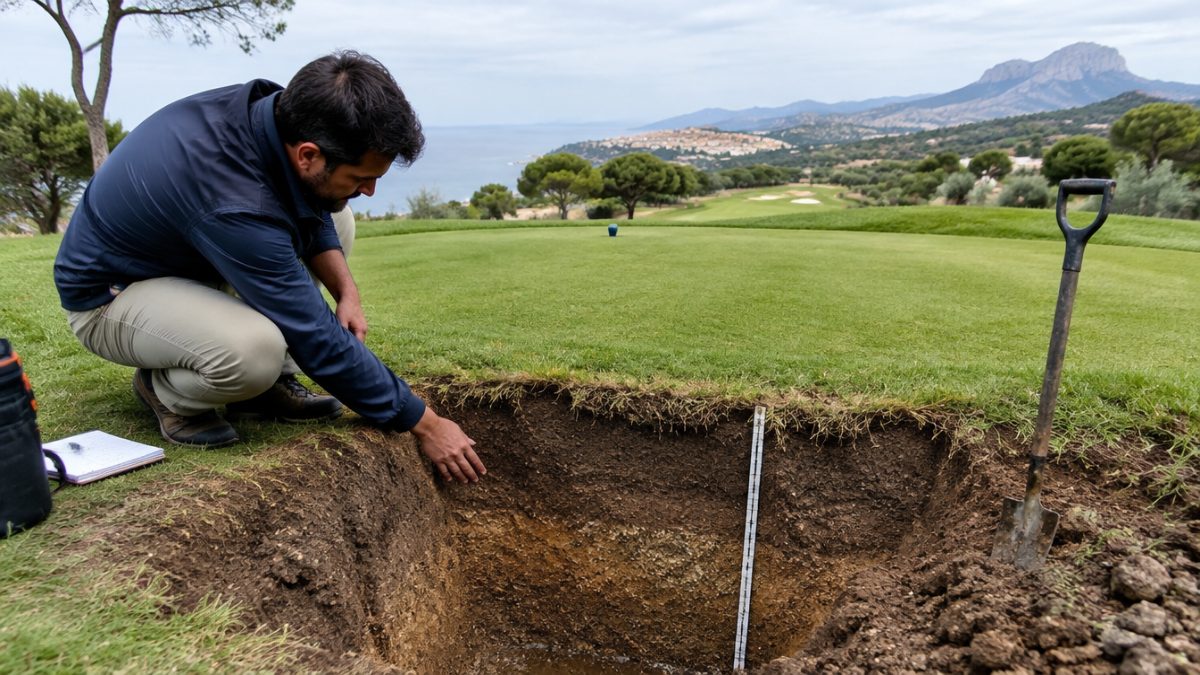
Each area floods for a different reason, and treating the symptom without knowing the cause is usually money wasted. After a significant rainfall, walk the course and mark where water collects, how long it takes to disappear and what type of soil lies beneath.
- Check for a compacted or impermeable layer at shallow depth with a simple soil profile pit.
- Observe the slope and where surface water runs.
- Ask the longest-serving staff whether the problem is historic or recent.
A good diagnosis distinguishes between an infiltration problem (the soil does not absorb), a runoff problem (water arrives from outside) or a deep drainage problem (it has nowhere to go). Each has its own answer.
A frequent example: a fairway that always floods in the same hollow. Sometimes the cause is simply a depression created over the years by machinery traffic, and a few turf cuts, sand fill and levelling are enough; other times there is a clay layer beneath. Telling them apart saves expensive decisions in golf course drainage.
Solution 2: Keep What Already Exists Clean
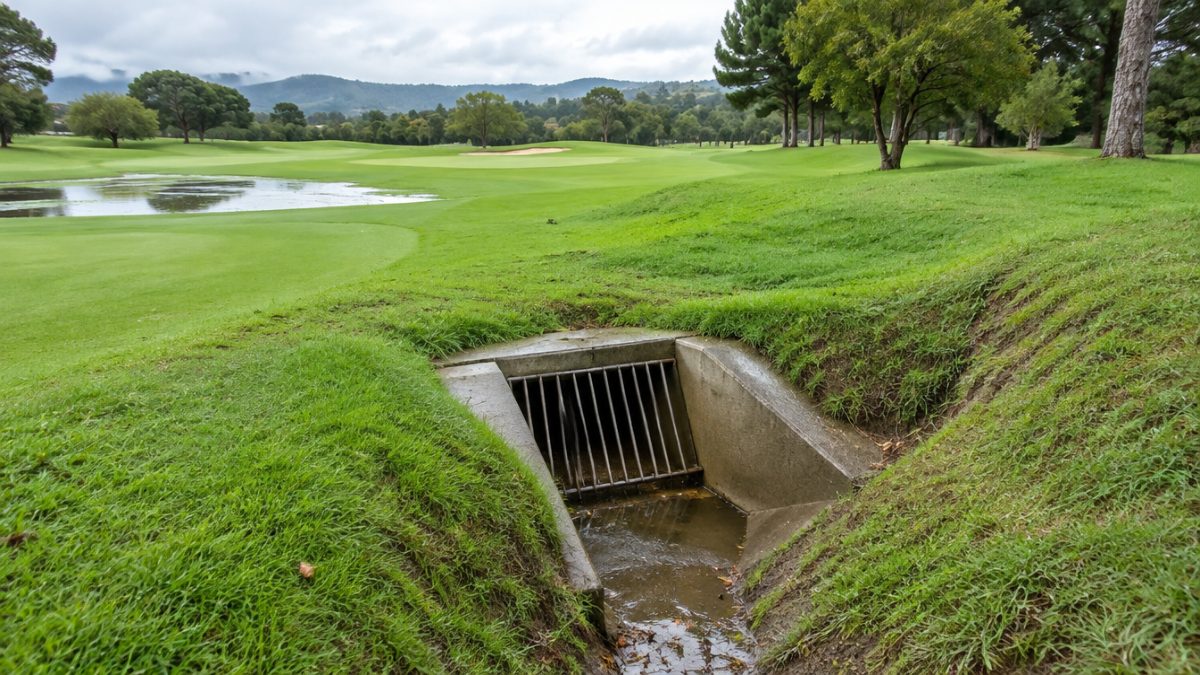
Before planning construction work, check the current system. Many drainage networks work badly through lack of maintenance: catch basins full of sediment, blocked grates, outlets covered by vegetation or crushed pipes.
A round after the first heavy rains is a way to check which catch basins drain and which do not. Clean the outlets, remove debris and locate areas where water goes in and does not come out. In golf course drainage, this simple task solves more problems than it seems and should be in the annual calendar. A good habit is to mark the covers of all catch basins with paint or a discreet marker, so the team can find them even when the turf has grown over, and to note on each round which ones were full of water. That way golf course drainage is monitored like any other installation.
Solution 3: Aeration and Improving the Surface Layer
When the problem is infiltration, it is often in the first few centimetres. Compaction from traffic, excess organic matter or a dense thatch layer stop water from going down. Aeration, spiking and sanding operations help restore permeability.
- Spike or aerate to the right depth to break through the compacted layer.
- Fill with sand compatible with the profile to keep the channels open.
- Repeat regularly in high-traffic areas such as tee boxes, access points and buggy paths.
It is a maintenance solution, not construction work, and it improves both root growth and turf resilience. Even so, it does not replace deep drainage when the water has nowhere to go.
Solution 4: Golf Course Drainage with Trenches and Pipes on Fairways and Tee Boxes
If the soil is poorly permeable and the water stays, the classic solution is a lateral drainage network: trenches with perforated pipe and filter material that collect the water and carry it to an outlet. On fairways and tee boxes, design it with sufficient slope and a backfill that connects to the surface.
- Set the spacing between lines according to soil type, as a guide closer together in clay soils.
- Ensure an outlet at a lower level that can be maintained.
- Mark the layout clearly on a plan so it is not cut during future work.
This type of work is best entrusted to a technician specialised in golf course drainage, because an incorrect design may not solve the problem or may create new ones.
Solution 5: Manage Runoff and Water Coming from Outside
Many waterlogging problems do not originate on the course but outside it: paths that channel water onto a fairway, banks without a ditch or developed areas upstream. In those cases, there is little point in draining below ground if the volume of surface water overwhelms any system.
Ditches, swales, well-adjusted slopes and small attenuation basins let you divert or hold back the water before it reaches sensitive areas. In any golf course drainage project it is worth first asking where the water comes from. An intervention at the point of entry is usually cheaper than extending drainage across the whole plot, and it also protects greens and bunkers from sand wash-out.
Solution 6: Prioritise, Record and Review Drainage Every Season
Not everything can be fixed at once. Make a map of problem spots and rank them by their impact on play, the risk of turf damage and the cost of acting. Start with the cheapest and highest-impact, such as cleaning catch basins and aerating, and leave major works until the diagnosis justifies them.
Recording is key: date of rain, areas affected, recovery time and work carried out. With that history, golf course drainage stops being a debate of impressions and becomes a plan with priorities you can demonstrate to management.
- Photos before and after each intervention.
- Staff and machinery hours used.
- Improvement observed after the next significant rainfall.
Further reading: STRI Group. Sports turf research bodies such as STRI publish general criteria for the design and maintenance of drainage at sports facilities.
Frequently asked questions
How do I know if golf course drainage is failing?
The clearest signs are puddles that take days to disappear, soft areas where machinery sinks, weakened turf or algae and moss in particular spots, and catch basins that do not drain. A walk after heavy rain and a soil profile pit in doubtful areas usually clarify whether the origin is at the surface or in the subsoil.
Can golf course drainage be improved without construction work?
In many cases, yes. Cleaning catch basins and outlets, aerating, spiking and sanding regularly, cutting back vegetation that blocks drains and correcting small depressions in the ground all improve the situation considerably. Trench and pipe works are only justified when the diagnosis shows the water has no natural outlet.
When should a specialist technician be called in?
When waterlogging persists after improving maintenance, when it affects greens or large areas, or when a new network of trenches and pipe is being considered. A golf course drainage specialist assesses soil, slopes and outlets, and avoids designs that fail to solve the problem or create others.
Keep reading
- Soil compaction Soil Compaction: 5 Causes and Fixes on Golf Courses
- Thatch in greens Thatch in greens: 6 warning signs and how to reduce it
- Golf fairway maintenance Golf Fairways: 6 Keys to Quality Maintenance