
Between mowing, tree pruning, leaf sweeping and cleaning bunkers and lakes, a golf course produces a notable volume of organic material. The usual practice is to pay to have it removed. However, compost on golf courses lets you close the loop: what leaves the course comes back to it as a low-cost soil conditioner.
Below you will see how to set up a composting area that works without bothering players or neighbours, and five concrete uses of the finished product, from improving nurseries and flower beds to rehabilitating rough areas. We will also look at what precautions to take so the result is safe and stable.
What materials go into compost on golf courses
The quality of compost on golf courses depends on what goes into the pile, hence the importance of being strict about inputs. It is worth separating materials by type and balancing nitrogen-rich ones with carbon-rich ones. Grass clippings provide moisture and nitrogen, while dry leaves, wood chips and shredded branches provide structure and carbon.
As a guide, the most common materials are:
- Clippings from fairways and rough, as long as they do not come from areas recently treated with products that restrict their reuse.
- Leaves, light prunings and chipped tree material.
- Plant waste from gardening around the clubhouse and flower beds.
Avoid plastics, ropes, branches with declared pests and any material of doubtful origin. A useful rule: if you do not know where it comes from or what it contains, it does not go in. That discipline at the start saves problems with the finished product.
Where to locate the course's composting area
A good location is half the success of compost on golf courses, because it determines odours, leachate and ease of work. Look for flat ground with machinery access, away from lakes, watercourses and wells to avoid leachate, and out of sight and smell of players and nearby homes. A firm, well-drained surface with some shade reduces moisture loss in summer.
Also think about daily logistics:
- Space to load, turn and store without interfering with other operations.
- One area for raw material and another for curing.
- Close enough to the workshop not to waste time on transport.
If the course is in a sensitive environment, check with the competent authority what requirements apply to on-site composting facilities, since waste regulations vary depending on volume and the destination of the product.
How to manage the pile to get good compost
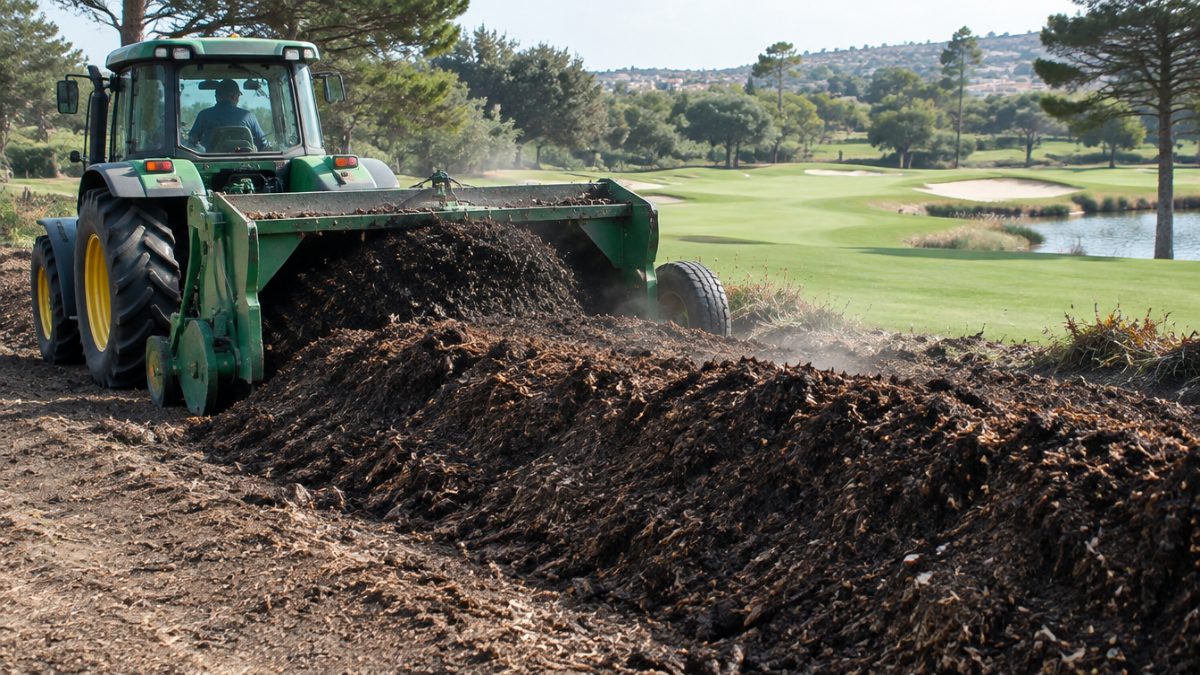
Stable compost cannot be improvised and, in the case of compost on golf courses, it must also fit in with the rhythm of course operations: it requires control of moisture, aeration and temperature. The pile should be as damp as a wrung-out sponge, neither dry nor waterlogged. If it smells of ammonia, it lacks carbon; if it smells rotten, it lacks air.
Basic management comes down to four tasks:
- Shred woody material to speed up decomposition.
- Mix layers of green and dry material in balanced proportions.
- Turn the pile when the temperature starts to drop.
- Let the product mature until it is dark, crumbly and smells of forest soil.
Compost on golf courses usually takes several months between collection and use, so it is worth planning the cycles to have product ready before the spring and autumn operations.
Uses 1 and 2: nurseries, flower beds and course plantings
The first natural destinations for compost on golf courses are within the club’s own grounds. Clubhouse flower beds, borders next to tee boxes and plantings of shrubs and trees welcome an organic amendment that improves soil structure and water retention.
In new plantings, compost mixed with the soil from the planting hole encourages rooting. In established flower beds, a thin surface layer acts as mulch, suppresses weeds and reduces evaporation. If the club has a nursery to replace native plants or trees, mature compost is an excellent component of the substrate.
These uses of compost on golf courses are the simplest because they tolerate variations in quality better, and they serve to build confidence in the product before applying it to more demanding surfaces.
Uses 3 and 4: rehabilitating roughs, banks and degraded areas
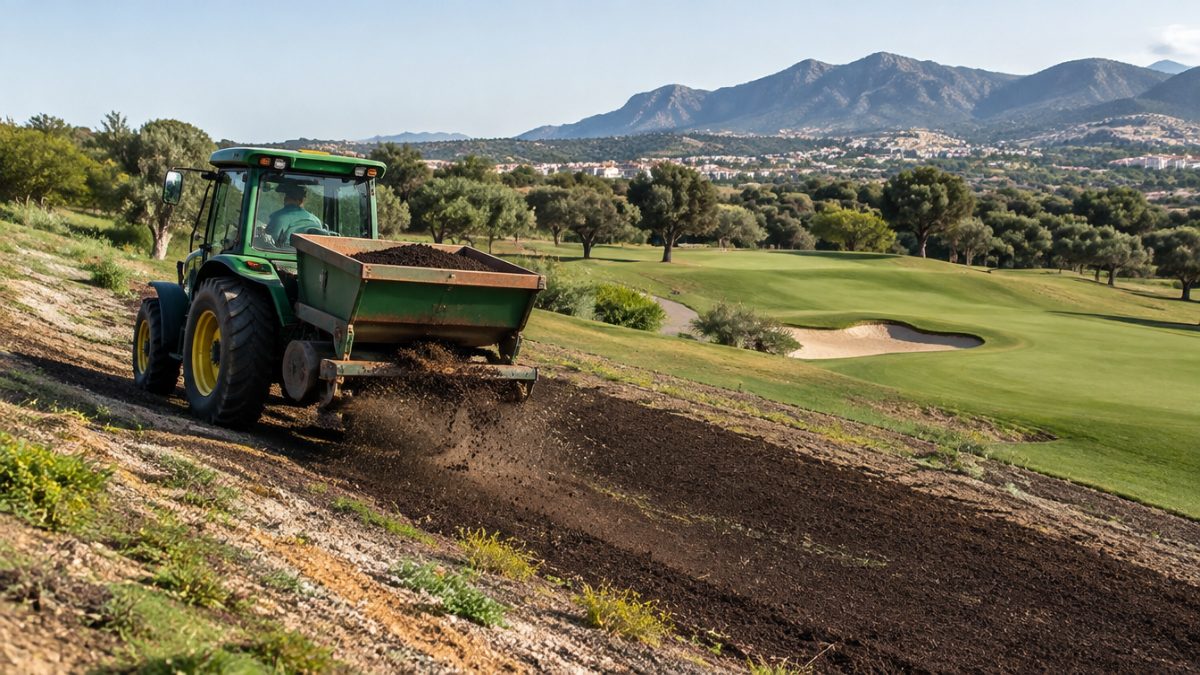
Where the soil is impoverished, compost on golf courses restores organic matter and microbial life. Eroded banks, rough areas with bare patches, path edges and recently disturbed construction zones benefit from a thin layer spread before reseeding.
Some practical guidelines:
- Spread thin, even layers without burying the existing turf.
- Combine with reseeding and establishment irrigation to fix the material in place.
- Avoid applying on steep slopes without a retention system, because rain would wash it away.
On precision playing surfaces, such as greens and tee boxes, compost should be used with great caution and only if it is perfectly screened and stabilised, and always with technical judgement. For those areas, a top-dressing sand of proven quality is usually preferable.
Use 5: selling or giving it away, and measuring the impact of compost
The fifth use is institutional: turning compost on golf courses into a visible sustainability action. Many clubs give away or sell the surplus to members, local gardeners or nearby farmers, or use it in community projects in the municipality. That strengthens the relationship with the surroundings and provides a simple story to tell.
To make it credible, measure:
- Volume of waste no longer going to landfill or an external handler.
- Avoided cost of removal and transport.
- Quantity of compost produced and where it is used.
With that data you can include compost on golf courses and composting in the club’s environmental report and support an application for sustainable management labels. What is not measured cannot be communicated rigorously.
Further reading: MITECO (Spain's Ministry for the Ecological Transition). Official information on waste and the circular economy is available from the Ministry for the Ecological Transition.
Frequently asked questions
How long does compost on golf courses take to be ready?
It depends on the type of material, the size of the pile and the management. With shredded material, good aeration and turning, the process usually lasts several months, plus a curing phase. What matters is that the product is dark, crumbly and free of strong odours before it is used on the course.
Can clippings treated with plant protection products be composted?
With caution. Some products leave residues that can affect the compost or the plants where it is used. Always respect the label, the safety intervals and current regulations, and consult an authorised technician or adviser before reusing clippings from recently treated areas.
Is authorisation required to make compost at the club?
It depends on the volume, the origin of the waste and the destination of the product, and the rules vary by region and municipality. The prudent course is to consult the competent environmental authority before setting up the facility, and to document the origin, treatment and use of compost on golf courses.
Keep reading
- pruning criteria for managing the course's trees Tree management on golf courses: 6 pruning criteria
- advantages of organic fertilisers in golf Benefits of using organic fertilizers on golf courses
- ways to make use of grass clippings Grass Clippings: 5 Ways to Make Use of Them on Your Course