

After a week of mowing, grass clippings pile up in baskets, trailers and corners of the workshop. Removing them costs time, fuel and sometimes an outside waste contractor. Yet turf clippings are organic matter rich in nutrients, and there is almost always a better alternative than taking them to a skip.
We suggest five ways to make use of grass clippings, from leaving them where they fall to composting them, with criteria to help decide which suits each area of the course and each time of year, and how to record the result to prove it.
First Way to Use Grass Clippings: Leave Them Where They Fall
The simplest and cheapest option is not to collect them. When mowing is frequent enough and the turf is dry, fine clippings break down quickly among the leaf blades and return nutrients to the soil. It works especially well on fairways and rough, where the cut is not as low.
- Mow often so the clippings are short; avoid removing more than a third of the leaf at once.
- Avoid leaving them in thick mats: they pack down, smother the turf and encourage disease.
- In very wet periods or flush growth, collect them and use one of the other options.
Good mulching depends on blades and cutting height being properly adjusted, so checking the machine is part of the strategy.
Second Way: Collect and Spread in Lower-Demand Areas
On greens, tee boxes and green aprons, clippings are always collected for the sake of playing quality. Those grass clippings can be reused in less demanding areas if spread in a thin layer, for example in rough, under trees or in naturalised areas, where they help conserve moisture and feed the soil.
The trick is the thin layer: if a heap is dumped, it heats up, smells and kills the turf beneath. Spread it with a loader bucket or a trailer with a spreader and let sun and rain do the rest.
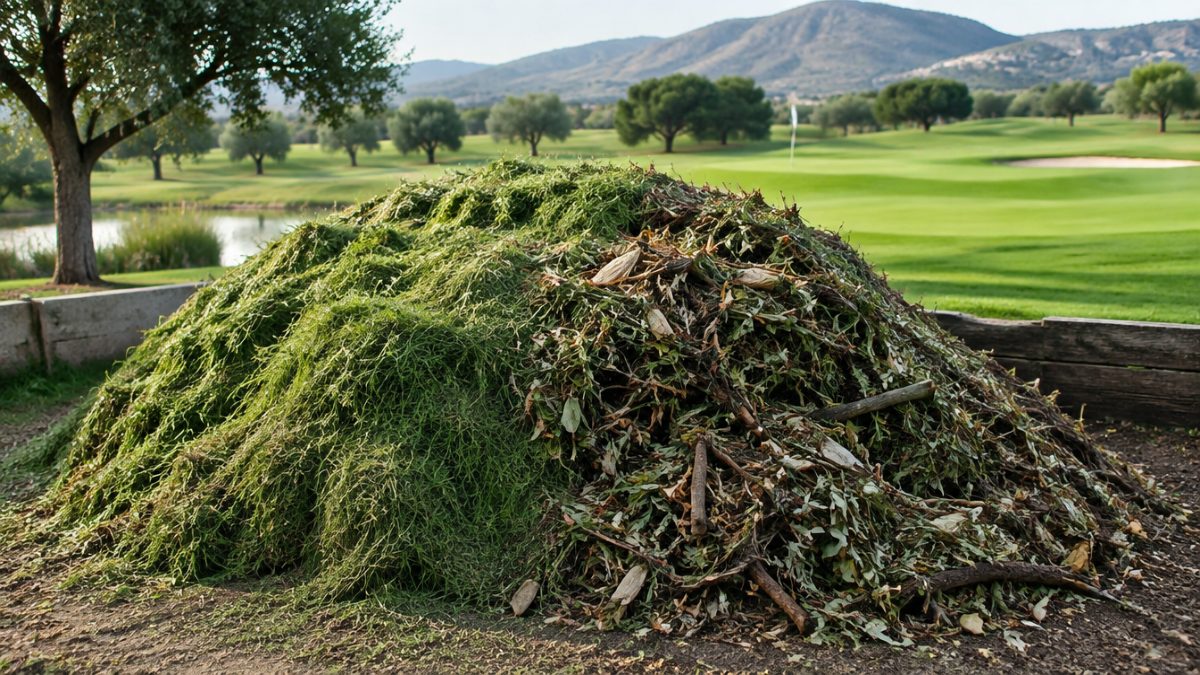
Third Way: Compost Grass Clippings with a Balanced Mix
Composting is the most complete route when there is enough volume. Clippings are rich in nitrogen and wet; on their own they rot and smell. They need to be mixed with dry, fibrous material to produce a stable compost.
- Mix the grass clippings with shredded pruning waste, dry leaves or fine bark.
- Form piles or windrows of a manageable size and turn them periodically to aerate.
- Watch the moisture: it should feel like a wrung-out sponge, neither dry nor waterlogged.
- Leave it to mature until the material is dark, crumbly and free of unpleasant odour.
Site the composting area away from watercourses and on a surface that prevents leachate. The resulting compost can be used in the club’s gardening, nurseries or as an amendment in rough or wooded areas.
Fourth Way: Be Careful What Your Grass Clippings Contain
Before reusing clippings, think about what they carry. If the area has just received a plant protection treatment, the clippings may contain residues or have restrictions on use. In that case, check the label, current regulations and an authorised technical adviser before deciding whether to reuse them or manage them as waste.
You should also separate clippings carrying weed seeds, obvious disease or traces of plastic and golf balls. A simple record of what was mown, where and what treatment the area had avoids mistakes when deciding where the material goes.
- Do not reuse clippings from areas under a treatment restriction period without checking.
- Set aside those from diseased turf, so as not to spread the problem.
- Avoid contaminating them with litter, plastics or workshop oils.
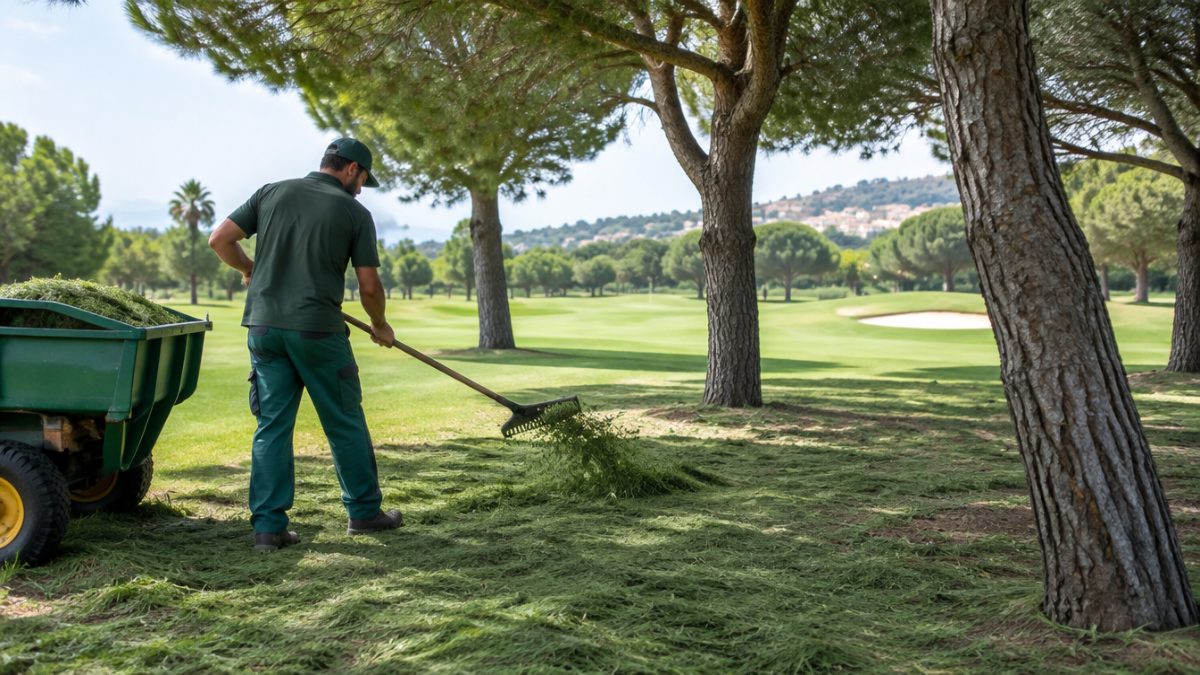
Fifth Way: Turn Them into a Course Sustainability Indicator
The best way for the club to recognise how you manage grass clippings is to measure it. You do not need a complex audit: it is enough to note regularly how much material is removed, how much is reused within the course and what transport or external disposal cost is avoided.
If the course has a scale in the workshop or a trailer of known volume, the estimate is even easier: count loads and multiply. Do not aim for laboratory precision; what matters is to keep the same method week after week so the trend is reliable. With a few data points per season you can explain to the committee that the course generates less waste, uses less fuel on haulage and returns organic matter to the soil. It is a solid environmental management argument, easy for members and directors to understand.
- Approximate weight or volume removed per week.
- Percentage going to mulching, spreading or composting.
- Staff hours spent handling it.
How to Decide What to Do with Grass Clippings by Area and Season
There is no single recipe. In spring and autumn, with strong growth, clipping production shoots up and it pays to have an exit route other than simple mulching. In summer, with warm soil, piled-up clippings break down fast and can cause odour and pest problems if not handled in time.
A practical rule: the lower the mowing height, the more is collected and the more important it is to have an orderly destination for the grass clippings. The higher the cut, the more sense it makes to return them to the turf. Adapt the method to machinery, labour and available space, and review each season what has worked.
A typical example: a course that combines fairways mown with mulching, greens collected and a small composting point beside the workshop can usually cut trips to the landfill a lot, without investing in new machinery. What is decisive is that the whole team knows where each load goes and that nobody improvises a heap in the first free corner.
Further reading: EPA. Bodies such as the US EPA publish general guides on composting and organic waste management that serve as a reference for designing your own system.
Frequently asked questions
Is it good to leave grass clippings on the turf?
Yes, if mowing is done at the right frequency, the turf is dry and the clippings are short. They break down soon and return nutrients. If thick mats form because of excess growth or moisture, it is better to collect them, since they can smother the turf, encourage disease and spoil playing quality in the area.
What do I do with grass clippings from greens?
They are collected to maintain playing quality. Afterwards they can be spread in a thin layer in less demanding areas or mixed into compost with dry material. Before reusing them, check whether the green has had any recent treatment, always following the label, current regulations and the advice of an authorised technician.
How do I stop grass clippings smelling bad when composting?
Bad odour is usually due to excess moisture and lack of air. Mix the grass clippings with dry, fibrous material such as shredded pruning waste or leaves, do not build piles too high and turn them regularly. A well-balanced pile heats up, transforms and hardly smells.
Keep reading
- Naturalised areas in golf Naturalised Areas in Golf: 6 Management Keys
- Carbon footprint in golf Carbon Footprint in Golf: 6 Steps to Measure It
- Biodiversity on golf courses Biodiversity on Golf Courses: 7 Practical Actions