

The species on a green is not a technical detail: it determines how many hours of work it demands, what water it tolerates, when it suffers and what speed you can offer the player. Choosing the right turf for greens, or deciding whether it is worth converting the current ones, is one of the highest-impact decisions on a course.
In this article we compare four species that are commonly used or discussed in Spain, with their strengths and limitations, and propose a method for choosing without being swayed by trends or by the experience of courses whose conditions differ from yours.
Preliminary criteria for choosing turf for greens
Before comparing species, it is worth setting the framework. A good starting point is to answer these questions:
- What are the real maximum and minimum temperatures at the site, and how long do they last?
- What quality and quantity of water is available throughout the year?
- What level of play and speed is expected from the green?
- What machinery, staff and budget does the team have?
- How much traffic does the course receive, and of what kind?
There is no universal turf for greens. There is the one that best fits a set of conditions, which is why the decision should be made with local data and not general impressions.
A common mistake is to copy the choice of a prestigious neighbouring course. If that course has more staff, a different type of water or a different green rootzone sand, the same species can behave very differently on yours. Choosing turf for greens requires looking first at your own reality.
Species 1: bentgrass, the classic for temperate climates
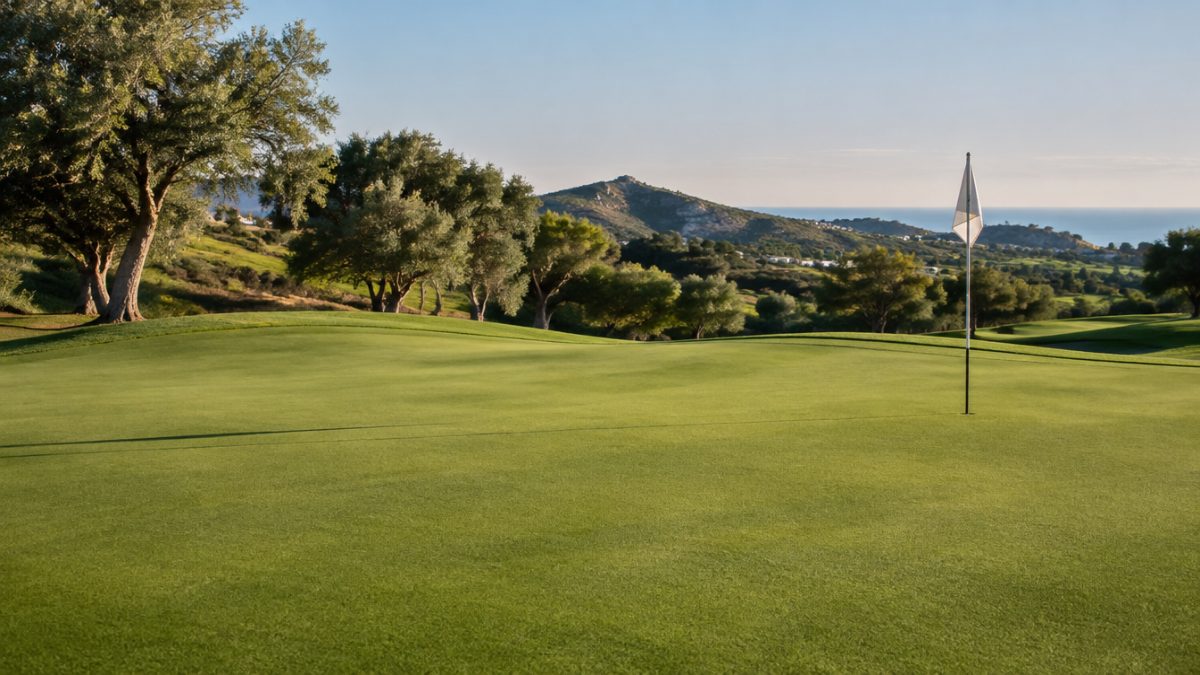
Bentgrasses (Agrostis) are the historical reference on greens: they produce a fine, dense sward, allow very low mowing and offer an excellent playing surface. Their limit is heat. In areas with harsh summers and warm nights, bentgrass suffers stress, demands more irrigation and is more vulnerable to disease.
It works best in cool climates or at moderate altitudes, and on courses able to manage it intensively in summer. In warm regions, maintaining it can require a considerable effort that must be assessed realistically. A practical criterion is to calculate how many weeks a year the green would be outside its comfort zone and what additional irrigation, air movement and staff resources would be needed to sustain that turf for greens during those weeks.
Species 2: fine-textured bermudagrass for warm climates
Low-growing hybrid bermudagrasses are a powerful option for turf for greens in warm areas. They tolerate heat and relative drought well, recover quickly during active growth and withstand low mowing if managed carefully.
On the downside, they go dormant in winter and lose colour, which forces you to decide how to handle that season: accept the colour change or resort to overseeding, with the work and cost that entails. They also require regular verticutting and aeration to control thatch and maintain speed and smooth ball roll. In the balance, you have to add the summer advantage and subtract the extra winter effort: a warm-climate turf for greens can be excellent six or seven months a year and demand more delicate management the rest of the time, something the club should know from the start.
Species 3: paspalum, an alternative with difficult water
Fine-textured paspalum has gained ground on courses with high-conductivity or recycled irrigation water. It tolerates salinity better than most, adapts well to heat and produces a dense, high-quality surface.
Its management is demanding: frequent mowing with well-sharpened blades, thatch control and careful fertilisation. It also goes dormant in sustained cold, although in mild winters the period of lower activity is short. It is a good candidate when water drives the decision, provided the team can take on its work routine. Before taking the step, ask for references from courses with comparable conditions and talk to their greenkeepers: the practical experience of those who already maintain that turf for greens is worth as much as any technical datasheet.
Species 4: Poa annua, the reality on many greens
Poa annua is rarely chosen as a primary species, but it is the protagonist on many existing greens because it colonises by itself. It produces a good surface in cool seasons but tolerates heat, drought and traffic poorly, and is prone to various diseases.
If your green already has Poa annua, the decision is not whether you want it but how to manage it: accept a controlled coexistence, work to favour the main species or plan a gradual conversion. In any case, realistic management of the Poa improves results more than ignoring its presence and waiting for it to disappear. Recording the approximate percentage of Poa on each green, with comparable photographs each season, lets you know whether it is advancing or retreating and whether your management decisions are working.
How to decide: trials, records and conversation with the club
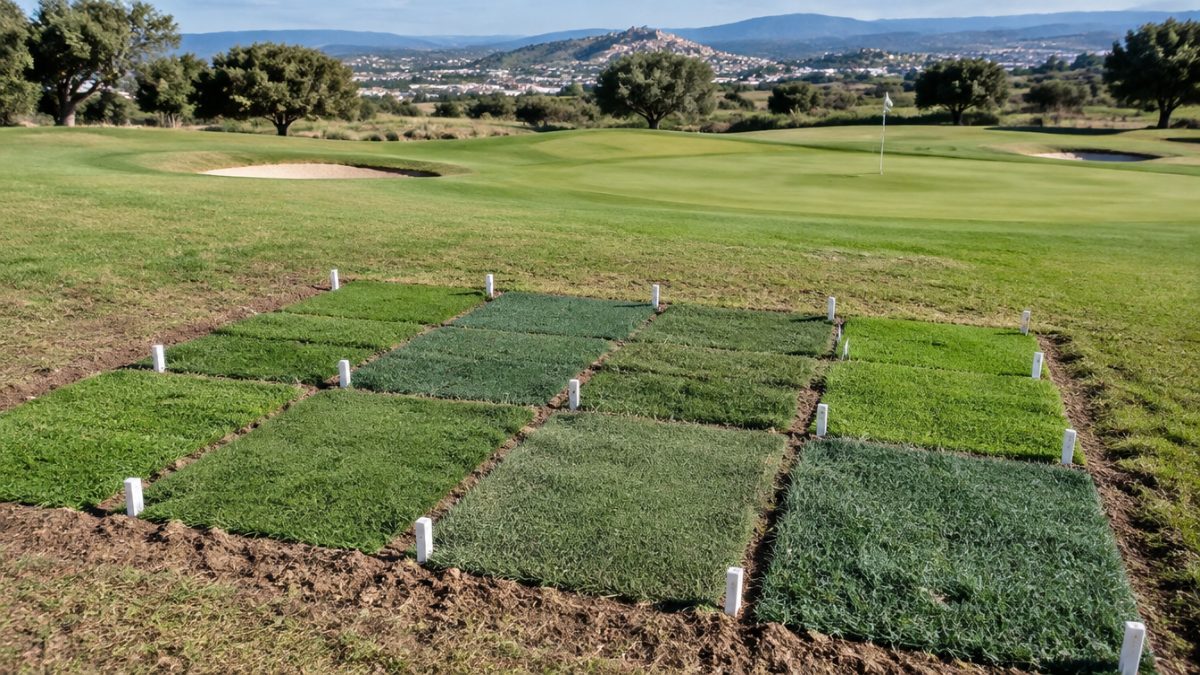
When you hesitate between two species, avoid deciding on theory alone. If possible, trial them on a small surface, such as a putting green or a practice green, and record over several seasons:
- Labour and machinery hours required.
- Water consumption and quality required.
- Incidence of disease and stress.
- Player assessment of speed, firmness and consistency.
With that data, choosing the turf for greens stops being a gamble and becomes a justified decision. Present the results to the committee clearly, including management costs and not just surface quality, and define with the club what is expected in each season of the year. If the decision involves a conversion, plan the transition in phases and communicate the schedule in advance, so that members understand the periods of lower quality as part of a project with a clear goal.
Further reading: USGA. The USGA offers guides on green construction and management that help cross-check the species decision.
Frequently asked questions
Which turf for greens is best in a Mediterranean climate?
It depends on the area. In very warm areas fine bermudagrasses or paspalum usually work better, while bentgrass requires more effort in summer. You should also consider water quality, the available team and the club's expectations. The prudent approach is to trial on a small surface before deciding.
Can the turf for greens be changed without closing the course?
It is possible to do it gradually, converting one green at a time or using an alternative surface during the works and establishment. Planning, the growth schedule of the new species and communication with players are essential. A technical project with specialist advice greatly reduces the risks.
How do I manage Poa annua in my turf for greens?
The first step is to know its proportion and distribution. Then decide between coexisting with it, favouring the main species through irrigation, fertilisation and mowing management, or planning a conversion. Any fungicide or herbicide treatment must follow the label, current regulations and the judgement of an authorised adviser.
Keep reading
- Poa annua and its management on greens Poa annua on Greens: 6 Effective Control Strategies
- building greens to USGA specifications USGA Green Construction: 6 Keys to the Layered Profile
- paspalum with saline water Paspalum in Golf: 5 Advantages with Saline Water