

A brown patch appears on a green collar, a tee box has leaf cut right down to the surface, or a fairway has birds pecking at it non-stop, and the first suspicion is a fungus or an irrigation fault. In many cases the cause is turf caterpillars, larvae of night-flying moths that feed on the leaf and sometimes on the crown of the plant.
This article proposes five steps to tackle them methodically: recognise the symptoms, understand their life cycle, monitor consistently, decide with judgement when to intervene and, above all, keep a record of what is done so you can learn from each season.
Step 1: Recognise the Damage from Turf Caterpillars
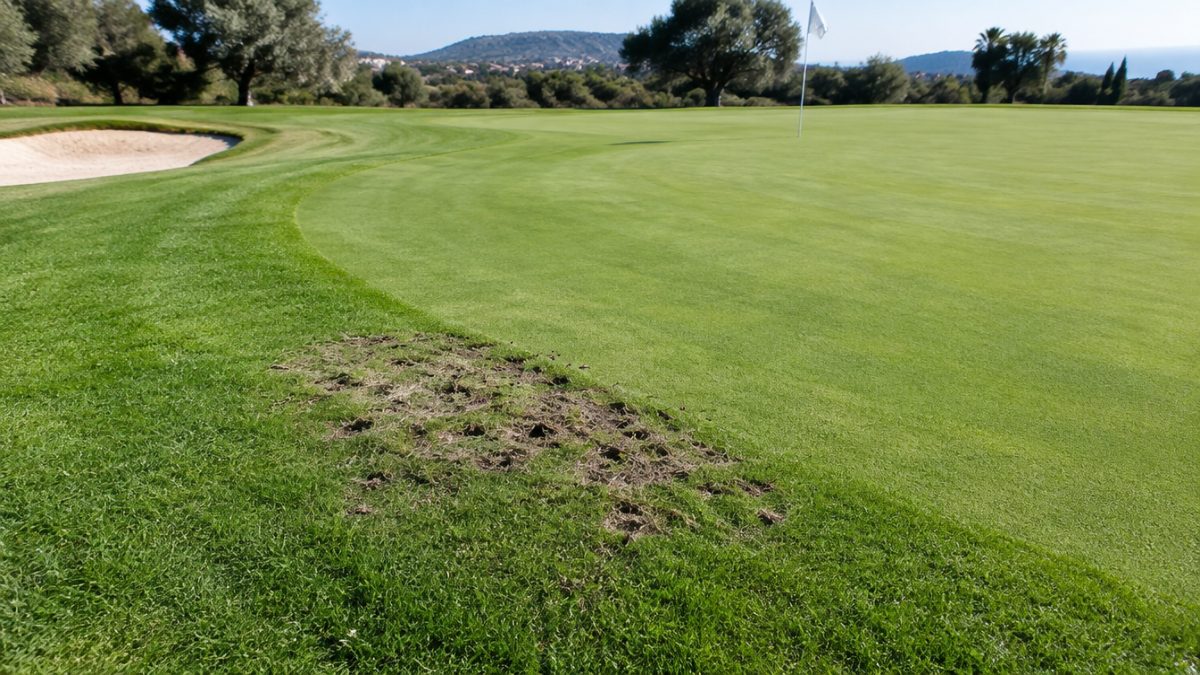
The typical symptom of turf caterpillars is an area of turf that thins out and is cut off unevenly, sometimes with small mounds of greenish droppings by the base of the plant. On very closely mown surfaces, dull patches appear that can be mistaken for drought stress, disease or traffic damage.
There are clues that help tell them apart from other causes:
- Frequent presence of birds in the morning, searching for larvae at the surface.
- Damage that advances within a few days, with poorly defined edges and without the characteristic ring of some diseases.
- Larvae that curl up when touched as the top layer of the canopy is carefully lifted.
The sooner it is confirmed that turf caterpillars are the cause, the cheaper it is to put right.
Step 2: Know the Life Cycle to Know When to Watch
Turf caterpillars are the larval stage of moths. The adults fly at night, feed on nectar and lay eggs on the leaf or near the ground. The larvae hatch from them, grow through several moults and spend the day sheltering in organic matter, in the thatch or in the surface soil, feeding at dusk.
In a Mediterranean climate, activity tends to be concentrated in the warm months and can extend into autumn if temperatures stay mild. Each species and each area has its own calendar, so it pays to note the dates on which activity is detected each year. With two or three seasons of data, the course will know when to start looking more closely.
Step 3: Monitor with a Simple, Repeatable Routine
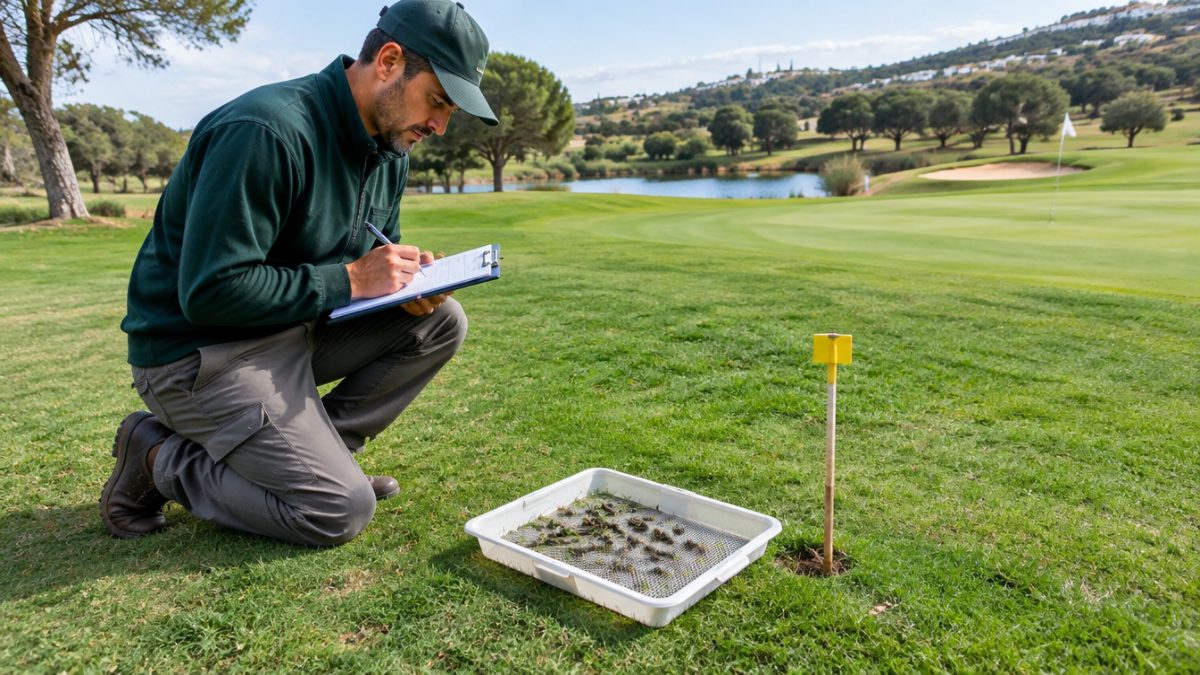
Monitoring turf caterpillars does not need sophisticated equipment, but it does need discipline. A classic technique is to dissolve a little mild detergent in water, pour it over a marked-out patch of turf and wait a few minutes: if there are larvae in the surface layer, they will come up onto the leaf. They are counted and the number per area is noted.
For the data to be comparable, always work the same way:
- Choose fixed monitoring points on greens, tee boxes and fairways, especially in areas with a history.
- Repeat the sampling at the same time of day and in similar conditions.
- Note the date, point, count and observations on bird or moth activity.
A count that rises week by week is worth more than an isolated impression.
Step 4: Decide When to Intervene and with What Approach
Not every presence of larvae calls for treatment. A low population can be tolerated on lower-demand surfaces, while on greens and tee boxes the acceptable damage threshold is much stricter. Agree with the greens committee what level of presence is accepted in each area before the season’s pressure arrives. That way, when turf caterpillars appear, the team does not have to improvise or justify every decision on the spot.
With an integrated management approach, the logical order is first to prevent and monitor, then to turn to low-impact options and only if necessary to other products. If you decide to apply a plant protection product, always follow the label, current regulations and the advice of an authorised technician, and consider the time of day, subsequent irrigation and the effect on beneficial fauna.
Step 5: Record and Learn from Each Season
When the problem is resolved, the work is not finished. What really reduces next year’s risk is understanding what happened: where the damage started, how many days passed between the first sign and the action, what was done and what the result was.
A well-kept record lets you detect patterns, for example that turf caterpillars always appear on the same tee boxes near areas with night lighting, or that certain fairways with more thatch hold more larvae. With that information you can adjust cultural practices, such as thatch control, and avoid repeating the improvisation every summer. Even a simple record, with date, area and a sentence of observations, makes a big difference compared with relying on what each team member remembers.
It is also worth sharing that information with whoever handles irrigation and fertilising, because many decisions in those areas affect the presence of larvae. A short meeting at the start of the risk season, with data from previous years on the table, helps coordinate monitoring of turf caterpillars and share out sampling responsibilities.
Cultural Practices That Reduce Pest Pressure
Healthy turf tolerates the presence of larvae better and recovers sooner, so the best defence against turf caterpillars starts long before the first patch is seen. Several practices help without the need for products:
- Control excess organic matter, which offers daytime shelter to the larvae.
- Avoid fertilising that forces soft, very appetising growth.
- Maintain a cutting height suited to the season and the condition of the canopy.
- Check night lighting near sensitive surfaces, because it attracts the adults.
It is also worth encouraging the course’s beneficial wildlife, such as insect-eating birds and other natural predators, one more good reason to avoid unnecessary applications.
Further reading: Ministry for the Ecological Transition (MITECO). For the general framework on the sustainable use of plant protection products and the protection of biodiversity, the information offered by Spain's Ministry for the Ecological Transition is useful.
Frequently asked questions
How do I tell turf caterpillars from a disease?
Larvae usually leave cut leaf, small droppings by the crown and bird activity, and they can be brought to the surface with mild soapy water. Fungal diseases, by contrast, usually show mycelium, patches with a defined pattern or rings. If in doubt, confirm with a technician before applying anything.
Is it always necessary to treat when turf caterpillars appear?
No. It depends on the area, the population level and the damage that is tolerated. In rough, monitoring may be enough, while on greens and tee boxes the margin is smaller. If you do intervene, it must be done following the label, current regulations and the advice of an authorised technician, weighing the lower-impact options first.
What data should I note about turf caterpillars?
The most useful is to record the date of first detection, the affected area, the count per area at each sampling, weather conditions and the actions taken with their result. With two or three seasons of information you can anticipate the monitoring calendar and justify decisions to the greens committee.
Keep reading
- integrated pest management on golf courses Integrated pest management in golf: 6 key steps
- how to deal with the pine processionary caterpillar Pine processionary moth on golf courses: 5 safe measures
- plant protection treatment records Pesticide Application Records: 6 Key Data Points