

A golf course uses energy in very different places: pumping stations, workshops, clubhouse, changing rooms, restaurant, electric vehicle charging. With so many roofs, car parks and open areas, it is natural to ask what role solar energy in golf can play and whether the investment pays off.
The answer depends on each facility, but some uses recur successfully. In this article we review five of them, along with the questions management should ask before deciding: what consumption needs to be covered, where to install the panels, what permits are needed and how to measure the result once it is up and running.
Use 1: solar energy in golf for irrigation pumping
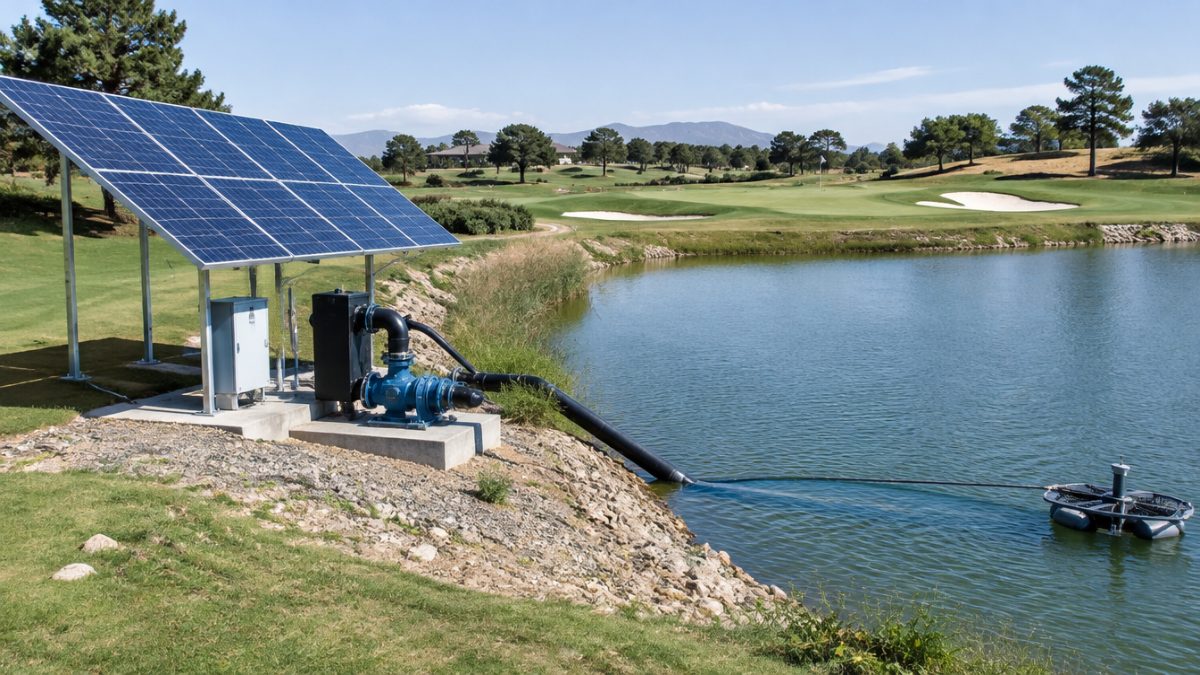
The pumping station is usually the course’s biggest electricity consumer, and it also works mostly at night and in summer. That affects how well it fits with solar generation, which produces by day. Even so, solar energy in golf offers interesting options for irrigation.
Some options being studied in practice:
- Pumping to a tank or regulating lake during daylight hours and irrigating by gravity or at lower power at night.
- Installing booster pumps powered by panels at isolated points on the course.
- Combining generation with the grid, so that solar covers part of the demand.
The design requires a study of consumption profiles by a qualified engineer. Solar energy in golf works best when irrigation adapts to it, and not the other way round, something that depends on the course’s water storage capacity.
Use 2: workshop, storage and clubhouse roofs
Machinery sheds, storage buildings and social buildings offer large roof areas that are almost always wasted. Installing panels on those roofs is the most common way to start with solar energy in golf, because it takes up no playing land and does not affect the landscape.
Before deciding, it is worth checking:
- The orientation, pitch and shading of each roof.
- The structural condition of the roof and its load capacity.
- The building’s daytime consumption, which determines how much of the output is used directly.
- Any heritage or landscape protection conditions in the area.
In a well-sized self-consumption installation, solar energy in golf reduces the electricity bill in the hours of greatest activity: the workshop, the machine wash bay, the clubhouse air conditioning or the restaurant kitchen.
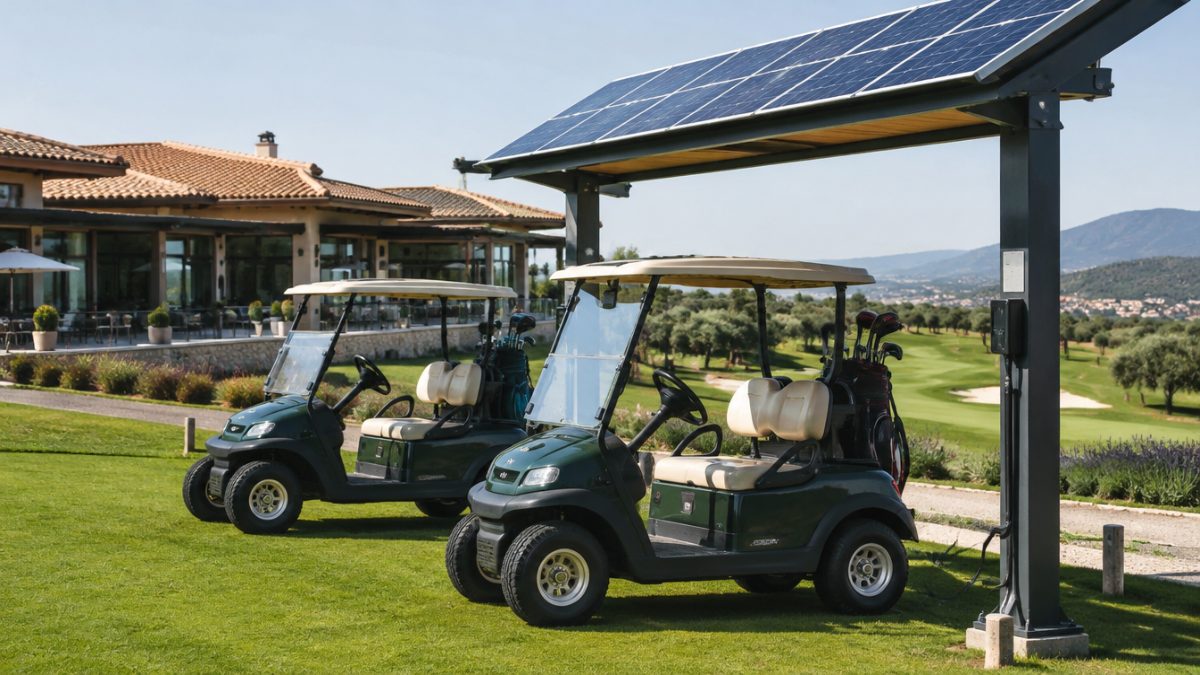
Use 3: charging electric machinery and buggies
More and more clubs are adding buggies, utility vehicles and electric machinery. Charging usually takes place at specific times, and there is an opportunity: adjusting recharge cycles to make use of the day’s solar output or, failing that, stored energy.
To make the approach coherent:
- Estimate the daily energy needed for the electric fleet.
- Locate charging points near the photovoltaic installation.
- Plan battery recharging during daylight hours when operations allow.
- Consider whether it is worth adding your own storage.
The combination of electric machinery and solar energy in golf strengthens the club’s environmental message, because it reduces local emissions and noise. That said, the choice of equipment should be based on performance and reliability criteria before image.
Use 4: lighting, auxiliary pumping and isolated points
Not everything is large installations. Many small applications fit well with stand-alone solar systems: lighting for paths and car parks, device chargers, small pumps for fountains or lake circulation, or control panels in remote areas of the course where the grid does not reach.
Their advantages are clear:
- You avoid trenching and cabling, with the works and cost they involve.
- Maintenance is low if they are sized well.
- They can be installed gradually, as the budget allows.
That said, it is worth sizing generously and considering autonomy on cloudy days. These kinds of small solutions are a good testing ground for the team before taking on a large investment: you learn how solar energy in golf behaves in the real conditions of the course.
Use 5: measuring, communicating and adding to the environmental strategy
The fifth use is less tangible but just as valuable: turning solar energy in golf into a management indicator. If a plant is installed, you need to know how much it produces, how much is self-consumed and what share of demand it covers. Without measurement there is no way to check whether the investment is paying off.
A good practice is to include in the club’s reports:
- Monthly energy production and the percentage self-consumed.
- The estimated emissions reduction compared with the scenario without the installation.
- The evolution of electricity consumption by area: irrigation, workshop, buildings.
This data feeds the environmental report, helps calculate the carbon footprint and supports applications for sustainability certifications. It also lets you explain the course’s commitment to members and neighbours with verifiable facts and numbers, not slogans.
What to study before investing in solar energy in golf
Before signing any quote, do your homework. A poorly conceived installation disappoints; a well-studied one becomes an asset for the club for many years. The first step is to know real consumption, from the bills and, if possible, the hourly curve of each supply point.
Then review these aspects:
- The administrative procedures, permits and connection conditions required by current regulations for self-consumption.
- The service life, warranty and maintenance of panels and inverters.
- Possible access to grants or incentives, which change over time and should be checked in official sources.
- The opinion of two or three installers, with comparable proposals.
Solar energy in golf does not replace good water or machinery management, but it adds to it. And like any investment, it should be reviewed with data: actual output against forecast, savings achieved and payback periods.
Further reading: IPCC. To understand the scientific framework for emissions reduction, the IPCC gathers the reference evidence on climate change.
Frequently asked questions
Is solar energy in golf cost-effective?
It depends on consumption, tariffs, available surface and how production fits with demand. It usually works best where there is high daytime consumption and usable roofs. It is advisable to commission a study from a qualified professional who calculates the sizing, investment and payback period specific to the course.
Where should solar panels be installed on a golf course?
The simplest is to use roofs of sheds, clubhouse and car parks, because they take up no playing land and do not alter the landscape. Areas not used for play, such as marginal land, can also be studied. The applicable planning and environmental regulations must be respected and the town council or competent authority consulted.
Can solar energy in golf power irrigation?
Yes, but the fit is the challenge, because irrigation usually runs at night and solar produces by day. It is solved by storing water in tanks or regulating lakes, pumping by day and irrigating afterwards, or supplementing with the grid. The design should be done by an engineer after analysing the course's consumption and water needs.
Keep reading
- steps to measure the carbon footprint in golf Carbon Footprint in Golf: 6 Steps to Measure It
- advantages and limits of electric golf machinery Electric Golf Course Machinery: 5 Advantages and Limits
- environmental certification labels within reach of your club Environmental Certification in Golf: 5 Labels Within Reach