
More and more members, tour operators and authorities are asking what the club does for the environment. Answering with a statement of intent is no longer enough: evidence is expected. Environmental certification in golf is the structured way to provide it, and a good part of the work depends on the maintenance department.
In this article we review five types of labels a club can consider, what they usually require in common, how to prepare the documentation from the course and which mistakes to avoid so that the process does not become a burden.
Why Consider Environmental Certification in Golf
Beyond image, there are practical reasons. A certification forces you to review water, energy and product consumption, to organise procedures and to set measurable objectives. Many clubs discover during the process savings they never suspected and improvement opportunities that had been postponed for years.
- Reputation: an independent label carries more weight than any brochure from the club itself.
- Relationship with the authorities: it eases dialogue when permits or water concessions are renewed.
- Market: some tour operators and events value or require environmental credentials.
- Internal management: it unites the team around common goals.
That said, it pays to be realistic and accept that the effort is shared across several departments: environmental certification in golf requires consistency; it is not an exam you pass once and forget.
Label 1: Golf-Specific Programmes
There are programmes designed by and for golf, normally driven by foundations or industry associations. They assess aspects such as nature and biodiversity, water use, product management, energy, the supply chain and community involvement.
As a starting environmental certification in golf, their main advantage is that they speak the language of the course: the indicators are understood in the machinery shed and the auditors know the reality of maintenance. They are usually a good starting point for a club that is just beginning, and many offer progressive levels that let you advance in stages without committing to everything at once.
Label 2: General Environmental Management Systems
These are international standards applicable to any organisation, not just golf. They require a documented system to be put in place: environmental policy, identification of aspects and impacts, objectives, operational controls and periodic reviews.
- They give great value if the club is part of a group with other facilities.
- They require documentary discipline and a recurring external audit.
- They require you to demonstrate continuous improvement, not just compliance.
They fit well in clubs with a solid management structure, because they require clear owners and management review. The course provides the data; management ensures the system works. For a large club, this type of environmental certification in golf also offers a common language with other departments, from the kitchen to reception.
Label 3: Biodiversity and Habitat Management Programmes
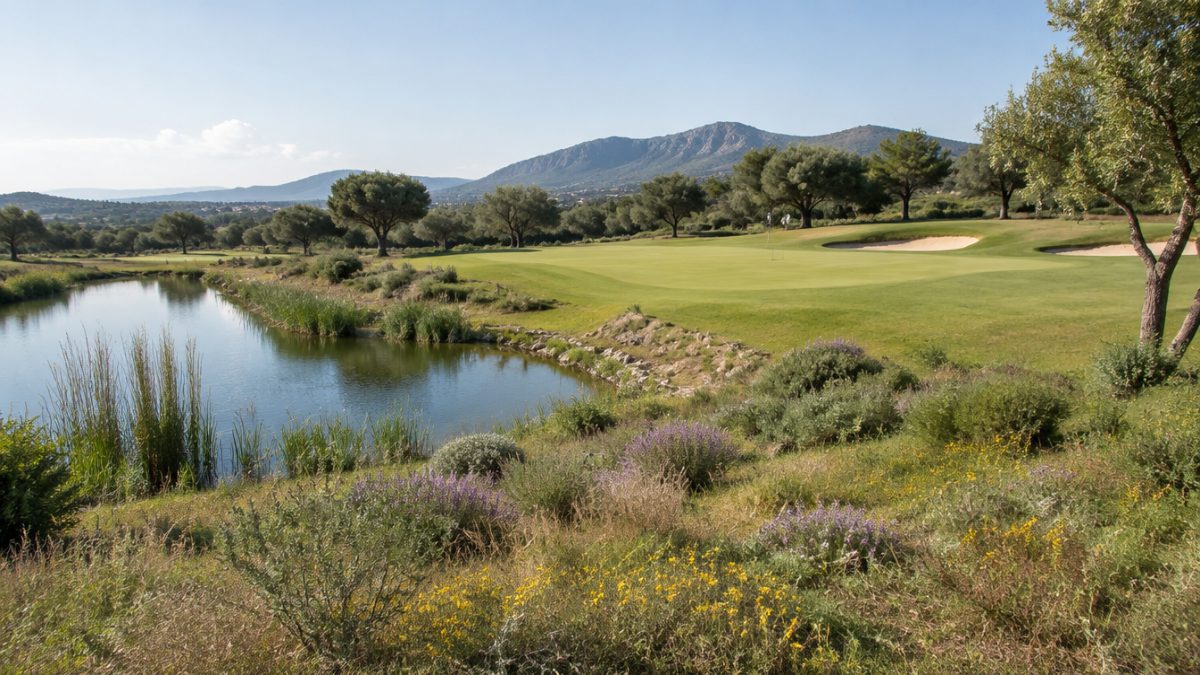
Some programmes focus on fauna, flora and habitat. They value the creation of naturalised areas, nest boxes, ponds, connectivity with nearby protected areas and control of invasive species.
For a first environmental certification in golf they are a good step if the course already has areas with native vegetation or lakes. A typical example: a club with little-played roughs decides to stop mowing them frequently, carries out a simple inventory of species and documents it with photographs. That improvement, at very low cost, earns points in the assessment and reduces machinery hours.
Label 4: Water and Energy Efficiency Recognitions
There are certifications and badges focused on the efficient use of resources. In a Mediterranean context, where water conditions every decision, they are especially relevant.
- Irrigation and electricity consumption audits.
- Use of reclaimed water or alternative sources.
- Control of losses, leaks and flows by sector.
- Reduction plan with objectives and monitoring.
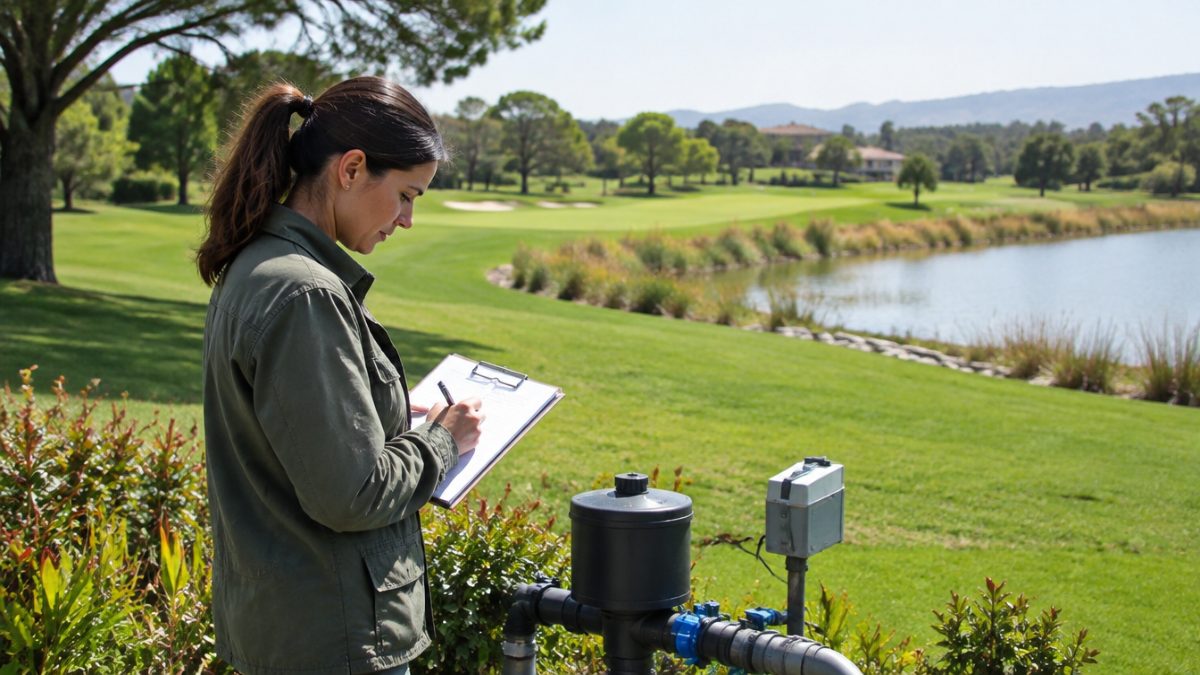
The value of these recognitions lies in the fact that they rely on the club’s own data. Whoever keeps good irrigation control starts with an advantage, because they already have much of the information requested. In an environmental certification in golf of this kind, auditors tend to look closely at the consistency between what is declared and what the records of each irrigation sector show.
Label 5: Sustainable Tourism and Quality Badges
Some labels belong to the tourism sphere and assess accommodation, catering and facilities as a whole. If the club includes a hotel, apartments or a resort, these badges help project a consistent image of a sustainable destination.
They usually have broader requirements than the course itself, so they demand coordination between departments. For maintenance, the challenge is to provide clear documentation on consumption, waste, products and good practices, and to keep it up to date. Approach it as part of the environmental certification in golf for the whole venue, not as an isolated course formality, and share responsibilities from day one.
How to Prepare for Environmental Certification in Golf from Maintenance
Whichever label is chosen, auditors ask for practically the same thing: evidence. A reasonable roadmap for the course crew:
- Take a baseline snapshot: water, energy and fuel consumption, products used, waste and natural areas.
- Organise the store and procedures: labelled products, separated waste, accessible data sheets.
- Set three or four measurable objectives: for example, reduce water use by a percentage per sector or expand the naturalised area.
- Record everything continuously: what is not written down does not exist for the auditor.
- Train the crew: every operator should be able to explain why each practice is carried out.
The most common mistake is to leave the documentation for the weeks before the audit. Information is lost, data is reconstructed from memory and unnecessary stress is created. An environmental certification in golf is prepared every day, not every year.
Further reading: MITECO. The Spanish Ministry for the Ecological Transition (MITECO) gathers information on environmental management systems and labelling applicable to organisations in Spain.
Frequently asked questions
How long does it take a club to achieve an environmental certification in golf?
It depends on the label and the club's starting point. A tiered programme can be achieved in a few months if the documentation is in order; a full management system usually takes considerably longer. What speeds up the process is having reliable data on consumption and work from the outset, something many clubs need to organise first.
Who should lead environmental certification in golf within the club?
Ideally a designated person with management support, because it affects several departments. Maintenance provides most of the data, but the process needs management backing to allocate resources and set objectives. It pays to name a specific person and to convene the committee at a fixed interval.
Is it mandatory to be certified to demonstrate good environmental performance?
No. Complying with current regulations is the mandatory baseline and many clubs apply good practices without a label. However, a certification provides independent verification, organises the way of working and makes it easier to communicate results credibly to members, authorities and tour operators, something hard to achieve with self-declarations alone.
Keep reading
- Carbon footprint in golf Carbon Footprint in Golf: 6 Steps to Measure It
- Biodiversity on golf courses Biodiversity on Golf Courses: 7 Practical Actions
- Reclaimed water for irrigation Reclaimed Water for Irrigation: 6 Keys for Your Course