
The last putt has dropped, the grandstands are coming down and the course is left to deal with what it endured all week: low mowing heights, daily rolling, spectators on areas nobody normally walks, organiser vehicles and irrigation tuned for play. Knowing how to recover the course after a tournament is as important as preparing it, because it determines whether members find a decent surface over the following two weeks.
Here is a six-step method to recover the course after a tournament without improvising: how to assess the damage, which jobs come first, how to split up the crew and how to document what was done for the next edition.
To recover the course after a tournament, start with a damage walk
The temptation is to launch aerators and seeders straight away. Hold off for a day. Walk the course with the management team, a tablet or a printed plan, and mark what you find: trampled areas, vehicle tracks, worn tee boxes, disturbed bunkers, eroded slopes, marks left by temporary structures.
Classify each point by urgency:
- Immediate: whatever affects safety or playability (holes with a broken surface, deep ruts).
- Short term: weakened turf that needs overseeding or top-dressing within a few days.
- Deferred: areas that will be resolved by the normal aeration and fertilization routine.
This list is the basis for choosing how to recover the course after a tournament sensibly and for justifying the hours invested afterwards.
Raise the mowing height and ease the pressure on the turf
During competition the turf works almost at its physiological limit. To recover the course after a tournament, the first move is to give it back some margin: raise mowing height progressively on greens, tee boxes and fairways, reduce the frequency of rolling and stop mowing dry wherever you can.
It is best done in steps rather than all at once, because an abrupt change also stresses the plant. As a rough guide, raise it a little every few days until you reach the usual maintenance height, watching how each species responds. In warm climates, bermudagrass or kikuyu react faster than ryegrass or weakened Poa annua, so the pace cannot be identical across the whole course.
If irrigation was kept tight to deliver speed, this is the time to restore a more generous water supply, always without waterlogging.
Decompact and aerate the hardest-hit areas
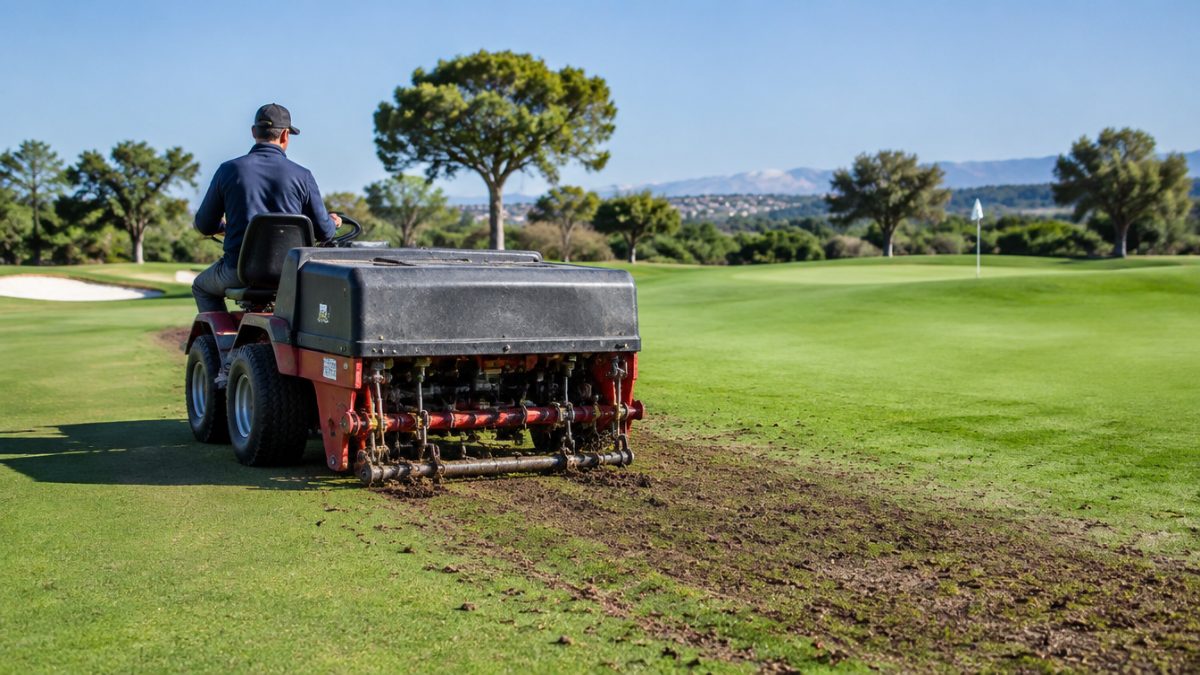
Heavy traffic compacts the soil, especially on access routes, green surrounds, spectator areas and vehicle crossings. Compacted soil breathes poorly, drains worse and delays any recovery effort, however good the seed or the fertilizer. Anyone who wants to recover the course after a tournament without repeating work must treat compaction as a technical priority, not a detail.
Consider a reasonable sequence:
- Aeration in the highest-traffic areas, adjusting depth and tine type to the condition of the soil.
- Spiking or vibration where compaction is deepest and drainage has suffered.
- Light top-dressing or sanding to level and improve the surface layer.
Avoid working when the soil is very wet or very dry: in the first case you damage the structure and in the second the machine barely penetrates. A good time is when the profile is friable to the touch.
Overseed, patch and rebuild what cannot be saved
Not everything damaged recovers by itself. Areas with dead or very thin turf need replacement, and the right call depends on the species and the season. On bermudagrass surfaces, vegetative recovery in warm weather is fast; on winter turf or ryegrass mixes, overseeding may be the main tool.
Some field tips to recover the course after a tournament on bare areas:
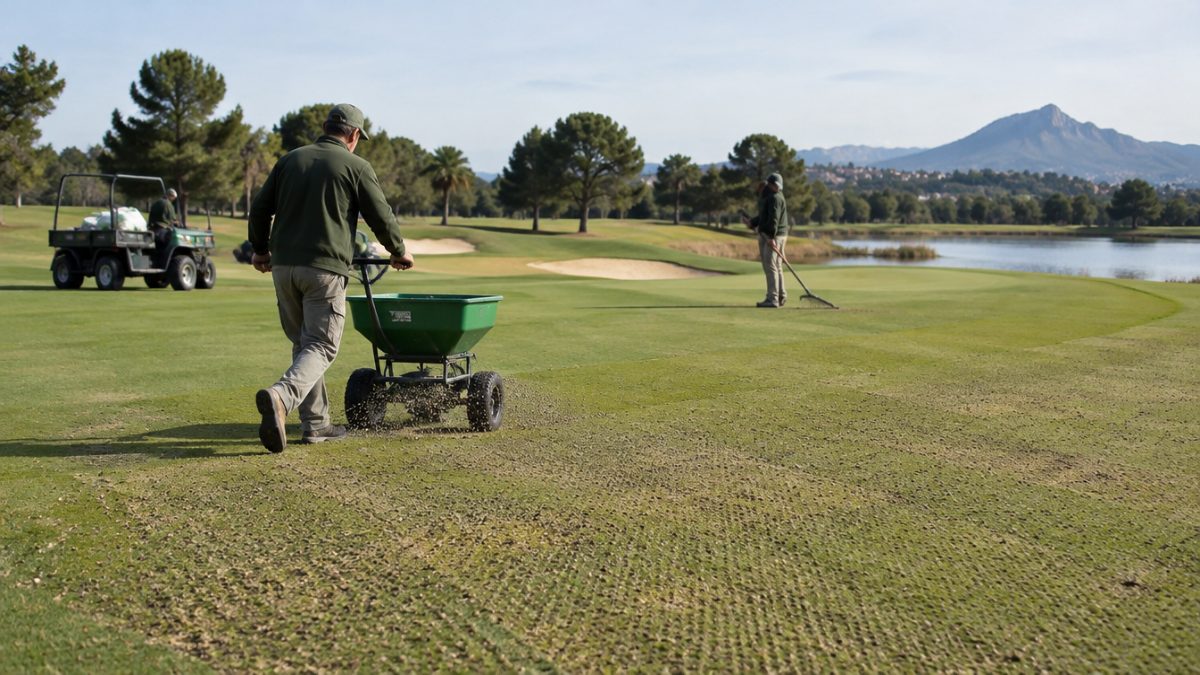
- Prepare the seedbed: light scarifying, seed in contact with the soil and a thin cover of sand or substrate.
- Protect seeded areas with ropes or stakes so they are not trampled again.
- On tee boxes and fairways, reseeding with divot mix or nursery sod lets you reopen sooner.
- Keep the surface moist with short, frequent irrigation until germination.
If the tournament coincides with the end of the season, consider whether to reseed now or wait for the right window for your species, rather than forcing a seeding that will not take.
Rebuild bunkers, slopes and surrounds
After an event, bunkers often come off worse than they look: sand mixed with mud, collapsed edges, blurred faces and partly blocked drains. Rake, check the sand depth and make sure drainage works before refilling anything.
On slopes and lake edges, trampling and rain can cause erosion. Repairing in time with compacted fill and plant cover stops the problem getting worse in the next heavy rain. Also check access routes, paths and walkways, which carry the wear of thousands of footsteps from the week.
Repairing these details is also part of recovering the course after a tournament, even if they are not visible from the fairway. Finally, remove any leftovers from temporary installations: cables, anchors, wooden stakes or forgotten geotextiles that could damage cutting equipment months later.
Reorganise the crew, log the work and close the cycle
After a week of long days, the crew is tired. Planning the split well is part of knowing how to recover the course after a tournament: grant compensatory rest, share out the hardest tasks and set a realistic two- or three-week schedule with clear priorities.
And do not forget the administrative close-out, which almost nobody does and which helps most at the next edition:
- Which jobs were done, in which areas and how many hours they took.
- Which materials and machinery were used.
- What worked and what you would do differently.
With that information you can present management with an objective account of the cost of recovering the course after a tournament, negotiate a better split of responsibilities with the organisers and prepare the next event with more margin. What is not written down is forgotten; and what is forgotten is paid for twice.
Further reading: USGA. To go deeper into managing surfaces under heavy play pressure, the USGA offers leading technical resources
Frequently asked questions
How long does it take the course to recover after a tournament?
It depends on the species, the season and the intensity of use. With bermudagrass in the warm season, many areas recover within a few weeks; with winter turf or heavily compacted soils it can take much longer. The most prudent approach, when recovering the course after a tournament, is to plan a recovery schedule of several weeks with periodic checks.
What should you do first to recover the course after a tournament?
Walk the course and document the damage with a plan or photos, classifying it by urgency. Then gradually raise the mowing height, restore balanced irrigation and relieve compaction in the highest-traffic areas. This order avoids spending seed and hours on spots that aeration would fix.
Is it better to overseed or wait for the turf to grow back?
When recovering the course after a tournament, if the plant still has live stolons, rhizomes or roots, it usually regrows with irrigation, moderate fertilization and less play pressure. If the turf is dead or very thin, it must be replaced with seed or sod. Do it in the right window for each species, not out of haste.
Keep reading
- How to prepare for a golf tournament from the maintenance side Preparing a Golf Tournament: 8 Maintenance Tasks
- Repairing divots in fairways in time Fairway Divots: 5 Methods to Repair Them in Time
- Causes and solutions for soil compaction Soil Compaction: 5 Causes and Fixes on Golf Courses