

One clean shot leaves a mark; a hundred shots a day leave a disfigured fairway. Fairway divots affect playability, spoil the look of the course and, if neglected, turn into gaps that weeds colonise or that lose water and roots. Repairing them in time is one of those modest tasks that make the difference between a well-kept course and a neglected one.
Here are five methods for repairing fairway divots, with their advantages, their limits and the situation in which each works best. At the end you will see how to organise rounds so that repair is systematic and does not depend on the crew’s spare time.
Method 1: sand and seed mix in buckets for players
This is the most widespread and cheapest system: buckets or containers on the carts with a mix of sand and seed that the player pours into the hole after their shot. It works well if there is good etiquette on the course and the containers are refilled regularly.
For it to really work, the mix must be uniform and suited to the species on the fairway. On fast-growing turf, such as bermudagrass in summer, recovery can be quick. On slower-growing species or in winter, repair by seed takes longer and calls for patience.
- Refill buckets every day in peak season.
- Post the rule at the first tee and on the practice area.
- Avoid mixes with too much seed: it is not put to use.
Method 2: players replacing their own divot
When the divot stays whole, nothing beats putting it back and pressing it down with the foot. That piece already has roots, is adapted to the spot and blends in almost immediately. It is the cheapest method for fairway divots and relies on player etiquette, so a constant message is worth keeping up.
For it to work, the divot must be replaced promptly and pressed firmly to ensure contact with the soil. If the sod dries out or is lost, there is no point replacing it.
On courses with a lot of regular member play, this habit spreads easily: it is enough for the regular players to practise it for visitors to copy them. A brief mention in the starter’s welcome about how to treat fairway divots often has more effect than any sign.
Method 3: filling with sand and seed by the course crew
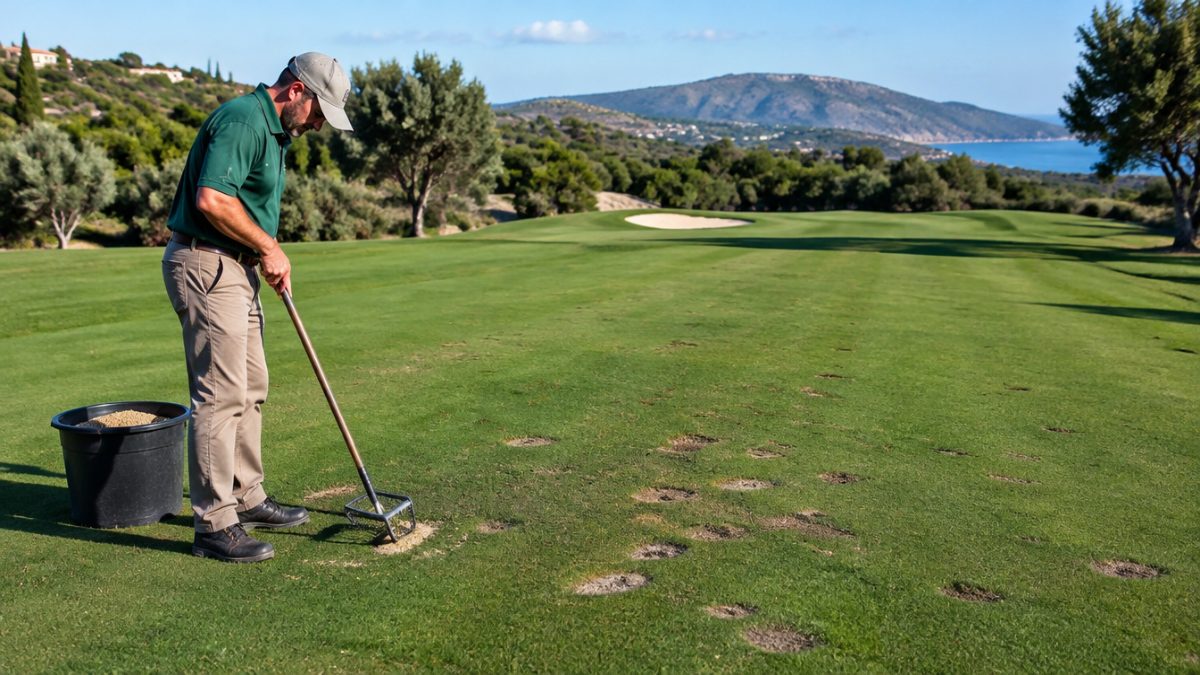
The maintenance crew goes round the fairways with a sand cart, a prepared mix and a simple tool. They check the fairway divots, fill them level and smooth them. It is an effective method, but it uses hours that must be scheduled realistically: it is not a task to be done in a hurry.
- Spot the most recent divots and those that have been open for days.
- Fill with a sand and seed mix slightly above ground level.
- Firm gently and irrigate according to the sector plan.
- Note the area and the approximate number of holes repaired.
Check the area a week later to confirm germination and repeat where needed. A fill that sinks or dries out has to be redone in time.
For the crew, a useful trick is to assign rounds by hole rather than by type of task: whoever repairs the fairway divots on a hole knows its condition and spots sooner the usual wear in the same strip. Responsibility shared among everyone tends to dilute; assigned responsibility does not.
Method 4: replacement sod from the course itself
In heavily damaged areas, fairway divots may need replacement with sod from the course nursery or from little-seen areas. It costs more in hours, but gives an immediate result and a playable surface in a few days, which is very useful before a tournament or a special day.
- Use sod of the same species and variety as the fairway.
- Cut the hole with clean edges to make it easier to fit.
- Press, smooth and irrigate carefully in the following days.
A nursery of your own, even a small one, is one of the most profitable investments for a course: it solves emergencies and keeps quality uniform.

Method 5: overseeding by zone and operations that speed up recovery
When fairway divots are concentrated in very specific areas, such as the landing strip for drives or the usual distance for second shots, it makes more sense to overseed by sector combined with aeration and light fertilisation. You work on the area, not on each hole.
This strategy reduces the number of individual interventions and improves the overall density of the turf. It is especially useful on species that recover quickly through stolons or rhizomes, and requires the operation to be accompanied by suitable irrigation, without waterlogging, to sustain germination.
- Identify the highest-impact zones on a plan.
- Schedule overseeding in the right window for each species.
- Temporarily protect the area from traffic if possible.
How to organise the repair of fairway divots
The best method is the one applied in time. A divot repaired within a few hours heals in days; one left for weeks may force you to replace sod. For the system to work without relying on goodwill, define routines.
- Set check rounds by fairway, starting with those with the most play.
- Assign a person in charge and weekly time to repair.
- Refill buckets and tools before they run out.
- Record zones, hours and the method used.
This record is more valuable than it seems: it lets you compare playing pressure by hole, justify staff hours and decide whether it is worth strengthening the repair method for the most punished fairway divots.
Further reading: R&A. The etiquette and course care rules published by the R&A remind each player of their responsibility to repair their own marks.
Frequently asked questions
How long does a fairway divot take to recover?
It depends on the species, season and moisture. On fast-growing turf and in good temperatures, a filled divot can close in a few weeks, while in winter or with slow species it takes longer. If fairway divots are dealt with in the first few hours, recovery is usually much faster.
Is seed or sod better for repairing divots?
Seed is cheaper and useful for small or scattered holes; sod gives an immediate result in heavily damaged areas or before an event. Many courses combine both: sand and seed for daily repair and nursery sod of their own when the divot is large or repeated.
How can players be involved in repairs?
With sand and seed buckets visible on the carts, clear signs at the first tee and a constant message from management. It also helps to explain why repairing fairway divots matters: it improves play for everyone. Replacing the divot, when it comes out whole, should always be encouraged.
Keep reading
- Golf fairways: key maintenance points Golf Fairways: 6 Keys to Quality Maintenance
- Mowing height: adjustment criteria Mowing height: a complete guide by course zone
- Soil compaction: how to detect it Soil Compaction: 5 Causes and Fixes on Golf Courses