
Every course fleet reaches a point where repairing a machine costs more than it contributes. The problem is that this point rarely announces itself: you find out when there is a breakdown in the middle of tournament week. Tracking machinery service life lets you anticipate and decide with data, not in a hurry.
We suggest six metrics that any greenkeeper can keep up to date: hours of use, accumulated maintenance cost, availability, quality of cut, fuel consumption and residual value. With them you will see when it makes sense to extend the life of a unit and when it is better to plan its replacement.
Why age is misleading when measuring machinery service life
Two mowers of the same model and the same date can have very different wear. One works eight hours a day on bermudagrass greens in midsummer and the other is used only for tournaments. Measuring machinery service life by the calendar leads to wrong conclusions.
It is more reliable to base it on actual use and the condition of critical components. For each unit, set an indicative reference of hours from the manufacturer and adjust it with your experience: a salty environment, dust, bunker sand or sloping terrain shorten or lengthen that expectation.
What matters is that each machine has its own record and not a fleet average.
Metric 1: accumulated hours of use
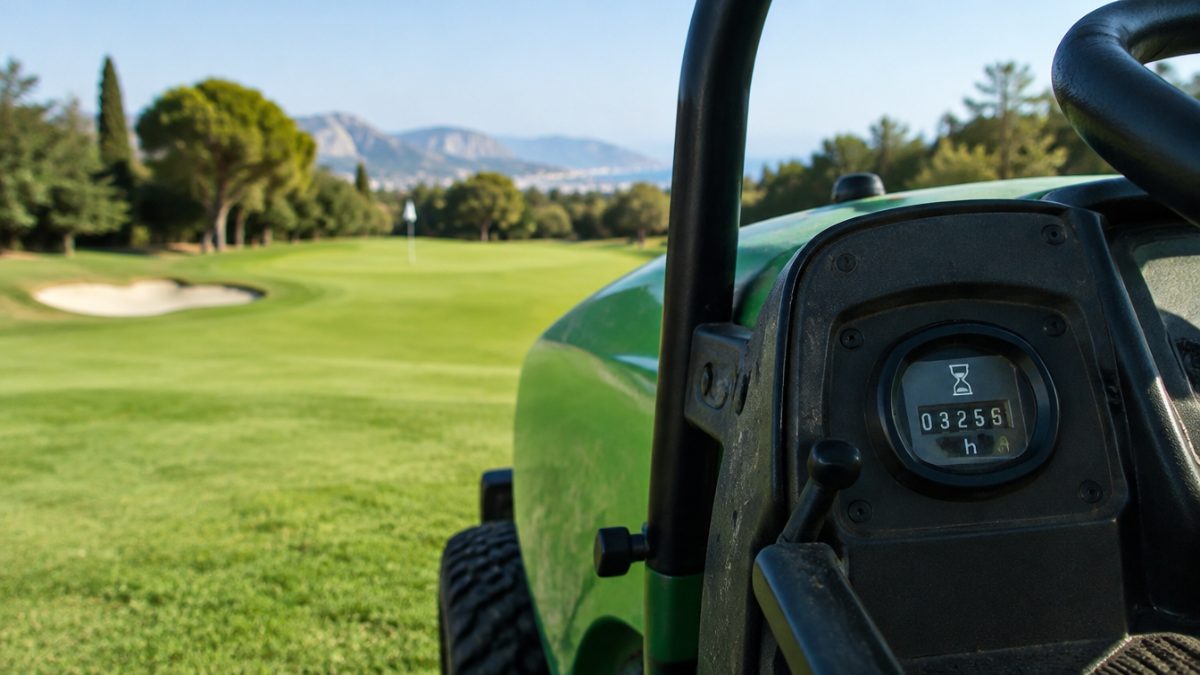
The hour meter is the starting point. Note the hours at the end of each month and compare them with the maintenance plan: oil changes, filters, belts, greasing and transmission checks are tied to hour intervals, not dates.
This reading is also useful for sharing out the work. If one machine accumulates twice the hours of its equivalent, perhaps you can rotate them and balance the wear. Extending the service life of course machinery often starts with something as simple as not always overloading the same unit.
Metric 2: accumulated maintenance cost
Add up everything invested in the machine: spare parts, workshop labour, outside services and downtime. Then divide that cost by the hours worked. You get a cost per hour that you can compare with that of a new unit or with a leasing alternative.
A widespread rule of thumb is to watch for the moment when a year’s repairs approach a significant fraction of the replacement price. There is no universal percentage, but when the spending curve accelerates, machinery service life is coming to its economic end, even if the engine still starts.
Metric 3: availability and repeated breakdowns
Calculate the percentage of days the machine was operational when it was needed. Low availability forces you to keep reserve units or delay tasks, and that hidden cost does not appear on the workshop invoice.
- Count how many breakdowns recur in the same system: hydraulic, electrical, transmission.
- Note the average repair time and the wait for spare parts.
- Assess whether the breakdown affects a safety component.
Recurring breakdowns are a clearer signal than a single serious one.
A common example: a utility tractor whose hydraulic circuit fails three times in one season. Each repair on its own seemed acceptable, but added to the days when you could not topdress or aerate, the real balance cuts machinery service life far sooner than expected.
Metric 4: quality of cut and of work
On greens, tees and fairways, the quality of the result rules. A cutting unit with play in it, worn bearings or a reel assembly that no longer holds its adjustment produces an uneven cut, which results in turf stress and player complaints.
Watch whether you need to adjust and sharpen more and more often to get the same result. It is a symptom of wear that shortens machinery service life even when the cost figures still look reasonable.
Metric 5: fuel consumption and leaks
Fuel consumption per hour worked and hydraulic oil leaks degrade over the years. A sustained increase in consumption with no change in the task usually indicates a loss of engine performance or resistance in the transmission.
Leaks, besides cost, represent an environmental risk to the turf and the soil. Check hoses and fittings on a fixed routine and keep a record of each intervention, since a leak history is a solid argument when justifying a replacement to management.
Metric 6: residual value and when to sell
A well-cared-for machine keeps its value, and that value falls quickly if you wait too long. Check the second-hand market and note the estimated price at the end of each season. Often the best time to renew is before repairs spiral, when you still recover a significant part of the investment.
Cross this information with the previous five metrics in a simple decision table: maintain, repair up to a spending limit, schedule replacement or remove from the fleet. That way machinery service life stops being a workshop hunch and becomes a criterion shared with management.
Review that table once a year, preferably at the end of the high season, when the incidents are still fresh and you can negotiate the purchase in good time. Presenting machinery service life as a staggered replacement plan, rather than a single large investment, makes it easier for the board to approve and spreads the financial effort over several financial years.
Finally, involve the mechanic and the operators: they notice vibrations, noises or a change in a machine’s behaviour before anyone else, and their observations enrich any calculation.
Further reading: GCSAA. The superintendents association GCSAA publishes equipment and workshop management resources that can serve as a reference.
Frequently asked questions
How do I estimate the service life of golf course machinery?
Start from the indicative hours given by the manufacturer and adjust them with your real experience: intensity of use, environment and quality of maintenance. Then cross-check with cost per hour and availability. When both worsen steadily, the machine is nearing the end of its cycle.
Is it better to repair or replace a greens mower?
It depends on the combination of accumulated cost, reliability and quality of cut. On precision equipment, an unreliable unit harms the green more than the repair saves. Compare the cost per hour and consider alternatives such as leasing before deciding.
What maintenance extends machinery service life the most?
Constant preventive maintenance: cleaning after each day, greasing, changing filters and fluids at their intervals, and sharpening and correctly adjusting the cutting units. Recording each intervention avoids oversights and lets you detect wear patterns before they lead to a costly breakdown.
Keep reading
- Preventive maintenance of machinery step by step Preventive Equipment Maintenance: 7 Key Tasks
- When to renew the course machinery fleet Replacing the machinery fleet: 6 key decision factors
- Leasing golf machinery: pros and cons Golf Equipment Leasing: 5 Real Pros and Cons