
November is the month when the course seems to fall asleep. The turf grows little, mowing is spaced out and the days get shorter, but the work does not disappear: it changes in nature. The greenkeeper tasks in November revolve around protecting what has been achieved during the year, managing the water that falls from the sky and using the calm to do what does not fit into peak season.
We review seven key jobs for a Mediterranean-climate course, with advice on setting priorities, dividing the crew’s time and keeping an eye on the condition of the surfaces with less light, more humidity and the first frosts.
Greenkeeper Tasks in November: Manage Moisture and Drainage
When the autumn rains arrive, among the greenkeeper tasks in November drainage stops being a detail and becomes the priority. A course that holds water on the surface suffers compaction, disease and traffic damage. Before the storms, it pays to walk the course with the eyes of someone who has already seen what happens when it rains heavily.
- Clean ditches, manholes, grates and bunker drains so they carry water away without obstruction.
- Mark on a plan the areas where water collects and plan improvement work for the winter.
- Check the condition of the paths and divert buggy traffic away from the softest areas.
Noting after each rain where the course floods is one of the best investments: after a few months you will have a clear map of the critical points.
Greenkeeper Tasks in November: Adjust Irrigation and Prepare for Shutdown
In many areas irrigation is cut to a minimum in November, but it does not disappear entirely. The important thing is not to leave the system running on inertia or switch it off without checking. Adjust the schedules to real demand and use the periods with no need to carry out system maintenance.
- Reduce run times and frequencies to what the turf really requires in each zone.
- Check filters, valves, controllers and pumps during the days without irrigation.
- If there is a risk of hard frost, consider draining exposed sections or protecting delicate components.
- Note the year’s incidents to plan repairs or improvements before spring.
If the course uses reclaimed or well water, take this moment to check the quality and condition of the installations.
Protect the Greens from Frost, Dew and Traffic
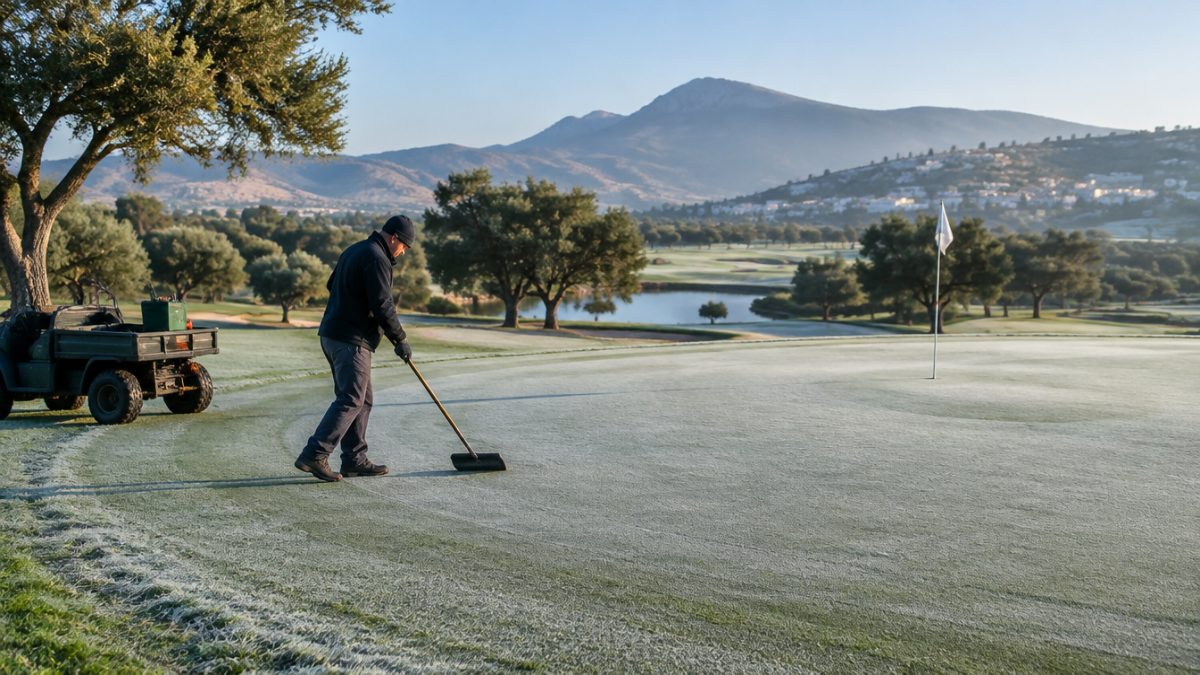
With the first frosts, a frozen green is a fragile surface: the leaf breaks when walked on and the marks take weeks to recover. Set a clear criterion for delaying play when there is frost and communicate it to reception and the starter, so that players do not find out at the tee.
- Do not carry on mowing or rolling over frozen leaves.
- Remove dew with gentle passes when appropriate, to reduce disease development.
- Consider using temporary greens or changing the pin position more often to spread the wear.
Discipline in these decisions protects the surface for the rest of the year, even if it sometimes means explaining to a player why they have to wait half an hour.
Fallen Leaves and Clean-Up: A Job That Cannot Be Postponed
In November the leaves of the trees fall in quantity, and piled on the turf they cause shade, humidity and cutting problems. If left for several weeks without removal, the turf underneath weakens and bare patches appear in spring.
- Organise blowing or vacuum routes with priority for greens, tee boxes and collars.
- Set aside a container or area to stockpile leaves and prevent them from blowing back onto the course.
- Coordinate the work with mowing, so the machine does not drag wet leaves.
This is one of the greenkeeper tasks in November that consumes the most hours, so it pays to plan it like any other and not treat it as filler between jobs.
Fertilisation and Low-Intensity Cultural Practices
With the turf in partial dormancy, the greenkeeper tasks in November call for caution with nutrition. In warm-season species, nitrogen inputs are usually minimised, and in cool-season species they are maintained depending on the plant’s response and the weather. The prudent approach is to rely on analysis and on observing the turf rather than on a fixed calendar.
- Apply only what the soil analysis and the condition of the turf justify.
- Consider shallow tining or light aeration if the soil is too compacted and moisture allows.
- Avoid working on waterlogged soil: more harm than good.
Every product must be applied according to the label and current regulations, with the advice of an authorised technician where applicable, recording date, zone and amount.
Machinery: A Thorough Overhaul, One of the Greenkeeper Tasks in November
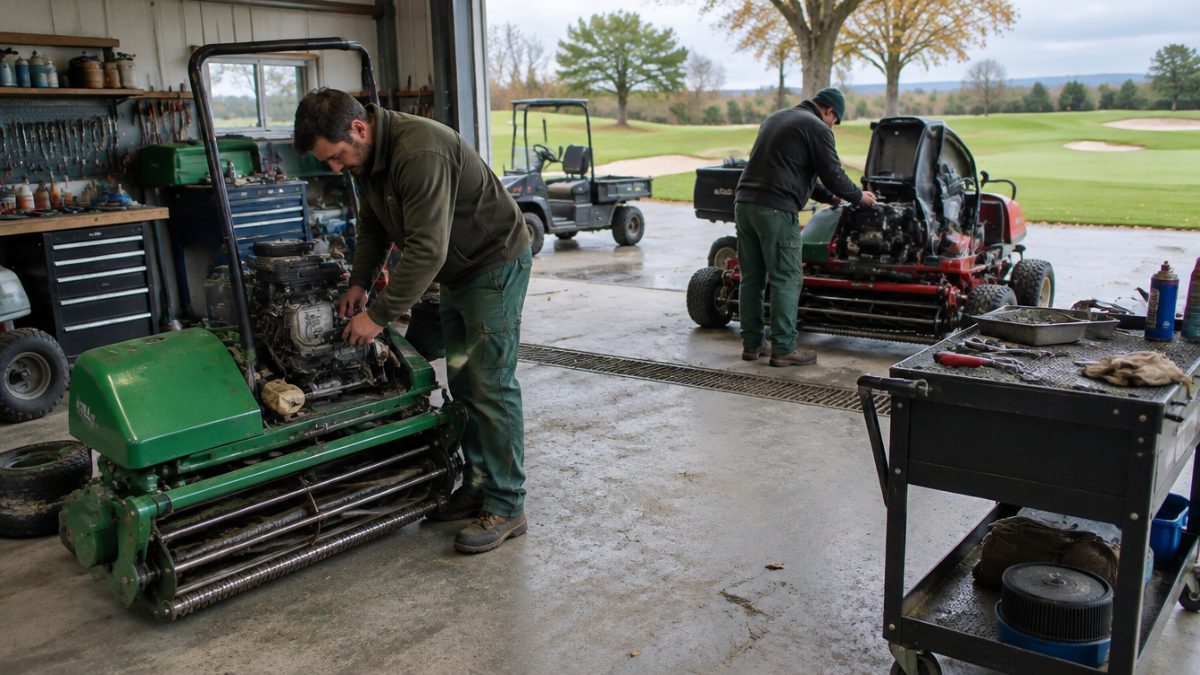
The slower mowing pace allows workshop jobs that are impossible in summer, and that is why the greenkeeper tasks in November always include an overhaul of the machinery fleet. It is the best time for full sharpening, oil changes, hydraulic checks, greasing and replacement of worn parts.
- Make an inventory of machines and mark which need a deep overhaul this winter.
- Prioritise those most used in spring: greens, tee and fairway mowers.
- Order early the spare parts that usually take a long time, so you are not left waiting in March.
Recording each intervention in the machine’s service history will give you valuable information to decide in the future when to repair and when to replace.
Plan the Winter Works and Training
The greenkeeper tasks in November end up looking towards winter, the season of works: tee box renovation, drainage, bunker improvements, paths and pruning. November is the time to define what will be done, who will carry it out and with what budget, before bad weather affects the deadlines.
- Prioritise projects according to their impact on play and urgency.
- Book dates with suppliers and external crews.
- Tell the club about partial closures as far in advance as possible.
- Use the low activity to train the crew in safety, machinery use and working criteria.
Closing the month with a works and training calendar makes it easier to explain to management how the crew’s time is being used over the winter.
Further reading: AEMET. The rain, wind and frost forecasts of the Spanish State Meteorological Agency (AEMET) help decide which days to work on the turf and which to postpone.
Frequently asked questions
What are the most important greenkeeper tasks in November?
The most important are managing drainage and moisture, protecting greens from frost and traffic, removing fallen leaves and adjusting irrigation. Next come the overhaul of machinery and the planning of winter works, which should be organised before bad weather affects the deadlines.
Can greens still be mown in November?
Yes, as long as the turf is growing, but less often and watching for frost. You must not mow or roll over frozen leaves, and it pays to wait for the frost to disappear. Adjusting height and frequency to real growth is one of the greenkeeper tasks in November that most protects the surface.
How do I organise the greenkeeper tasks in November with a small crew?
Set priorities in order of risk: first what can damage the course, such as drainage or frost, then what improves its condition, such as works or training. A weekly calendar with clear owners and a daily report of what has been done avoid overlaps and omissions.
Keep reading
- What to do on the course during October Greenkeeper Tasks in October: 7 Key Jobs
- Key jobs for September Greenkeeper Tasks in September: 7 Key Jobs
- How to plan winter overseeding Winter overseeding: 6 steps for a green course