
Hardly anyone enjoys filling in paperwork at the end of a spraying day, but everyone is glad to have it when an inspection, a complaint or a question arrives about what was applied to a green three months ago. Pesticide application records are, as well as an obligation, a very useful management tool.
In this article we review six key data points that good pesticide application records should contain, how to organise them so they are quick to complete, and which mistakes to avoid. All of this is general guidance: current regulations and your authorised adviser always set the exact requirements your course must meet.
What pesticide application records are really for
Beyond legal compliance, well-kept records let you answer everyday questions precisely: what was applied, where, when and with what result. That information avoids repeating unnecessary treatments, helps rotate strategies and makes diagnosis easier when something fails.
They are also useful for communication. Faced with a worried member, an authority or an auditor, being able to show a clear history conveys professionalism. And for the team itself, it is collective memory: the person who knows what was done last year may be on holiday or may have left the club.
A frequent example: a patch appears on a green and someone remembers that “something like this has happened before”, but nobody knows when or what was done. With good pesticide application records, the answer is a minute away and the decision is made with data rather than recollection.
Data point 1: Date, time and application conditions
The first data point seems obvious, but it is often recorded wrongly or late. Record the day and time slot, and add the relevant weather conditions: wind, temperature and humidity. These conditions affect efficacy, drift and the safety of the application. When every entry in the pesticide application records includes this context, it becomes much easier to understand why the same product worked well one day and less well another.
- Note the actual time of application, not the scheduled one.
- Record whether it had to be interrupted by wind or rain.
- Log subsequent irrigation or rainfall if they affect the result.
Data point 2: Area treated and surface
Good pesticide application records clearly identify where the application took place: green number so-and-so, the fairway of a specific hole, tee boxes, rough or ornamental areas. They also give the area treated, even if approximate, because the consumption calculation depends on it.
If the course has areas with different turf species, it is worth noting that. It makes it easier to see patterns, for example which disease always appears in the same shaded or poorly ventilated area, and lets you consider underlying solutions such as pruning, drainage or a change in management, in addition to the one-off treatment.
Data point 3: Product, reason and target pest or disease
You must record precisely which product was used, as shown on its label or authorised data sheet, and for what specific problem. The reason matters as much as the product: without it, the record is a list of applications with no logic.
Good-practice recommendations:
- Identify the problem with a reliable diagnosis, relying on the adviser if in doubt.
- Note whether it is a preventive or curative application.
- Record the intervention criterion applied, for example the threshold observed.
Rates and method of use are always determined by the label, current regulations and the authorised technician.

Data point 4: Responsible person and equipment used
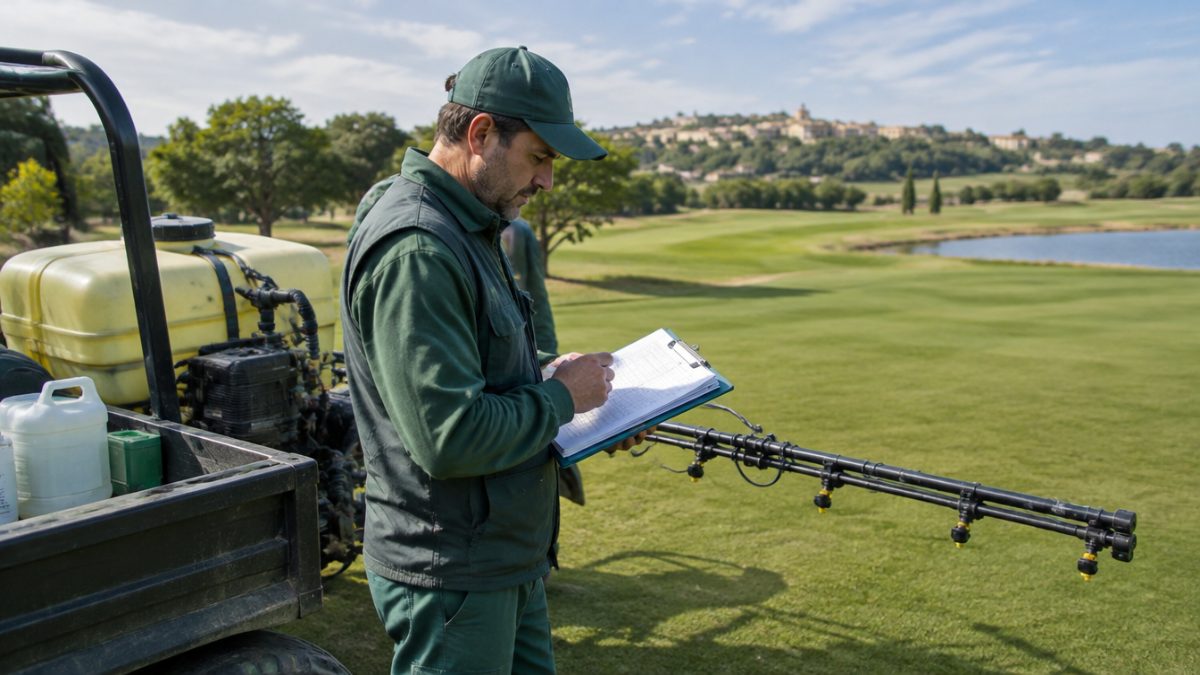
Every treatment must be traceable to the person who carried it out and, where applicable, to the person who authorised it. It is essential that the applicator has the required training and accreditation, and that the record reflects that responsibility.
It is also useful to note the machine used, its calibration and the maintenance of the equipment. A poorly calibrated sprayer can ruin a correct treatment, and in case of doubt, being able to check which equipment was used saves hours of investigation. This information ties in with preventive machinery maintenance and with staff safety.
If the course works with outside contractors, the pesticide application records must likewise show who applied and under whose responsibility, so there are no gaps when the service is subcontracted.
Data point 5: Safety intervals and access restrictions
Each product has associated intervals and conditions that protect people and the environment. Effective pesticide application records capture when it is safe to re-enter the treated area, whether it must be signposted and what precautions must be maintained.
- Post signs on treated areas where appropriate.
- Notify the golf department so tee times and tournaments can be adjusted.
- Take into account proximity to water, walkways or homes.
A good entry here avoids conflicts with players and protects the club from claims.
Data point 6: Observations and subsequent result
The sixth data point is the one most often forgotten and the one that adds the most value: what happened afterwards. Noting the turf’s response after a few days, whether the problem subsided, whether there was phytotoxicity or whether it had to be repeated, turns the record into a learning tool.
Over time you build your own history: which strategy works best on your course, at what times of year problems appear and how your species react. That knowledge reduces product use, supports integrated management and makes it easier to justify decisions to management.
For the habit to stick, make it easy: simple forms, entry immediately after the application and a weekly review by the person in charge. A record that is a chore to fill in ends up abandoned.
Finally, review the whole thing once or twice a year with the adviser: see which areas receive the most applications, which products are repeated and whether there is room for cultural measures that reduce reliance on treatments. That way the pesticide application records stop being a file and become a tool for continuous improvement.
Further reading: Ministry for the Ecological Transition (MITECO). MITECO, Spain's Ministry for the Ecological Transition, centralises official information on the environment and resource management that is worth consulting when planning the use of products on the course.
Frequently asked questions
Who should keep the pesticide application records on a golf course?
Usually they are kept by the maintenance manager or the person designated by the club, with the support of the applicator and the authorised adviser. What matters is that there is a clear person responsible, that data is entered promptly and that the pesticide application records are available for any inspection.
How long must the records be kept?
The specific period is set by current regulations, so check with the authorised adviser or the competent authority. As a general rule, it is advisable to keep the history for considerably longer than the minimum required, because its technical value for future decisions is very high.
Is it better to keep the records on paper or digitally?
Both are valid if they meet regulatory requirements, but the digital format makes searching easier, avoids losses and lets you cross-reference data between areas and dates. Digital pesticide application records are easier to share with the adviser and to present at inspections.
Keep reading
- Integrated pest management in golf: key steps Integrated pest management in golf: 6 key steps
- Fusarium in turf: winter measures Fusarium patch in turf: 5 winter measures
- Pine processionary moth in golf: safe measures Pine processionary moth on golf courses: 5 safe measures