
One week of fog, persistent dew and mild temperatures is enough for the first spots to appear on a green. Fusarium patch in turf is one of the most recognisable diseases of winter and early spring, and on golf surfaces, with low cutting heights and high demands, it can ruin weeks of work.
In this article we go through five winter measures: understanding which conditions favour Fusarium patch, managing moisture, adjusting fertilisation, monitoring and deciding when to treat, and keeping a record of everything. These are general criteria and do not replace a diagnosis from a specialist technician.
Understand when Fusarium patch appears
It is a fungal disease that tends to be most aggressive with persistent moisture on the leaf, cool temperatures and low light, although the exact range varies with climate and species. It is especially feared on Poa annua and bentgrass greens, and it can also affect areas of ryegrass overseeded in winter.
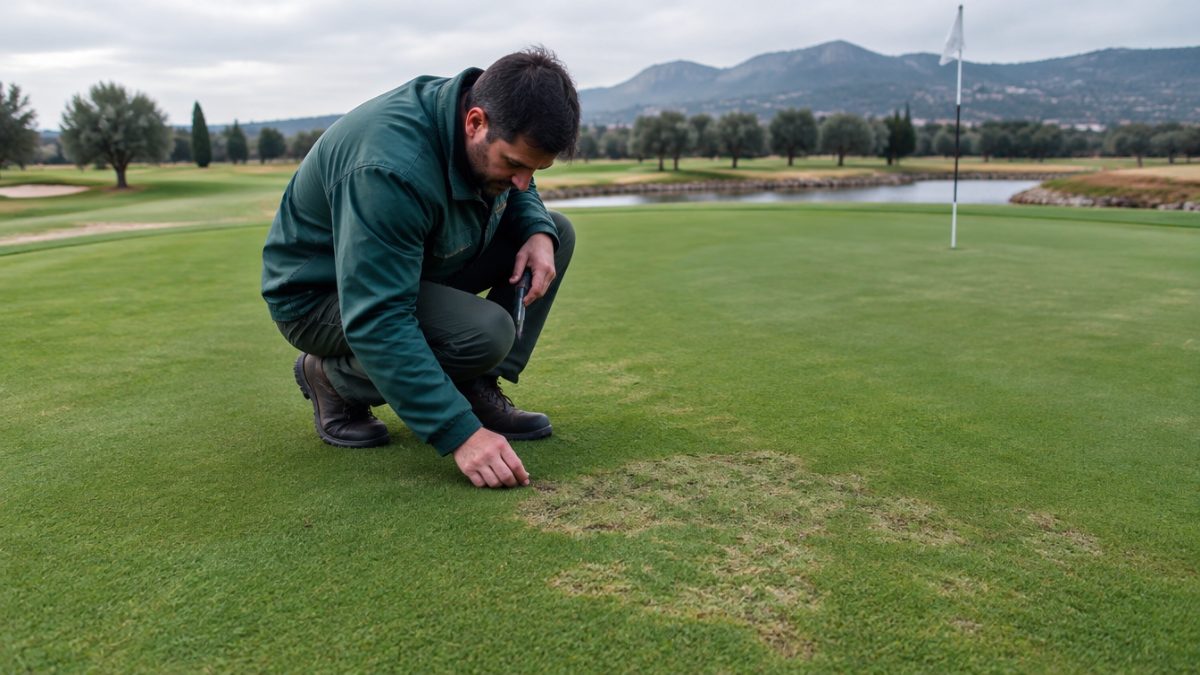
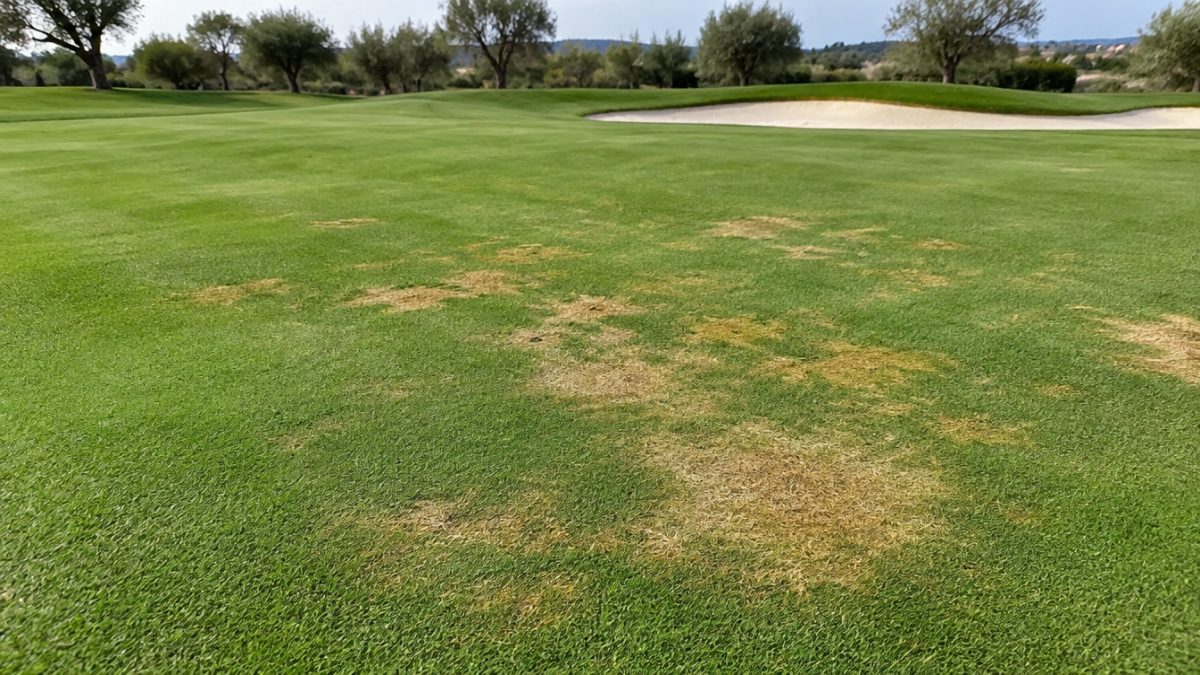
The most common symptoms are rounded patches, straw-coloured or reddish-brown, of variable size, sometimes with a darker ring. In high ambient humidity, whitish or pinkish mycelium may be visible. Before acting, confirm the diagnosis: other causes, such as animal urine, spills, different fungal rings or herbicide damage, leave similar marks.
It also helps to know the history. Greens with morning shade, poor air movement or slow drainage repeat year after year, and are usually the first to give the signal. If you identify those weak points on your course, you can focus monitoring and preventive measures there instead of spreading the effort equally across the whole surface.
Reduce moisture on the leaf and improve drainage
Almost all preventive management of Fusarium patch revolves around water. The less time the leaf stays wet, the lower the risk.
- Irrigation: water in the early hours or in the window that leaves the fewest hours of wet leaf afterwards, and avoid unnecessary irrigation in winter.
- Dew: remove it with a light mowing, a roller or by dragging, if the mowing schedule allows.
- Drainage: check that the surface and profile drain without persistent puddles.
- Light and air: prune or thin trees that keep areas in continuous shade.
On the most problematic greens, the combination of aeration and fine top-dressing sand usually improves how the profile behaves over time.
Do not underestimate surface details: a green with undulations that collect water or with compacted areas holds moisture in the same spots, and that is where Fusarium patch usually breaks through first.
Adjust fertilisation and turf management in autumn
Excess nitrogen as the cold arrives produces soft, lush leaves that are much more susceptible. On the other hand, turf without enough nutrients recovers poorly. The balance depends on the soil analysis and the species, so consult your technician before setting the autumn programme.
Other factors that influence Fusarium patch pressure:
- Excess organic matter (thatch), which holds moisture and keeps the fungus alive between episodes.
- Unbalanced pH or potassium imbalances.
- A cutting height that is too low for the season, which stresses the plant.
Against Fusarium patch, raising the cutting height slightly in winter is usually a simple measure that reduces stress without affecting play too much.
Monitor Fusarium patch daily and decide when to treat
Early detection makes the difference. Do a visual round during the dew hours, when the spots and mycelium are most visible, and pay attention to greens with a history, shaded areas and the dampest edges. Photograph the first outbreaks and locate them on a map to see whether they grow, merge or stabilise.
The decision to treat should be made with judgement: the level of damage, the weather forecast, the importance of the surface and the resources available. Any plant protection treatment must respect the label, current regulations and the advice of an authorised technician or adviser; it is also wise to rotate strategies to avoid building resistance.
Take care with traffic and machinery on high-risk days
Fusarium patch also spreads mechanically. A mower that passes over an active outbreak and then carries on over the healthy green can distribute spores and fragments of mycelium. With the disease present, organise the work so that affected areas are cut last, and clean machines and shoe soles well before moving to another surface.
- Avoid mowing with very wet leaves if you can delay mowing a few hours.
- Reduce buggy and player traffic over active outbreaks, using ropes or signs.
- Consider cutting back aggressive operations, such as verticutting or deep spiking, while there is an outbreak.
These are decisions that sometimes clash with the play or tournament calendar, so it pays to discuss them in advance with management and explain the reason.
Record and learn from every Fusarium patch episode
Every episode is a source of information. Note the date of onset, the weather in the preceding days, the green or area affected, the damaged surface, the cultural measures applied, any treatments and the weekly progress. With three winters documented you will begin to see patterns: which greens are most sensitive, which conditions trigger the disease and how long the turf takes to recover.
These Fusarium patch records will let you anticipate problems, justify resource use to management and evaluate whether preventive measures work. And if the team changes one day, the knowledge does not leave with the person. A good archive is, in practice, the best vaccine against improvisation.
Further reading: STRI. To go deeper into sports turf disease management, you can consult the resources of the STRI research institute.
Frequently asked questions
How do I recognise Fusarium patch on golf turf?
It usually appears as rounded straw-coloured or reddish-brown patches that can grow and merge, sometimes with a darker edge and, in high humidity, whitish or pinkish mycelium. Because other causes give similar symptoms, the prudent course is to confirm the diagnosis with a technician before treating.
Can Fusarium patch be prevented without fungicides?
The risk can be reduced a great deal with cultural management: less moisture on the leaf, good drainage, more light and air, thatch control, balanced fertilisation and a suitable cutting height. It does not guarantee avoiding every outbreak in years very favourable to the disease, but it lowers their frequency and intensity.
How long does turf take to recover after an outbreak?
It depends on the species, the severity of the damage and the temperature. In cold weather growth is slow and recovery drags on. If only the leaf is affected, the turf regrows sooner than if the crown has been damaged. In badly damaged areas, overseeding or repair may be needed.
Keep reading
- Strategies to control pests and diseases in golf turf Strategies to control pests and diseases in golf turf
- Pine processionary moth on golf courses: safe measures Pine processionary moth on golf courses: 5 safe measures
- Winter overseeding: steps for a green course Winter overseeding: 6 steps for a green course