
One dewy morning is enough to see them: patches of a different texture on the fairway, a circle of broadleaf weeds on the tee box, a lighter-coloured grass breaking the green of a well-kept rough. Weeds in turf are one of the most visible complaints from members and players, and also one of the easiest to make worse with a wrong diagnosis.
Controlling weeds in turf is not about spraying once they are visible, but about understanding why they got in and which conditions favour them. These six strategies help you organise the work and decide with judgement when cultural management is enough and when a treatment is needed.
Identify the species before deciding anything
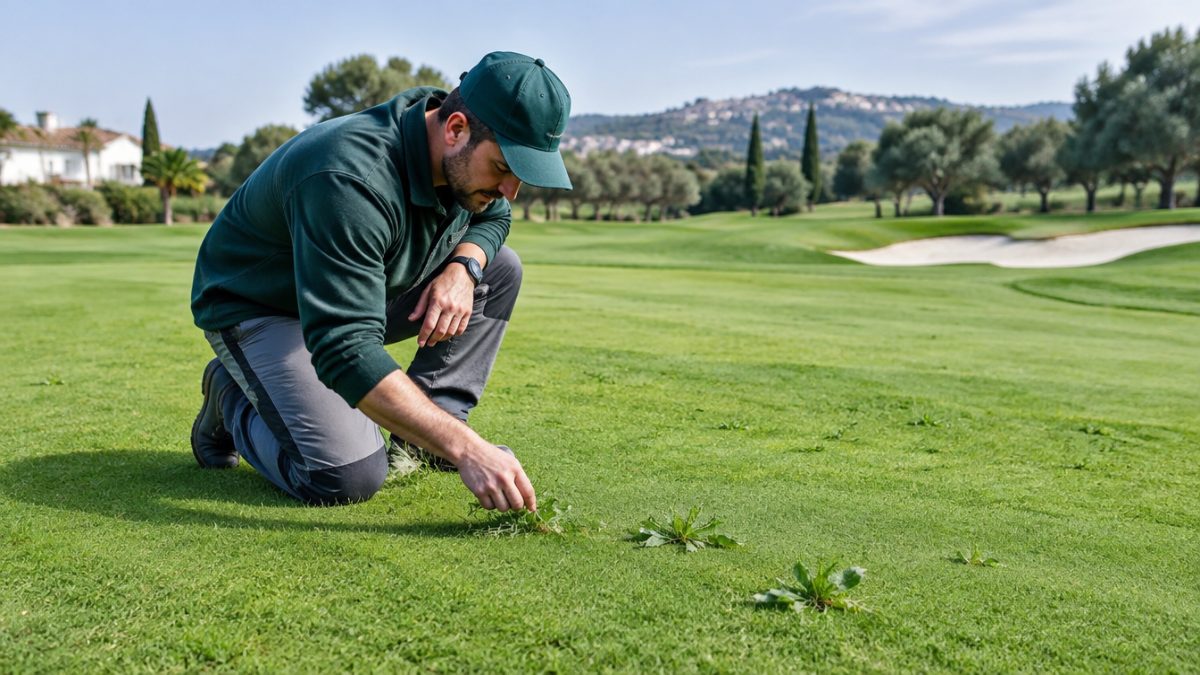
Not all weeds in turf are controlled in the same way. A summer annual, a creeping perennial, a sedge such as nutsedge and an invasive grass respond to different management, and confusing them is the most common cause of failed treatments.
Think, for example, of a tee box where a creeping broadleaf weed is growing: if you simply pull it out, it regrows from the fragments; if it is identified and dealt with in time, it is contained without harming the turf. Make the diagnosis methodically:
- Photograph the plant and the area with a date reference.
- Observe the growth habit: erect, creeping, tufted, with stolons or rhizomes.
- Note the time of year and the conditions: moisture, shade, compaction, fertility.
- If in doubt, consult an authorised technician or adviser before acting.
Knowing which species you have and when it germinates or regrows lets you get ahead of it, which is always cheaper than reacting.
Look for the cause: weeds in turf exploit gaps
A dense, healthy surface leaves little room for intruders. When weeds in turf appear repeatedly, there is usually a factor weakening the turf or opening gaps:
- Mowing heights too low for the species, which reduce density and vigour.
- Compaction, which favours opportunistic plants of trampled areas.
- Excess or deficit of irrigation, which benefits some species over others.
- Unbalanced fertilization, with deficiencies that the turf does not tolerate and other plants do.
- Mechanical damage, divots and unrepaired wounds.
Correcting the cause is usually more lasting than removing the plant. If you do not act on the origin, weeds in turf come back the following season.
Strengthen cultural management as the first line of defence
Good turf management is the cheapest herbicide and the one with the fewest side effects. The denser, more vigorous and better fed the turf, the fewer opportunities weeds in turf will have.
Practices that help:
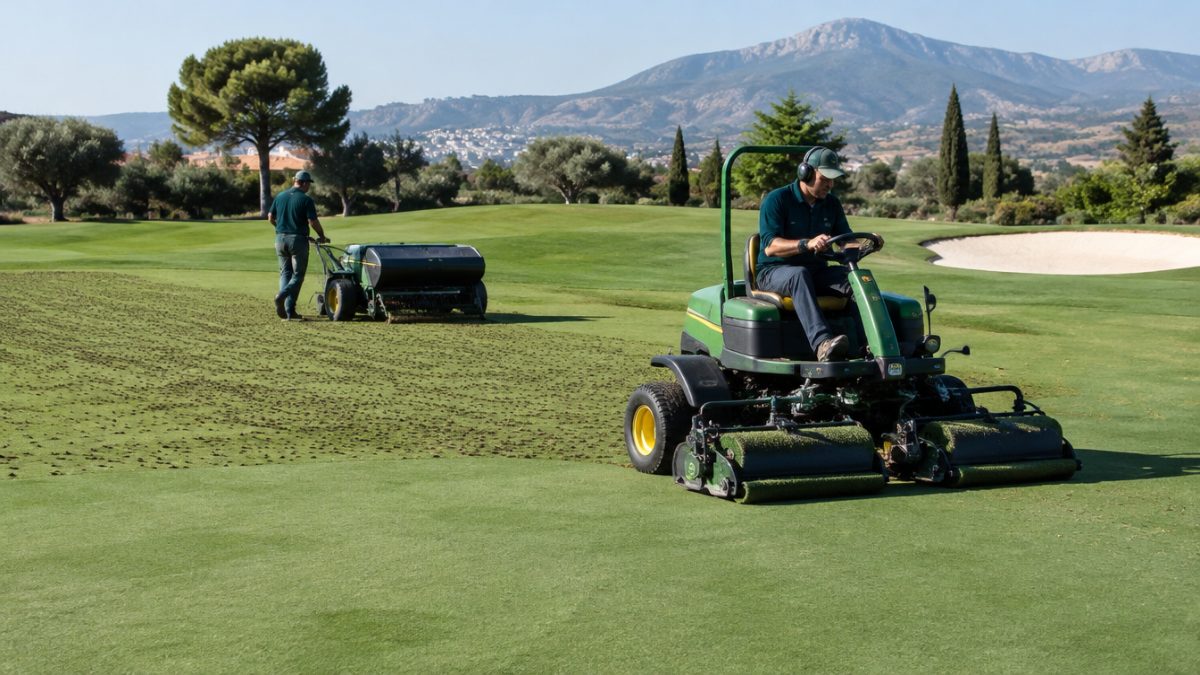
- Mow at the right height for each species and zone, without scalping.
- Periodic aeration and decompaction.
- Deep, spaced-out irrigation, avoiding constant surface excess.
- Fertilization based on testing and the real needs of the season.
- Overseeding or replanting as soon as bare patches appear.
- Cleaning machines when changing areas so seeds or fragments are not carried over.
This block requires consistency more than investment, and it is the foundation on which every other measure rests.
A detail that gets forgotten: fairway edges, bunker surrounds and buggy paths are the usual entry points. Giving them a more frequent check, with clean mowing and turf replacement where it is missing, blocks many species before they settle into the interior of the course.
Act in time, in the window of least effort
Almost every weed is easier to control when it is young. Seedlings have few reserves and a small root system; adult plants, with stolons, rhizomes or tubers, demand much more effort.
That is why it pays to have a scouting calendar: periodic walks in spring and autumn, special attention to edge areas, paths and bunker surrounds, and manual removal of small foci before they produce seed. Where appropriate, mechanical or manual weeding on small surfaces is an effective option that uses no products.
Putting action off until it “looks worse” usually means having to treat a larger area, at more cost and with more risk of damaging the turf.
A good habit is to mark on a plan the foci found on each walk. That way you can see at a glance whether a patch grows, holds or disappears after the intervention, and assign the task to the right member of the team.
Use selective treatments only when justified
When cultural management is not enough, a herbicide treatment may be necessary. It is one more tool of integrated management, not the first. Before applying, confirm the species, the tolerance of the turf to the chosen active ingredient, the condition of the plant and the weather conditions.
Any intervention of this kind must be carried out following the product label, current regulations and the advice of an authorised technician or adviser, with properly trained personnel and calibrated equipment. Avoid treating in intense heat, wind or when rain is imminent, and protect sensitive areas such as lakes, watercourses or areas of frequent use.
Also plan to rotate strategies so you do not always depend on the same tool, and make clear who authorises each application.
Record every action and evaluate the results
Without records, it is impossible to know whether a strategy worked. Systematically note where the weeds in turf appeared, which species they were, what was done, when and with what result. If there was a treatment, record the product, date, area, conditions and the person responsible.
With that information you can:
- Detect recurring zones that point to a structural problem.
- Compare the effect of different practices over time.
- Meet any applicable traceability requirements.
- Justify to management the real cost of weed control.
Review the results at the end of each season and adjust next year’s plan. It is the way for weed control in turf to stop being a reaction and become a process.
Further reading: MITECO. For the general framework on the sustainable use of plant protection products in Spain, you can consult the Ministry for the Ecological Transition (MITECO)
Frequently asked questions
Why do weeds appear in the turf of a golf course?
They usually get in where the turf is weak or there are gaps: excessively low mowing heights, compaction, poorly adjusted irrigation, unbalanced fertilization or unrepaired damage. They also arrive as seeds carried by machinery, water or wind. Correcting those conditions reduces the pressure from weeds in turf.
Can weeds in turf be controlled without herbicides?
In many cases yes, or at least their use can be greatly reduced. Correct mowing, aeration, proper irrigation, overseeding of bare patches and manual removal of small foci limit their spread. When a treatment is used, it must follow the label, current regulations and the advice of an authorised adviser.
When is the best time to act against weeds in turf?
Ideally when they are young and before they produce seed, since the young plant is more vulnerable. A scouting calendar in spring and autumn, with regular walks and removal of small foci, lets you intervene in the window of least effort.
Keep reading
- Integrated pest management in golf Integrated pest management in golf: 6 key steps
- Poa annua control strategies on greens Poa annua on Greens: 6 Effective Control Strategies
- Pesticide application records: key data Pesticide Application Records: 6 Key Data Points